
Hi, How Can We Help You?
  • Planning for all of life's "What Ifs".

Category Archives: Corporate Owned Life Insurance


Time is the only asset that cannot be replaced. In the world of high-level finance, whether you are running a regional bank or a multi-state corporation, you know that a missed opportunity today translates into a massive liability tomorrow. You’ve worked hard to build your organization, to hire the right people, and to protect your bottom line. But often, the very tools designed to safeguard your future, Corporate Owned Life Insurance (COLI) and Bank Owned Life Insurance (BOLI), become stagnant because of a "set it and forget it" mentality.


Are you absolutely certain your current portfolio is actually working for you, or is it just sitting there? Does your executive benefits strategy still align with the goals you set five years ago?


At Schiff Executive Benefits, we believe in a "reverse engineering" approach. We don't start with a product; we start with your desired outcome. Whether you’re looking to offset benefit costs, secure "golden handcuffs" for key talent, or fund a buy/sell arrangement, your portfolio needs to be precise.


Here are the 7 most common mistakes we see in COLI and BOLI portfolios and, more importantly, how you can fix them.


1. Treating Your Portfolio as a "Static" Asset


The market moves. Regulations shift. Tax codes evolve. Yet, many corporations and banks treat their life insurance portfolios like a dusty file in a cabinet. A common misperception is that BOLI or COLI is illiquid or unchangeable. In reality, these are dynamic financial instruments.


If you haven't reviewed your portfolio in the last 24 months, you are likely missing out on repricing opportunities or better-performing crediting rates. Market conditions change, and a portfolio requires periodic review to identify upgrade opportunities. Just as you wouldn't ignore your equity portfolio or your loan book, you cannot ignore your COLI/BOLI holdings.


2. Neglecting 101(j) and 409A Compliance


Compliance isn't just a box to check; it’s the foundation of your tax-advantaged status. Under IRC Section 101(j), if you don’t follow specific notice and consent requirements before the policy is issued, the death benefit, which should be tax-free, could suddenly become taxable income.


Similarly, for corporations using nonqualified deferred compensation (NQDC) plans, the shadow of Section 409A is always present. A single mistake in how your plan is structured or how the COLI informally funds it can lead to immediate taxation and 20% penalties for your key executives.


The Fix: Conduct a comprehensive audit of your documentation. Do you have the signed consents? Is your plan document 409A compliant? If you're unsure, it’s time to bring in our team to look under the hood.
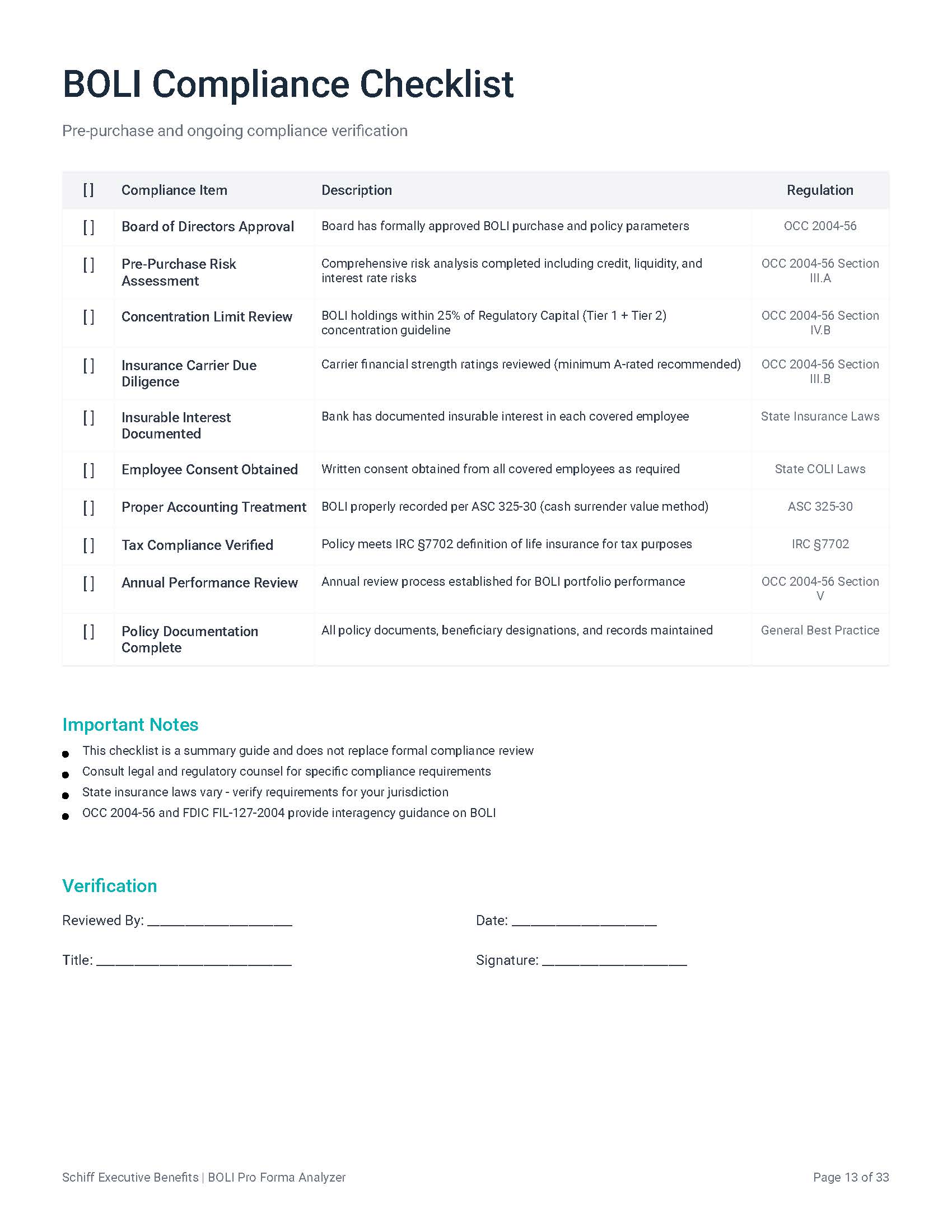

BOLI Compliance Checklist showing detailed regulatory requirements


3. Ignoring Credit Quality and Concentration Risk


We’ve all seen what happens when an organization puts too many eggs in one basket. In a BOLI environment, credit quality is paramount. Many providers pass along data from insurance carriers without truly validating it. Are you monitoring the financial health of the carrier? Are you diversified across multiple carriers to mitigate risk?


A healthy portfolio requires in-depth insurance carrier analysis. At Schiff Executive Benefits, we help you look beyond the marketing materials to the actual solvency and commitment of the carrier to the BOLI/COLI market.


Professional advisors analyzing carrier solvency and credit quality for a BOLI and COLI portfolio.
Suggested prompt: A professional, high-end close-up of a hand reviewing a financial spread sheet with a glass of water on a polished wooden desk, warm natural lighting.


4. Failing to Link the Portfolio to Executive Retention


Why do you have these policies in the first place? For many of our clients, the goal is "Full Cost Recovery" of executive benefit plans. However, if your executive retention strategies are disconnected from your portfolio performance, you aren’t maximizing your "Ownership Feel."


Are you using Split Dollar arrangements? Are you leveraging the portfolio to create a "Golden Handcuff" effect that makes it impossible for your competitors to poach your top talent? If your portfolio is just a line item on the balance sheet and not a tool for talent management, you’re missing half the value.


5. Underestimating the Power of ESOP Integration


For partnerships and private corporations, Employee Stock Ownership Plans (ESOPs) are a powerful way to align employee interests with company growth. However, ESOPs create unique liquidity needs, especially when it comes to repurchase obligations.


Mistake number five is failing to use COLI to "sprinkle in" liquidity for these obligations. By reverse-engineering your future cash flow needs, we can structure a COLI portfolio that grows tax-deferred, providing the cash exactly when the company needs to buy back shares from retiring employees.

A compilation of diverse company logos representing Schiff Executive Benefits clients


6. Overlooking Buy/Sell and Succession Funding


What keeps you up at night? For many business owners, it’s the question of what happens to the firm if a partner passes away or becomes disabled. Many Buy/Sell arrangements are funded with outdated policies that don't account for the current valuation of the business.


If your business has grown (and we hope it has!), your 10-year-old policy is likely insufficient. You are essentially leaving your legacy to chance. We use a technical lens to ensure your Buy/Sell funding matches your current "dream value," ensuring a smooth transition for the remaining partners and the family of the deceased.


7. Lacking a "Team of Advisors" Approach


The most dangerous phrase in business is "I’ve got it covered." Managing a COLI/BOLI portfolio requires a blend of legal, tax, accounting, and insurance expertise. If your insurance agent doesn't understand the nuances of FASB accounting or the specific regulatory hurdles faced by banks, they aren't helping you, they're creating risk.


At Schiff Executive Benefits, we don't work in a vacuum. We collaborate with your existing CPAs and legal counsel to ensure that your Perfect Plan® is airtight from every angle.
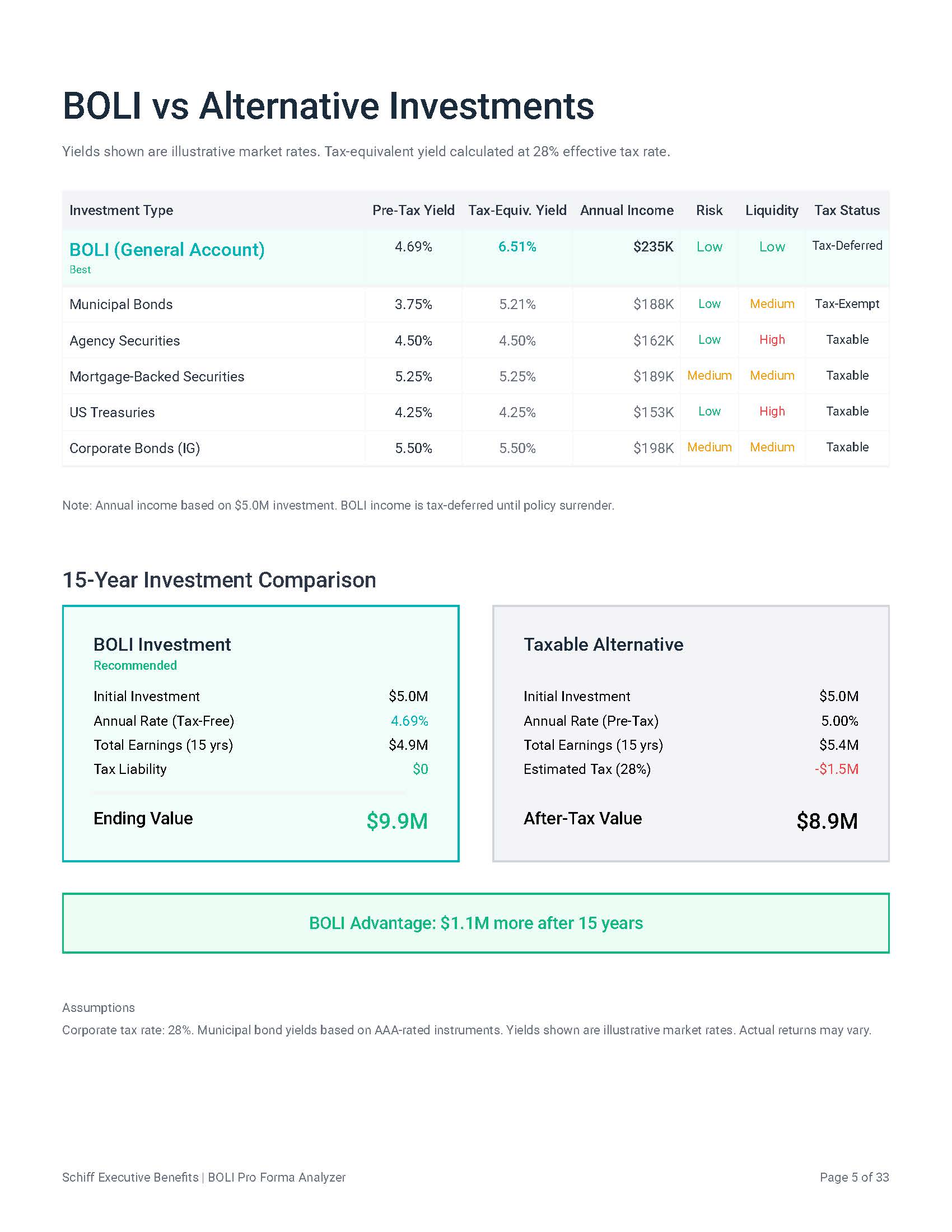

Comparison chart showing BOLI versus alternative fixed income investments


The Path Forward: Reverse Engineering Your Success


The national debt is rising, market volatility is the new constant, and the "war for talent" is only getting more intense. In this environment, you cannot afford a mediocre portfolio. You need a strategy that is as sophisticated as the organization you’ve built.


Are you realizing the maximum after-tax yield on your assets? Is your plan structured to recover every dollar of cost, including the opportunity cost of the money?


If these questions give you pause, it’s okay. Most of our clients felt the same way before we began the "reverse engineering" process with them. They were looking for security and a guarantee that their hard work would translate into a lasting legacy.


We invite you to stop guessing and start knowing. Your professional legacy is too important to leave to "standard" industry practices. You deserve a plan that is built your way, with your goals as the blueprint.


Sit back, grab your coffee, and let’s have a conversation. Whether you want to dive deep into the technicalities of a 409A plan or just want a second set of eyes on your BOLI holdings, we are here to guide you through the uncertainty.


Come join us at Schiff Executive Benefits. Let’s make sure your portfolio is doing exactly what it was meant to do: protect your business and reward your people.


To hear more about our philosophy and see these strategies in action, check out The Perfect Plan® Podcast where we break down complex financial structures into actionable executive advice.


Schiff Executive Benefits provides specialized consulting. For specific legal or tax advice, please consult with your professional advisors. You can find our full disclosure here.


Learn more: our complete guide to Bank Owned Life Insurance (BOLI) and Corporate Owned Life Insurance (COLI).






They say that a society grows great when old men plant trees in whose shade they shall never sit. In the world of business ownership, we call that a legacy.


If you’ve followed our series this week, you’ve seen the evolution. We’ve talked about the scrappy startup days, the high-octane growth phase, and the steady hand required during maturity. Now, we arrive at the summit: Scaling Your Legacy.


This is the stage where the conversation shifts from "How do I make this work?" to "How does this work without me?" It’s the moment you realize that your business is no longer just a job or an investment, it is a living, breathing entity with its own culture, its own impact, and its own future. But here’s the cold, hard truth: without a structured plan, that legacy is fragile.


At Schiff Executive Benefits, we specialize in Restoring Alignment and Retention during these critical transitions. When you scale a legacy, you aren't just looking at the balance sheet; you are looking at the next twenty years.


The Gravity of the "What Ifs"


Succession planning isn't just a legal checkbox. It’s an emotional and financial gauntlet. As you move into this final stage of ownership, two of our core "What If" questions become the primary drivers of your strategy:


  1. What if you end up in business with a widow? (Succession Alignment)

  2. What if a partner needs a buy-out? (Liquidity and Continuity)


Imagine the business you’ve spent thirty years building. Now imagine your partner’s spouse: who has never spent a day in the office: suddenly owning 50% of the voting stock because of an outdated or unfunded buy-sell agreement. It happens more often than you’d think. It’s messy, it’s stressful, and it’s entirely preventable.


Scaling a legacy requires ensuring that the transition of power is as seamless as the transition of capital. This is where specialized benefits move from "perks" to "structural necessities."


Business owner and advisor discussing succession planning and executive benefits for a seamless transition.


Buy-Sell Agreements: The Foundation of Continuity


Most business owners have a buy-sell agreement tucked away in a drawer from 1998. The problem? The business is worth ten times what it was then, and the funding mechanism (if there even is one) is woefully inadequate.


To scale your legacy, your buy-sell agreement must be a living document. We help owners utilize Corporate Owned Life Insurance (COLI) to fund these transitions. Why COLI? Because it provides the immediate liquidity needed to buy out a deceased or disabled partner’s interest without gutting the company’s operating capital.


It ensures that the remaining owners keep control and the departing family receives fair value. That is how you preserve a legacy. You can learn more about how we structure these arrangements on our Our Services page.


Protecting the "Secret Sauce": Executive Retention


As you step back to look at the "big picture," who is actually running the day-to-day? It’s your key leadership team. If they leave the moment you start talking about retirement, your legacy value plummets.


At this stage, we often implement The Perfect Plan®. This isn't just another benefit package; it’s a strategic alignment tool. By using Nonqualified Deferred Compensation (NQDC) or Executive Split Dollar arrangements, we create a "Golden Handshake" for your top tier.


  • Split Dollar Plans: These allow the corporation to help a key executive secure significant life insurance protection and retirement income while the company eventually recovers its costs. It’s a win-win that anchors your best people to the firm’s long-term success.

  • 409A Compliance: This is where the "IRS technical vibe" comes in. Any time you promise to pay an executive in the future, you are dancing with Internal Revenue Code Section 409A. The penalties for non-compliance are draconian: immediate taxation and a 20% penalty to the executive. Part of scaling your legacy is ensuring you aren't leaving a tax time bomb for your successors.


bank-boli-regulatory-guidelines.jpg


The Technical Guardrails: 101j and Beyond


Scaling a legacy means doing things the right way, especially when the IRS is watching. When we implement COLI to fund legacy benefits or succession plans, we have to be meticulous about Section 101j.


Before a policy is even issued, there are strict notice and consent requirements. If you miss a signature or fail to file the proper annual reporting forms, the death benefit: which is normally tax-free: could become fully taxable. When you are dealing with multi-million dollar legacy transitions, that's an unforced error you cannot afford.


We act as the "technical navigators" through these waters. Whether it’s ensuring your 409A plan documents are airtight or managing the ongoing compliance of your insurance portfolio, our goal is to provide the security that allows you to sleep at night.


boli-compliance-checklist-document.jpg


Alternative Exits: ESOPs and Wealth Transfer


For some owners, scaling a legacy means giving the business to the people who helped build it. An Employee Stock Ownership Plan (ESOP) can be a powerful tool for succession. It provides a ready market for your shares, offers significant tax advantages, and ensures the company culture remains intact.


However, ESOPs are complex. They require a team of advisors working in concert. We often work alongside valuation experts and ERISA attorneys to ensure that the executive benefits remain aligned with the new employee-owned structure.


Is your current retirement strategy sufficient to carry you through a 30-year "permanent vacation"? Or are you worried about running out of retirement money (What If #5)? Scaling your legacy isn't just about the business; it’s about ensuring your personal "Perfect Plan" is funded and protected.


The Cultural Intent: Why We Do This


The technicalities of COLI, 409A, and 101j are the "how," but the "why" is much simpler. You built something. It stands for something. You want it to continue.


When we sit down with a client at this stage, we often ask: If you weren't here tomorrow, what would happen to the thirty families that depend on this company for their mortgage payments?


That question usually clarifies things pretty quickly.


Scaling your legacy is an act of stewardship. It’s about moving from owner to founder, from manager to mentor. It requires a level of planning that looks past the next quarter and into the next generation.


Executive observing a productive team, symbolizing a thriving business legacy and strong company culture.


Your Next Steps in the Journey


You’ve spent a lifetime building your business. Don't leave the final chapter to chance. Whether you are looking to update a buy-sell agreement, secure your top talent for the next decade, or ensure your estate plan is as efficient as possible, we are here to help.


The transition from growth to legacy is the most significant move you will ever make as a business owner. It’s the "point of no return." But you don't have to navigate it alone. Our team at Schiff Executive Benefits has been guiding owners through these stages for decades.


Take a moment to look at our Frequently Asked Questions or reach out to us directly.


So, sit back, grab your coffee, and let’s talk about what you want your legacy to look like. You’ve done the hard work of building it; now let's make sure it lasts.


Restoring Alignment and Retention. It’s more than a tagline; it’s our mission for your business’s future.


Come join us and let’s start building your Perfect Plan®.


They say a rising tide lifts all boats, but in the world of executive benefits, the tide often hits a sea wall just as things are getting interesting.


If you’ve spent your career building a business, a partnership, or a bank, you know that your most valuable asset doesn’t show up on a balance sheet: it walks out the door every evening at 5:00 PM. Keeping that talent happy, motivated, and, most importantly, stationary is the secret sauce to long-term success. But as we head into 2026, many of your top performers are hitting a "contribution ceiling" that is quietly eroding their ability to retire on their own terms.


You see, the traditional 401(k) is a fantastic tool for the broad employee base. It’s the "Old Reliable" of the retirement world. But for your high-earners: the C-suite, the rainmakers, and the key partners: it’s often woefully inadequate.


Are you asking your top people to settle for a retirement plan that covers only a fraction of their income? Or are you looking for a way to let them save in a way that actually mirrors their value to the firm?


Let’s look at the fork in the road and decide which path is right for your team in 2026.


Executives discussing high-earner retirement strategies and 401k mirror plan options.


The Problem: The 401(k) Glass Ceiling


The universal truth of qualified plans is that they are built for the "average," not the "exceptional." As an executive or a high-compensated employee (HCE), the IRS places strict limits on how much you can squirrel away.


For 2026, the elective deferral limit is hovering around $24,500. While that sounds like a decent chunk of change, consider someone earning $400,000 or $500,000 a year. That $24,500 represents a tiny percentage of their total compensation. When they retire, they are going to face a massive "income gap" because they couldn't defer enough of their salary during their peak earning years to maintain their lifestyle later.


And then there is the "Top-Heavy" problem. If your lower-level employees don’t participate in the 401(k) at high enough rates, the IRS steps in and actually limits what the HCEs can contribute even further. It’s a frustrating reality: your best people are penalized because of the choices of the broader workforce.


Why 2026 Changes the Math


We are currently standing at a unique financial crossroads. The SECURE Act 2.0 has introduced several shifts that are coming to a head this year. Specifically, for those earning over approximately $145,000, any "catch-up" contributions must now be made on a Roth (after-tax) basis.


For the high-earner who was counting on that extra pre-tax deduction to lower their current tax bill, the IRS just moved the goalposts. This shift toward mandatory Roth treatment for HCE catch-ups is making the traditional 401(k) less attractive for immediate tax planning.


This is where the 401(k) Mirror Plan: formally known as a Nonqualified Deferred Compensation (NQDC) plan: starts to look like a much better vehicle.


Enter the Mirror Plan: Reflection Without the Restrictions


So, what exactly is a 401(k) Mirror Plan? Think of it as a "shadow" version of your existing 401(k), but without the IRS handcuffs.


A Mirror Plan is a type of nonqualified deferred compensation plan designed to allow executives to defer a much larger portion of their compensation: sometimes up to 100% of their base salary and bonus: on a pre-tax basis. It "mirrors" the 401(k) in user experience (you choose your investments, you see a balance, you have a login), but it operates under a completely different set of rules.


The Deferral Advantage


While the 401(k) caps you at $24,500 (plus catch-ups), an NQDC plan allows your top talent to bridge that income gap. If a partner wants to defer $100,000 of their bonus to avoid a massive tax hit this year and let that money grow tax-deferred for a decade, they can. That is simply impossible in a traditional qualified plan.


Financial blueprint analysis emphasizing plan design and compliance


Side-by-Side: The 2026 Comparison


When we sit down with clients to build out The Perfect Plan®, we look at the numbers. Here is how the two stack up for a high-earner in today’s environment:


  • Contribution Limits:

    • 401(k): Strictly capped by the IRS.

    • Mirror Plan: Virtually unlimited (determined by the company’s plan design).


  • Tax Treatment:

    • 401(k): Pre-tax deferrals, but 2026 catch-ups are now mandatory Roth for HCEs.

    • Mirror Plan: Remains 100% pre-tax on all deferrals, providing immediate tax relief.


  • Matching:

    • 401(k): Limited by Section 401(a)(17) (the "compensation cap").

    • Mirror Plan: The company can provide "make-whole" matches that exceed the IRS compensation cap.


  • Vesting & Retention:

    • 401(k): Standard vesting schedules.

    • Mirror Plan: Can include customized "Golden Handcuff" provisions to ensure your top people stay for the long haul.


The Elephant in the Room: Security


If Mirror Plans are so much better, why doesn't everyone use them for everything? It comes down to one word: Security.


A 401(k) is a "qualified" plan, meaning the money is held in a trust for the employee. Even if the company goes bankrupt, that money is safe. A Mirror Plan, or NQDC plan, is "unfunded" in the eyes of the IRS. It is essentially a promise by the company to pay the executive in the future. The assets technically remain on the company's balance sheet and are subject to the claims of the company’s general creditors.


This is the "what keeps you up at night" factor. Executives often ask, "Matt, what if the bank is sold? What if the company hits a rough patch in ten years?"


This is why we focus so heavily on the funding of these plans. Using tools like Corporate Owned Life Insurance (COLI) or Bank Owned Life Insurance (BOLI), a company can informally fund these obligations. COLI provides a way for the company to offset the cost of the plan while providing a layer of informal security that the funds will be there when the executive retires. You can learn more about how we structure these at our COLI information page.


Lists key features of BOLI/COLI including tax-deferred growth and yield guarantees


Why 2026 is the Year to Review Your Design


We are currently in a period of fiscal uncertainty. With the national debt at record highs and tax laws in a state of constant flux, the ability to control when and how you take your income is the ultimate luxury.


Waiting until 2027 to fix a top-heavy 401(k) issue is a reactive move. Being proactive in 2026 by implementing a Mirror Plan allows you to:


  1. Recruit Top Talent: When a candidate is choosing between two firms, the one offering a way to save $100k pre-tax usually wins.

  2. Reward Your "Engine": Show your HCEs that you recognize they are different and deserve a plan that reflects that.

  3. Hedge Against Tax Hikes: By deferring income now, executives can potentially take distributions in the future when they are in a lower tax bracket or when they have more control over their financial picture.


Executive leader reviewing financial growth and tax-deferred strategies for a Mirror Plan.


Building It Your Way


At Schiff Executive Benefits, we don’t believe in "off-the-shelf" solutions. Every corporation, partnership, and bank has a different culture and a different set of goals. Our mission is to guide you through the "unstable" air of modern finance to find a destination that works for everyone.


Whether you are looking at Buy/Sell arrangements, ESOPs, or complex Nonqualified Deferred Compensation plans, the goal is always the same: The Perfect Plan®.


So, which is better for your high-earners in 2026?


The answer is usually "both." A robust 401(k) for the foundation, and a carefully structured Mirror Plan for the penthouse. One provides the baseline; the other provides the incentive for your most valuable people to stay and build their legacy with you.


Let’s Start the Conversation


If you’re wondering how your current plan stacks up, or if you’re tired of your top people complaining about their 401(k) limits, let’s chat.


There is no pressure and no "hard sell." Just a consultative dialogue about your professional legacy and how to protect it. Grab a coffee, take a look at our team of advisors, and when you're ready, reach out. We’d love to help you realize your dream value.


Come join us. Let's build something that lasts.


Contact Matt Schiff and the team today to review your executive benefit strategy.


Learn more: how a 401(k) Mirror Plan works.


They say the only constant in life is change, but for a business owner, the only constant is the "What If."


In the early days, the "What If" is usually about survival: What if we don't get this client? What if the payroll check bounces? But as you move through the stages of the business lifecycle, those questions don't disappear: they just get more expensive. They shift from tactical anxieties to legacy-defining concerns.


At Schiff Executive Benefits, we spend a lot of time talking about "Restoring Alignment and Retention." But before we can align your benefits or retain your people, we have to look at the roadmap of your journey as an owner. Most advisors want to sell you a product to fix a specific symptom. We prefer to reverse-engineer your entire trajectory. We start at the finish line: where you want your family to be, how much income you want in retirement, and who should be running the shop — and then we build the bridge to get you there.


The Evolution of the "What If"


Every business follows a predictable path: Inception, Growth, Maturity, and eventually, Exit. The mistake most owners make is using a "Stage 1" plan to solve a "Stage 3" problem.


Think about your time allocation. When you started, you were probably 90% "doer" and 10% "leader." As you scale, that ratio has to flip. If it doesn't, you become the bottleneck. The same logic applies to your financial planning. A simple life insurance policy might have covered your debt in the startup phase, but does it solve the problem of a $20 million buy-sell triggered by an unexpected disability in the growth phase?


Probably not.


Stage 1: The Foundation and the First Big Question


In the beginning, it’s all about the "What if I die too soon?" stage. Your family is likely your primary concern. If you aren't there to drive the engine, the engine stops.


At this stage, we focus on 100% protection for the family. This isn't just about a death benefit; it's about liquidity. It's about ensuring that your spouse isn't forced to become an accidental business partner with your co-founder. We look at the first of our core five "What Ifs": What happens if your partner ends up in business with your widow?


Executive Retirement Planning Stages
(Technical visual: A flowchart mapping the flow of assets in a sudden succession event versus a structured buy-sell agreement, styled with clean, IRS-technical lines.)


Stage 2: The Scaling Phase and the Talent War


Once the business finds its footing and starts to scale, the "What Ifs" shift toward your people. You’ve hired "Rockstars." They are the reason you can finally take a vacation. But that creates a new anxiety: What if my top talent leaves?


This is where specialized executive benefits come into play. Standard 401(k) plans are great for the rank-and-file, but they are often "reverse-discriminatory" toward your highest earners due to IRS contribution limits. If your key execs can't save enough for their own retirement, they are going to look for a platform that allows them to do so.


We use strategies like Corporate Owned Life Insurance (COLI) to fund nonqualified deferred compensation plans. This allows you to offer "Golden Handcuffs": incentives that make it mathematically painful for a competitor to poach your best people. By using COLI, the business can recover the cost of these benefits, essentially creating a self-funding retention machine.


Executive Retirement Planning Stages


Reverse-Engineering Your "Perfect Plan"


Most financial planning is reactive. You have a windfall, so you look for a tax shelter. You have a heart scare, so you look for insurance. We believe in a proactive, goal-oriented approach we call The Perfect Plan®.


The philosophy of The Perfect Plan® is simple: Start with the end in mind.


When we sit down with a business owner, we ask: "In your ideal world, what does 100% income in retirement look like?" Most owners are surprised to find that their current trajectory only covers 40% or 50% of their current lifestyle once they exit. We identify that gap and then reverse-engineer a solution to fill it using the most tax-efficient vehicles allowed by the IRS.


Addressing the 5 Core "What Ifs"


To build a truly resilient business, you have to have a documented answer for these five questions:


  1. Business with a Widow: If you passed away tomorrow, would your spouse have the liquid cash to live, or would they have a pile of illiquid stock in a company they can't run?

  2. Business Buy-Out: Is your buy-sell agreement funded? A legal document without a funding mechanism (like COLI or disability buy-out insurance) is just a piece of paper that guarantees a lawsuit.

  3. Top Talent Leaving: If your #2 person left for your biggest competitor on Monday, what would it cost you in lost revenue and replacement time?

  4. Senior Exec Retirement: Are you prepared for the cost of replacing your aging leadership team? How do you transition them out with dignity while keeping the business's balance sheet healthy?

  5. Running Out of Money: This is the ultimate fear. After 30 years of building a legacy, will you have to downgrade your lifestyle because of taxes, inflation, or poor planning?


Executive Retirement Planning Stages
(Technical visual: A bar chart comparing "Traditional Retirement Savings" vs. "The Perfect Plan® Approach," showing 100% income replacement levels and the impact of tax-deferred growth.)


The Technical Edge: Why COLI Matters


For corporations and partnerships, Corporate Owned Life Insurance (COLI) is often the "Swiss Army Knife" of the balance sheet. It isn't just about a death benefit; it's an institutional asset.


COLI allows a company to:


  • Offset the liabilities of executive retirement plans.

  • Accumulate cash value on a tax-deferred basis.

  • Receive tax-free death benefits to help transition the business or buy out a partner's interest.


When you look at the technical pro-formas of these plans, the math becomes undeniable. It’s about moving money from a taxable "bucket" on your balance sheet to a tax-advantaged "bucket" that performs a specific job: protecting the business while growing an asset that can eventually fund your own exit.


Executive Retirement Planning Stages


Transitioning to the Exit


The final stage of the journey is the exit. Whether you are passing the business to your children, selling to an ESOP, or looking for a third-party buyer, your "What Ifs" are now about the "Point of No Return."


Have you maximized the value of the business? Is the culture stable enough to survive your departure? (Hint: The "Top Talent" retention strategies we mentioned in Stage 2 are what make your business attractive to a buyer in Stage 3).


We help owners realize their "dream value" by ensuring the business isn't just a job they created for themselves, but a self-sustaining entity. By addressing the "What Ifs" early, you aren't just buying insurance; you are building a fortified legacy.


You’ve Built the Business. Now, Secure the Life.


You’ve spent years, maybe decades, navigating the unstable waters of entrepreneurship. You’ve survived the market crashes, the hiring headaches, and the late-night "What Ifs." You deserve a plan that is as robust as the company you built.


Our job at Schiff Executive Benefits is to be your guide through these technical and often overwhelming financial environments. We don’t just want to talk about products; we want to talk about your mission. We want to help you realize that 100% protection for your family and 100% income in retirement isn't a pipe dream: it’s a matter of engineering.


If you’re wondering where your business stands in this lifecycle, or if one of those five "What Ifs" is currently keeping you up at 2:00 AM, let’s talk.


Sit back, grab your coffee, and let’s look at the roadmap together. Come join us at Schiff Executive Benefits to see how we can start reverse-engineering your version of The Perfect Plan®.


You can learn more about our process on The Perfect Plan® Podcast or reach out to us directly through our contact page.


Let’s turn those "What Ifs" into "I’m Covered."


They say that the only constant in life is change, and in the world of business ownership, that isn’t just an aphorism, it’s a daily reality. You start with a vision, a laptop, and maybe a few key people who believe in the dream as much as you do. But as the years tick by, the "dream" gets a lot more complicated. The problems you faced on day one, like making rent or finding your first client, evolve into much heavier questions.


What if your top talent leaves for a competitor? What if you suddenly weren't there to run the shop? What if you want to retire, but all your wealth is tied up in the company?


At Schiff Executive Benefits, we’ve seen this movie before. We know that a business is a living, breathing entity. The benefits you offered when you were a three-person startup won't cut it when you’re a fifty-person powerhouse. Managing this evolution is about more than just "insurance" or "tax breaks", it's about Restoring Alignment and Retention.


The Early Growth Stage: Building the "Ownership Feel"


In the beginning, cash is king, and you probably don't have enough of it to pay Silicon Valley salaries. You’re looking for "believers", people who will work the long hours because they feel like they own a piece of the pie. But actually handing over equity? That’s a messy, expensive road that can lead to a crowded cap table and loss of control.


This is where the concept of the "ownership feel" without actual ownership comes into play. You want your key people to think like owners, act like owners, and stay like owners.


Phantom Stock: The Ultimate Alignment Tool


Phantom Stock is one of the most elegant solutions for the early growth phase. It’s exactly what it sounds like: a contractual agreement that gives an employee the right to receive a payment tied to the value of the company’s shares, without actually giving them a single share of voting stock.


When the company grows, their "phantom" value grows. It aligns their success directly with yours. It answers that nagging "What If": What if my top talent leaves? With a properly structured Phantom Stock plan, leaving means walking away from a significant future payout. It creates the "golden handcuffs" that keep your A-players focused on long-term growth.


Restricted Executive Bonus (Section 162)


Another heavy hitter for the early stages is the Restricted Executive Bonus. You want to reward a key executive, but you want to make sure they stick around to earn it. By using a life insurance policy (COLI) as the vehicle, the company pays the premium as a bonus to the executive.


However, you add a "restrictive covenant." If they leave before a certain date, they don't get full access to the policy’s cash value. It’s professional, it’s tax-efficient for the business, and it provides a real, tangible asset for the employee.


Professional team of executives collaborating on business growth strategies in a modern office.
Caption: A professional workspace featuring detailed compliance documents and structured financial planning tools, reflecting the technical precision required for executive benefit design.


The Scaling Phase: From Growth to Maturity


Once you’ve hit your stride, the risks change. Your business has a real valuation now. Your "What Ifs" become more about sustainability and replacement costs.


What if a senior executive retires? What will it cost to replace their institutional knowledge?


At this stage, you’re likely looking at more sophisticated structures like Nonqualified Deferred Compensation (NQDC) and the strategic use of Corporate Owned Life Insurance (COLI).


Shifting the Tax Burden


As a high-earning business owner or executive, you’re probably hitting the ceiling on what you can put into a 401(k). You’re paying the highest marginal tax rates, and you’re looking for a way to defer that income until retirement when you might be in a lower bracket.


NQDC plans allow your top people to defer a portion of their compensation, often without the low limits of a traditional 401(k). For the business, this is a powerful retention tool. For the executive, it’s a way to avoid running out of retirement money.


We often talk about The Perfect Plan®. It’s not a one-size-fits-all product; it’s a philosophy of reverse-engineering your goals. We look at the liabilities on your balance sheet, like the promise to pay out these deferred bits of compensation, and we find the most efficient way to fund them. Often, that involves COLI, which provides tax-deferred growth and a death benefit that can help the company recover the cost of the plan.


The Mature Stage: Succession and the "Point of No Return"


Eventually, every owner reaches the stage where they start looking at the exit. This is the most critical transition in the Business Owner Lifecycle. It’s where the "What Ifs" get very real, very fast.


  1. Business with a widow: What happens if your partner passes away? Are you suddenly in business with their spouse who knows nothing about the industry?

  2. Business buy-out: Do you have a funded Buy/Sell agreement? Or is your succession plan just a handshake and a prayer?


Buy/Sell Arrangements and 409A Compliance


In the mature stage, your executive benefits and your succession planning must be perfectly synchronized. If you have a Buy/Sell agreement, it needs to be funded. You don’t want the company’s cash flow crippled because you had to buy out a departing partner’s shares on short notice.


Furthermore, as your company grows, you fall under the watchful eye of the IRS and Section 409A. This is where the "IRS technical vibe" becomes a reality. 409A regulates how and when deferred compensation can be paid. Get it wrong, and your executives face immediate taxation and a 20% penalty. This is why you need a team of advisors who live and breathe compliance.


Financial compliance documents and reading glasses on a mahogany desk for executive succession planning.
Caption: A deep-dive look at financial spreadsheets and regulatory checklists, emphasizing the importance of compliance and precise data in succession planning.


Realizing Your Dream Value


I remember a client, let’s call him John. John had built a fantastic manufacturing business over thirty years. He had three key VPs who were essentially running the day-to-day. John wanted to retire, but he was terrified that the moment he announced his exit, those three VPs would look for more "stable" jobs elsewhere.


By implementing a tailored executive benefit strategy, incorporating a mix of NQDC and a transition-based bonus plan, we were able to show those VPs that their financial future was more secure if they stayed and helped transition the company to the new ownership. We turned a potential "talent drain" into a "stability anchor." John was able to sell the business for his dream value because he could prove the leadership team wasn't going anywhere.


That is what we mean by Restoring Alignment and Retention.


Why Expertise Matters


You wouldn't ask a general practitioner to perform heart surgery. So why would you ask a generalist insurance agent to design a 409A-compliant executive benefit plan? The stakes are too high.


Whether you are in the early stages of growth or you’re staring down the barrel of retirement, your needs are evolving. The plans we build at Schiff Executive Benefits are designed to grow with you. We help you navigate the complexity of:


  • Our Services

  • COLI (Corporate Owned Life Insurance) for cost recovery.

  • Split Dollar arrangements for tax-efficient death benefits.

  • Comprehensive Buy/Sell funding.


Success is a journey, not a destination. But if you don't have the right roadmap, you might find yourself at the "point of no return" without the resources you need to cross the finish line.


So, take a moment. Sit back, grab your coffee, and think about your own "What Ifs." Are you prepared for a business buy-out? Is your top talent truly locked in, or are they just passing through?


If you aren't sure, let’s have a conversation. We’re here to help you build it your way and protect your legacy every step of the way.


Feel free to check out our team or reach out to us directly. Your future self will thank you for the planning you do today.


Disclosure: For more information on our processes and compliance, please visit our disclosure page.


"Begin with the end in mind."


Stephen Covey made that phrase famous, but in the world of executive benefits, it’s more than a habit: it’s a necessity. Too often, I see business owners and HR directors approach an NQDC plan (nonqualified deferred compensation plan) by looking at what they think they can afford today, rather than what their key people actually need tomorrow.


They start with the "how" before they’ve even defined the "why."


At Schiff Executive Benefits, we flip the script. We use a methodology I call Goal-Oriented Reverse Engineering. It sounds technical, but it’s actually the most human way to design a plan. Instead of starting with contribution limits or vesting schedules, we start with the finish line: the lifestyle, the legacy, and the specific cash flow an executive needs to feel secure.


If you aren't designing your executive retention strategies this way, you’re likely leaving money on the table: for both the company and the individual.


The Problem with "Standard" Plan Design


Most nonqualified deferred compensation plans are built using a "box-ticking" approach. A consultant walks in, hands you a menu of options, and asks you to pick a vesting schedule and an investment lineup. It’s transactional. It’s cold. And frankly, it’s risky.


When you design a plan without reverse engineering the goal, you end up with "accidental" outcomes. You might find that after ten years of contributions, the executive’s account balance doesn’t actually move the needle for their retirement. Or worse, the tax impact of the payout creates a net result that feels more like a burden than a benefit.


Are you building a plan to simply "have one," or are you building it to solve a specific problem?


For most corporations and partnerships, the problem is simple but profound: How do we keep the people who make this company run? How do we ensure that our top talent doesn't look across the street to a competitor because they feel their long-term security isn't being addressed?


Financial blueprint analysis emphasizing plan design and data visuals


What is Goal-Oriented Reverse Engineering?


Reverse engineering starts with a conversation about the "What Ifs."


  • What if you wanted to retire at 60 with $250,000 in annual inflation-adjusted income?

  • What if the company grows by 15%: how does that change the executive’s "win"?

  • What if tax rates at the federal level spike in the next decade?


We work backward from the desired cash flow. If an executive knows they need $X per year to maintain their lifestyle, we calculate exactly what needs to happen today to make that a reality. We don't just guess at contribution levels; we math it out.


This approach changes the psychology of the plan. It moves the NQDC plan from being a "nice-to-have" perk to being a critical component of the executive’s personal financial success. When an executive sees a direct line between their performance today and their specific lifestyle goals tomorrow, your executive retention strategies become bulletproof.


A diverse team of executives collaborating on goal-oriented NQDC plan design and retention strategies.


The Perfect Plan® Framework


When we reverse engineer these outcomes, we always aim for what I call The Perfect Plan®. Whether we are working with a bank, a law firm partnership, or a manufacturing corporation, the framework remains the same.


The Perfect Plan® is built on three pillars:


  1. Pre-tax contributions: Every dollar goes to work before the IRS takes a bite.

  2. Tax-deferred growth: Let the power of compounding work without the annual drag of taxes.

  3. Tax-free benefits: Using the right funding vehicles: like Corporate Owned Life Insurance (COLI): to ensure that when the money comes out, it’s as efficient as possible.


This isn't just about 409A plans and compliance (though that’s the foundation). It’s about creating a mathematical advantage. By using this framework, we can often show an employer how they can provide a more robust benefit than a traditional 401(k) mirror plan, often with a neutral or even positive impact on the company’s balance sheet.


Retirement Made Simple: The Four Fixed Pillars


One of the biggest anxieties executives face is the "moving target" of retirement. Will the market stay up? Will the company’s stock fluctuate? To combat this, our reverse engineering focuses on four simple factors:


  • Fixed Dollar: Knowing exactly what the payout will be.

  • Fixed Period: Knowing exactly when and for how long the income lasts.

  • Fixed Rate: Removing the volatility of the market where appropriate.

  • Fixed Cash Flow: Designing the plan so it acts as a reliable "pension-style" stream of income.


When you simplify the outcome, you increase the perceived value of the benefit. Executives don't want to spend their weekends worrying about their deferred compensation volatility. They want to know that their work is building a stable future.


The Perfect Plan® Podcast banner featuring Matthew E. Schiff


Addressing the "What Ifs" for Business Owners


It’s not just about the executive; it’s about the entity. Whether you’re a partnership or a corporation, you have your own "What Ifs."


  • What if the executive leaves early? We design vesting schedules and "Golden Handcuffs" that protect the company’s investment.

  • What if we want to recover the cost of the plan? This is where COLI and other funding strategies come into play.


Through Employer Cost Recovery, we can structure plans where the company eventually gets back every dollar it paid out in benefits, plus the cost of money. It sounds too good to be true, but it’s simply the result of smart math and the right insurance-based funding vehicles. By using the tax advantages of life insurance within the corporate structure, we can offset the liabilities of the NQDC plan.


Culture, Intent, and the Human Element


Technical expertise is table stakes. You can find a dozen firms that understand the nuances of 409A plans. What’s harder to find is a partner who understands your company’s culture and intent.


Are you trying to reward a "lifer" who has been with you since the garage days? Are you trying to lure a high-level CEO away from a Fortune 500 company? Or are you looking to create a succession bridge via an ESOP or a Buy/Sell arrangement?


The intent drives the design.


In partnerships, for example, the goal is often about equalizing the "buy-in" and "buy-out" for senior partners. Reverse engineering allows us to see how an NQDC plan can act as a bridge, providing the departing partner with the income they need without crippling the cash flow of the junior partners taking over.


Economic advantages of BOLI and COLI for cost recovery


The Point of No Return


We are living in an era of massive economic shifts. Tax rates are at historical lows, but the national debt suggests that won't last forever. Inflation is a constant shadow. If you are waiting until "next year" to look at your executive benefit structure, you are missing the window to lock in current advantages.


Designing an NQDC plan isn't a "set it and forget it" task. It’s a dynamic process that requires a team of advisors who are looking at the horizon, not just the feet.


At Schiff Executive Benefits, we don't just sell plans; we build security. We act as your guide through the unstable landscape of modern finance, ensuring that your professional legacy and your personal lifestyle goals are perfectly aligned.


Let’s Sit Down and Do the Math


If your current plan feels like a generic template, or if you’ve never actually run the numbers to see if it will meet your executives' end goals, it’s time for a change.


Let's grab a coffee: virtually or in person — and talk about your "What Ifs." We’ll start with the end goal and work our way back. You might be surprised at how much more powerful your benefits can be when they are engineered with a purpose.


Come join us at Schiff Executive Benefits. Let’s build something your way.


Learn more: our complete guide to NQDC plans.


Category: Deferred Compensation

In the world of business, what you don’t know can’t just hurt you: it can cost you a fortune. There is an old military adage that "amateurs study tactics, while professionals study logistics." When it comes to executive benefits, the "logistics" are the compliance filings that keep your plan from turning into a liability.

We often talk to business owners who have spent months designing the perfect NQDC plan (Non-Qualified Deferred Compensation) to keep their top talent from jumping ship. They’ve crunched the numbers, selected the right COLI (Corporate Owned Life Insurance) funding vehicles, and signed the documents. But then, a silent clock starts ticking. If you miss a simple administrative step within the first 120 days, the DOL could suddenly treat that specialized plan you built for your "Top Hat" group like a standard 401(k), bringing with it a mountain of paperwork and potentially devastating daily fines.

At Schiff Executive Benefits, we believe in Restoring Alignment and Retention. That begins with making sure your plan is legally "invisible" to the more cumbersome parts of ERISA.

What Exactly is a "Top Hat" Plan?


Before we dive into the deadlines, let’s clarify what we’re talking about. In the industry, we use the term "Top Hat plan" to describe a non-qualified deferred compensation plan that is unfunded and maintained by an employer primarily for the purpose of providing deferred compensation for a "select group of management or highly compensated employees."

These are the core of most executive retention strategies. Why? Because they allow your key players to defer income far beyond the limits of a traditional 401(k). However, because these plans are technically "pension plans" under ERISA, they are subject to strict reporting and disclosure requirements unless they meet a specific exemption.

To get that exemption, you have to tell the Department of Labor (DOL) that the plan exists. This is not a complex filing, but it is a mandatory one.

Executive Confidence

The 120-Day Rule: Your Line in the Sand


The Department of Labor is very clear on the timing. You must file a Top Hat plan statement within 120 days of the plan's effective date.

Think of this as the "honeymoon phase" of your new executive benefit. You’re excited about the new structure, your executives are feeling valued, and the 409A plans are set up. But if that 120th day passes and you haven't filed, the DOL no longer views your plan as an exempt executive benefit. Instead, they view it as a non-compliant pension plan.

You complete the filing itself electronically. You can access the portal here: https://www.askebsa.dol.gov/efile/Home/tophat.

It requires basic information: the name and address of the employer, the employer identification number (EIN), a declaration that the employer maintains the plan primarily for a select group of management or highly compensated employees, and the number of plans and employees covered.

When Does the Clock Actually Start?


In practice, this is where many businesses trip up. Does the clock start when you sign the document? When do you make the first contribution? Generally, the clock starts on the effective date of the plan. If you backdate a plan's effective date for accounting reasons, you might accidentally shorten your filing window without realizing it. We always recommend filing as soon as the plan is implemented to avoid any "calendar math" errors.

Business executive tracking the 120-day deadline for Top Hat Plan compliance in a professional office setting.

The "What If" Scenario: The Cost of Missing the Window


We often ask our clients five core "What If" questions to help frame their risk. One of the most overlooked is: What if your senior executive retirement plan suddenly becomes a massive tax and regulatory burden?

If you miss that 120-day window, your Top Hat plan becomes subject to the full reporting and disclosure requirements of ERISA Part 1. This means you are now required to file an annual Form 5500 for the plan.

Most employers intentionally set up NQDC plans to avoid the 5500 filing process because it’s a public disclosure and an administrative headache. But the real sting comes from the penalties. If the DOL initiates an enforcement action because you failed to file, the penalties can be astronomical:

  • Daily Fines: The DOL can assess penalties of up to $2,739 per day for failure to file a Form 5500.

  • No "Statute of Limitations": If you’ve had a plan for ten years and never filed the Top Hat letter or a 5500, those daily fines can technically be backdated.


How would that impact your business buy-out or your succession planning? Imagine trying to sell your company, only for the buyer’s due diligence team to discover a decade of unfiled ERISA reports and millions in potential contingent liabilities. It’s a deal-killer.

How to Fix a Mistake: The DFVC Program


If you are reading this and realizing your 120-day window closed months (or years) ago, don’t panic — but do act.

The DOL offers a "get out of jail" card called the Delinquent Filer Voluntary Compliance (DFVC) program. This is designed for plan sponsors who realize they’ve missed a filing and want to come clean before the DOL finds them first.

Here is the silver lining: For Top Hat plans, the DFVC program is incredibly reasonable if you use it proactively.

  1. The Flat Fee: Instead of thousands of dollars in daily fines, the penalty for a Top Hat plan is a flat $750 fee, regardless of how many years the filing is late or how many participants are in the plan.

  2. The New Payment Method: As of late 2025, the DOL has streamlined the process. The DOL has shifted away from older check-based systems to direct gov.pay payments. This makes the correction process faster and provides an immediate digital paper trail of your compliance.


Therefore, by paying the $750 and filing the statement through the DFVC portal, you essentially "reset" your compliance status and gain the same exemptions you would have had if you filed on day one.

Business partners discussing the DFVC program to correct delinquent Top Hat Plan filings and restore compliance.

Why Compliance is Part of the "Perfect Plan®"


You didn’t build your business to become an expert in ERISA filing software. You built it to create value, provide for your family, and leave a legacy. At Schiff Executive Benefits, we specialize in what we call "Reverse Engineering."

When we look at executive retention strategies, we don't just look at the investment side. We look at the finish line first. We ask: What is the ultimate goal for this executive, and what are the regulatory hurdles between here and there?

Whether you are implementing 409A plans, exploring Split Dollar arrangements, or managing a complex COLI portfolio, compliance must be baked into the design. We help ensure that your plan meets the rigorous standards of Internal Revenue Code Section 409A (to avoid 20% excise taxes for your executives) and Section 101(j) (to ensure the death benefits of your COLI policies remain tax-free).

Managing "Double Duty Dollars": where your corporate cash works twice as hard by funding a benefit while remaining an asset on the balance sheet: is only effective if the legal structure is sound.

Taking the Next Step


Is your current Top Hat plan statement filed? Are you sure?

If you aren't 100% certain, or if you are in the process of designing a new executive benefit package, let’s make sure your "logistics" are as strong as your "tactics." Missing a deadline shouldn't be the reason you lose your alignment with your top talent.

The team at Schiff Executive Benefits is here to act as your guide through these unstable regulatory environments. We work alongside your existing team of advisors to ensure that your executive benefits are a source of security, not a source of stress.

Contact Schiff Executive Benefits

Sit back, grab your coffee, and let’s take a look at your current structure. Whether it’s succession planning, business buy-outs, or simply making sure your 409A plans are bulletproof, we’re here to help you build it your way.

Come join us. Let’s make sure your "What If" questions are answered before they become "What Now" problems.

Learn more about our Executive Benefit Consulting or explore our Deferred Compensation expertise.

If you are a business owner or decision making executive, how would you want to design The Perfect Plan™ to retain and reward your employees? A 401K is terrific for basic retirement savings, but there are limitations to how much you can put in, and it must be given to everyone on a proportional basis.

In this episode, we discuss the decision making process, how you can get the perfect timing of your deductions, and include the people and benefits that are needed most, in the most tax efficient manner.  No two companies are alike, and neither should your plans be.

Come and listen to this podcast as we lay it out for you.


In a PERFECT world, how would you design a "benefit" plan for you (the Business Owner), your key executives, and your family? Well, in this Episode, Matt goes through some design options available when starting a brand new plan.  In essence, you have a blank piece of paper that allows you to build it YOUR way.

Sit back grab your coffee, and listen to some options available to you depending on your role.