
Hi, How Can We Help You?
  • Planning for all of life's "What Ifs".

Category Archives: Life Insurance


It has often been said that a man who has his health has a thousand dreams, but a man who does not has only one. For the high-achieving executive, the transition from a storied career into a hard-earned retirement is the ultimate "dream value." You have spent decades navigating market volatility, managing complex teams, and securing the future of your organization. But there is one variable that remains stubbornly outside of any spreadsheet: the unpredictable nature of long-term health.


The reality is that traditional retirement strategies often overlook the "What If" that keeps many leaders up at night: What if I run out of retirement money because of a long-term care event?


At Schiff Executive Benefits, we believe in Restoring Alignment and Retention. When it comes to protecting your most valuable human capital: and your own personal legacy: the choice between Long-Term Care (LTC) riders and standalone coverage isn't just a technical insurance decision. It is a strategic move to safeguard a lifetime of work.


The "What If" Problem: Why Long-Term Care is the Missing Piece


Most executive benefit packages are robust when it comes to life insurance, disability, and deferred compensation. However, the gap between "wealthy" and "secure" is often defined by long-term care coverage. A private room in an assisted living facility or 24-hour home care can easily exceed $150,000 a year in today's market: and those costs are only rising.


For the corporation, the question is equally pressing: How do you attract and retain senior talent when the competition is offering "The Perfect Plan®"? If your senior executives are worried about their personal solvency in the face of a health crisis, they aren't focused on the long-term vision of your company.


Secure executive at home reflecting on a legacy protected by a comprehensive executive LTC strategy.


Standalone LTC Policies: The Traditional Specialist


Standalone long-term care insurance was once the gold standard. These policies are dedicated instruments designed for one thing: paying for care.


The Pros:


  • Customization: You can often dial in specific elimination periods, inflation protection percentages, and benefit durations.

  • Pure Focus: Every dollar of premium is directed toward the LTC benefit.


The Cons:


  • The "Use It or Lose It" Trap: This is the primary anxiety for many executives. If you pay premiums for twenty years and then pass away peacefully in your sleep without ever needing care, the insurance company keeps the premiums. For a high-net-worth individual, this feels like an inefficient use of capital.

  • Volatile Premiums: Many older standalone policies saw significant rate increases over the years, creating uncertainty in retirement budgeting.

  • Stringent Underwriting: Getting approved for a standalone policy can be a gauntlet of medical exams and history checks.


LTC Riders on Life Insurance: The Integrated Alternative


In recent years, we have seen a massive shift toward "linked-benefit" or "hybrid" strategies. This usually involves adding an LTC rider to a permanent life insurance policy, often structured as Corporate Owned Life Insurance (COLI).


How It Works


Instead of a separate policy, the LTC benefit is "accelerated" from the death benefit. If you need care, you tap into the life insurance policy's face value. If you don't need care, your beneficiaries receive the full death benefit.


The Benefits of the Rider Approach:


  • Efficiency: Your premium is never "wasted." It either pays for care or it pays a death benefit.

  • Simplified Underwriting: When these plans are implemented as part of a deferred compensation or executive benefit program, we can often negotiate simplified or "guaranteed issue" underwriting for a group of executives. This is a massive win for senior leaders who might have minor health hiccups that would disqualify them from standalone coverage.

  • Cost Recovery: This is where the strategy becomes a powerful executive retention strategy.


Visual display of leading insurance and financial carriers Schiff Executive Benefits works with


Why Riders Are More Cost-Effective for Employers


When we sit down with a board of directors or a business owner, the conversation usually turns to the bottom line. How can the company afford to provide such a high-tier benefit?


The answer lies in the structure of the COLI. If structured correctly, the employer can achieve full cost recovery. The company pays the premiums and remains the beneficiary of the policy. The executive receives the long-term care protection as a benefit of their employment. When the executive eventually passes away (long after they have retired), the company receives the death benefit tax-free, which can reimburse the company for every dollar of premium paid, plus a rate of return.


This transforms an "expense" into an "informal funding vehicle." It allows the company to offer a world-class benefit that helps attract and retain top talent without permanently depleting the balance sheet.


Senior executive and partner collaborating on executive benefit plans to improve retention and alignment.


Comparing the Strategies: At a Glance


Feature Standalone LTC LTC Rider (Hybrid/COLI)
Primary Purpose Long-term care only Death benefit + Long-term care
Premium ROI None if care is never needed Guaranteed (either care or death benefit)
Underwriting Strict/Medical Often Simplified for Executive Groups
Cost Recovery None for employer Possible full recovery for employer
Flexibility High customization of care Integrated into broader financial plan

Compliance and Company Culture


Choosing the right strategy isn't just about the math; it’s about alignment. Does the plan reflect your company culture? If you pride yourself on being a "family-first" or "legacy-focused" organization, providing a benefit that ensures an executive won't be a burden to their family is a powerful message.


However, you must ensure compliance. Whether you are dealing with 409A plans or complex buy/sell arrangements, the integration of LTC coverage must be handled by experts.


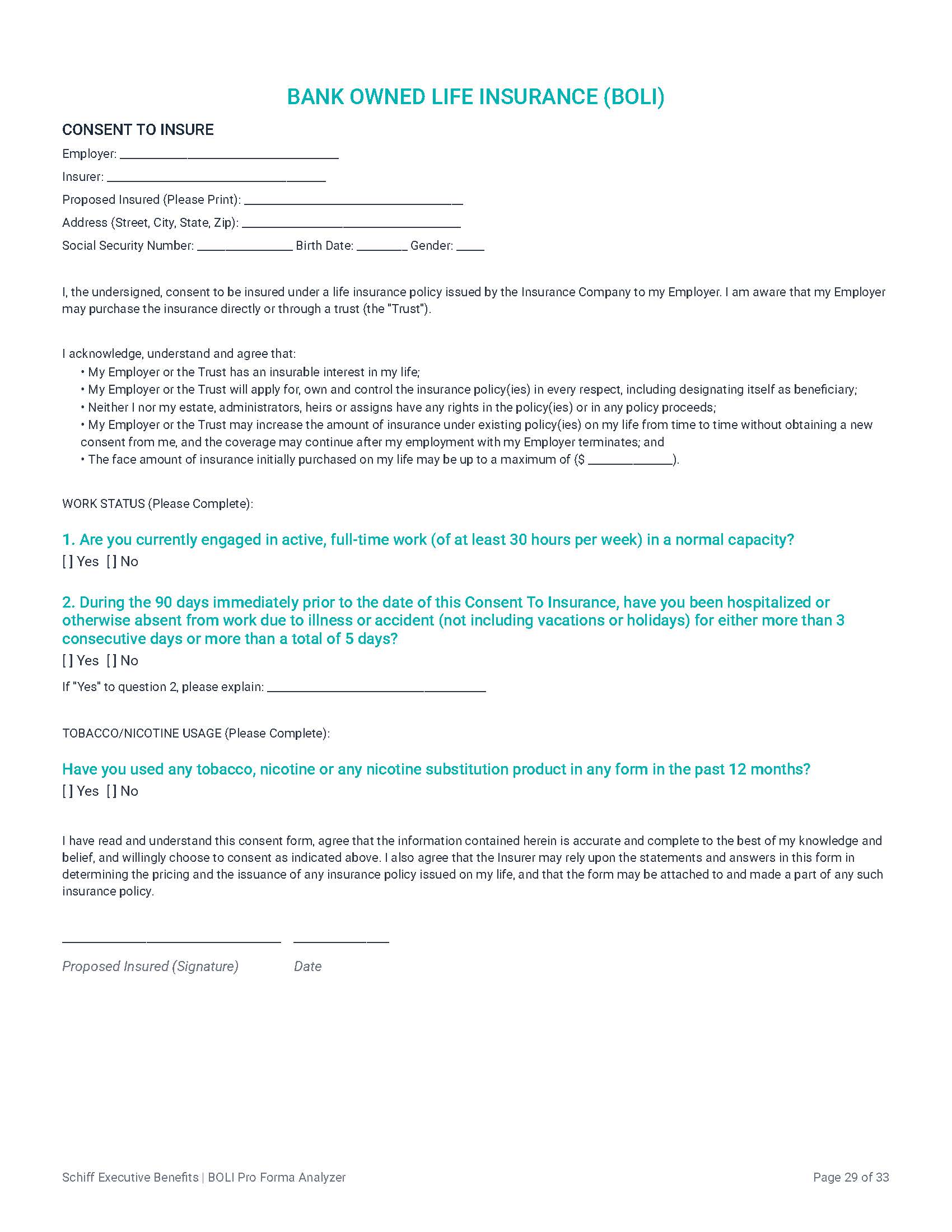
At Schiff Executive Benefits, we guide you through the regulatory environment, ensuring that the consent forms are in order and that the plan is communicated clearly to the participants.


Sample Bank Owned Life Insurance (BOLI) consent form, used to ensure compliance in executive benefit structures


The Path Forward: Which is Best for You?


So, how do you choose?


If you are a solo practitioner or a small business owner with no interest in permanent life insurance, a standalone policy might still hold some appeal for its pure-play simplicity.


However, for the majority of corporations and partnerships looking to solve for the "5 What Ifs," the LTC Rider/Hybrid approach is usually the superior choice. It addresses the senior executive retirement/replacement cost efficiency, provides a guaranteed return on premium, and serves as a formidable tool for retention.


Are you worried that your current retirement strategy is one health crisis away from collapse? Are you concerned that your top talent might be lured away by a competitor offering more security?


These are the questions that define your professional legacy. You don't have to navigate these "unstable" financial environments alone. Building it your way means having a team of advisors who understand that your business and your personal life are inextricably linked.


We invite you to take a breath, sit back, grab your coffee, and let’s look at your current plan. Is it truly The Perfect Plan®? If not, we are here to help you find the alignment you deserve.


Come join us at Schiff Executive Benefits. Let’s make sure your "thousand dreams" remain intact, no matter what the future holds.


Contact us today to explore executive LTC strategies tailored to your firm.


A bank is only as strong as its community, and its community is only as strong as the leaders who serve it. In the financial world, stability is the cornerstone of trust. Yet, many bank executives find themselves facing an unstable paradox: how do you maintain a competitive edge and protect your balance sheet while simultaneously funding the escalating costs of employee benefits?


If you are leading a financial institution today, you are likely wrestling with the "What Ifs" that keep even the most seasoned presidents awake at night. What if your top talent is lured away by a larger competitor? What if the cost of your pension and health plans continues to outpace your portfolio’s yield? What if your senior executive retirement costs become a drag on your regulatory capital?


To find the answer, we look toward a strategy utilized by over 65% of banks in the United States. It is a tool designed for Restoring Alignment and Retention: Bank-Owned Life Insurance (BOLI).


What is BOLI, and Why Does It Matter?


At its most fundamental level, Bank-Owned Life Insurance is a life insurance policy purchased by a bank on the lives of its key employees: usually officers and directors. The bank is the owner and the beneficiary of the policy.


While the term "insurance" is in the name, for a financial institution, BOLI is primarily a sophisticated investment and a Tier 1 asset. The bank pays a premium (often a single lump sum), and the cash value of the policy grows over time.


Why is this so popular? Because it solves the problem of "lazy capital." Instead of holding assets in low-yield taxable instruments, banks move capital into a tax-advantaged BOLI structure where the growth can offset specific liabilities. It is a method of taking a "dead" expense: like the cost of executive benefits: and turning it into a high-performing asset.


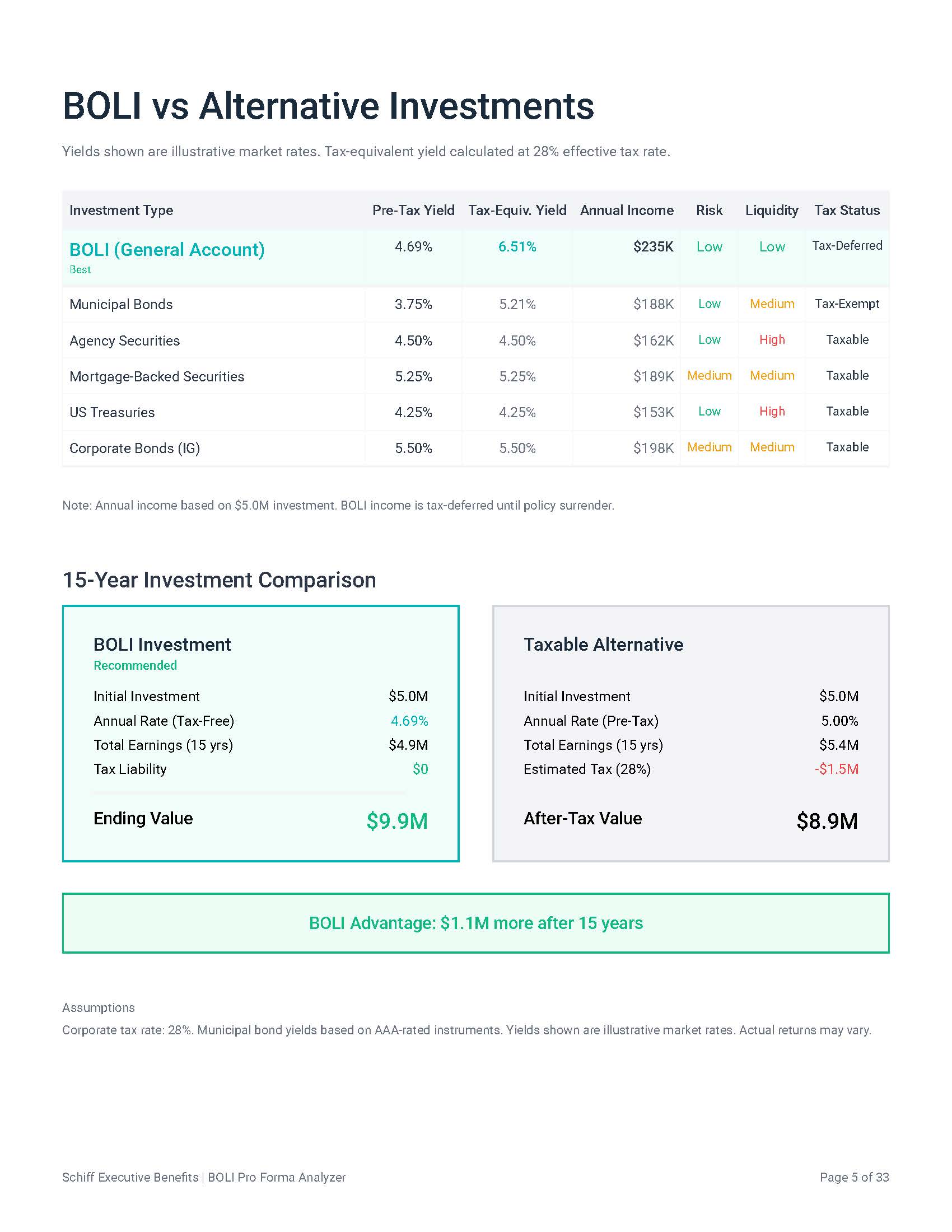
Comparison chart showing Bank-Owned Life Insurance (BOLI) versus alternative fixed income investments


The Economic Reality: After-Tax Yield and Efficiency


In a world where interest rates are volatile and traditional fixed-income yields are often squeezed by taxes, BOLI stands out as a beacon of efficiency.


When you compare BOLI to alternative fixed-income investments: such as municipal bonds, agency securities, or Treasuries: the difference is often staggering. Because the cash value growth within a BOLI policy is tax-deferred (and tax-free if held until the death of the insured), the "tax-equivalent" yield is significantly higher than what a bank can typically earn elsewhere.


As shown in our proprietary BOLI Pro Forma Analyzer, a $5 million investment in BOLI can provide a tax-equivalent rate that significantly outperforms corporate bonds or MBS portfolios. This isn't just about "beating the market"; it’s about generating the necessary cash flow to fund Non-Qualified Deferred Compensation (NQDC) and other executive carve-outs that are essential for retention.


Offsetting the Rising Cost of Talent


What is the true cost of losing your CFO or a high-performing VP of Lending? It isn't just the recruiter's fee. It is the loss of institutional knowledge, the disruption of client relationships, and the significant expense of "buying" a replacement in a competitive market.


Most banks use BOLI to recover the costs of:


  • Post-retirement medical benefits

  • Supplemental Executive Retirement Plans (SERPs)

  • Group term life insurance premiums

  • 401(k) matching and pension obligations


By utilizing BOLI, you are essentially creating an informal "sinking fund" to pay for these future obligations. It allows you to offer "ownership-like" benefits without actually diluting your bank’s equity. This is how you retain your key people while keeping the bank’s financial health intact.


Bank executives in a boardroom discussing bank-owned life insurance and executive retention strategies.


Regulatory Compliance: The Tier 1 Advantage


One of the most frequent questions I get from Bank Presidents is: "How will the regulators view this?"


The answer is found in the Interagency Statement on the Purchase and Risk Management of Life Insurance. BOLI is recognized as a permissible investment for banks, provided it is managed within specific guidelines. Most notably, the Office of the Comptroller of the Currency (OCC) and other regulators generally allow BOLI holdings up to 25% of a bank’s Tier 1 capital.


Because BOLI is a high-quality asset backed by highly-rated insurance carriers, it provides a stable foundation for your balance sheet. Unlike securities portfolios, BOLI cash values are typically not subject to the "mark-to-market" volatility that can plague a bank during periods of rising interest rates. This makes it a preferred tool for managing earnings consistency.


The Human Element: Survivor Income as an Incentive


While the bank is the primary beneficiary, BOLI can also be structured to provide a powerful direct benefit to the insured executives.


Through "split-dollar" arrangements, a portion of the death benefit can be directed to the executive’s family. This provides "pre-retirement survivor income": a massive incentive for a key leader who wants to ensure their family is protected while they focus on growing your institution.


Think about the peace of mind you are offering your top officers. You aren't just giving them a salary; you are giving them a legacy. When you align the bank’s financial goals with the personal security of its leaders, you create an environment where talent stays for the long haul.


Why the "Carrier Agnostic" Approach Matters


The BOLI market is nuanced. There are different types of products: General Account, Hybrid Account, and Separate Account: each with its own risk profile and yield potential.


At Schiff Executive Benefits, we believe that your bank deserves a solution tailored to your specific capital structure and risk appetite, not a "product of the month." We operate as independent brokers, which means we work with all the major, highly-rated carriers to find the right fit for you.


Our process, which we call The Perfect Plan®, involves:


  1. A Deep-Dive Needs Analysis: We look at your current benefit liabilities and capital ratios.

  2. Carrier Evaluation: We vet the financial strength and historical performance of potential insurance partners.

  3. Pro Forma Modeling: We show you exactly how BOLI will impact your EPS and ROA over 10, 20, and 30 years.

  4. Implementation and Administration: We handle the heavy lifting, from board education to ongoing compliance monitoring.


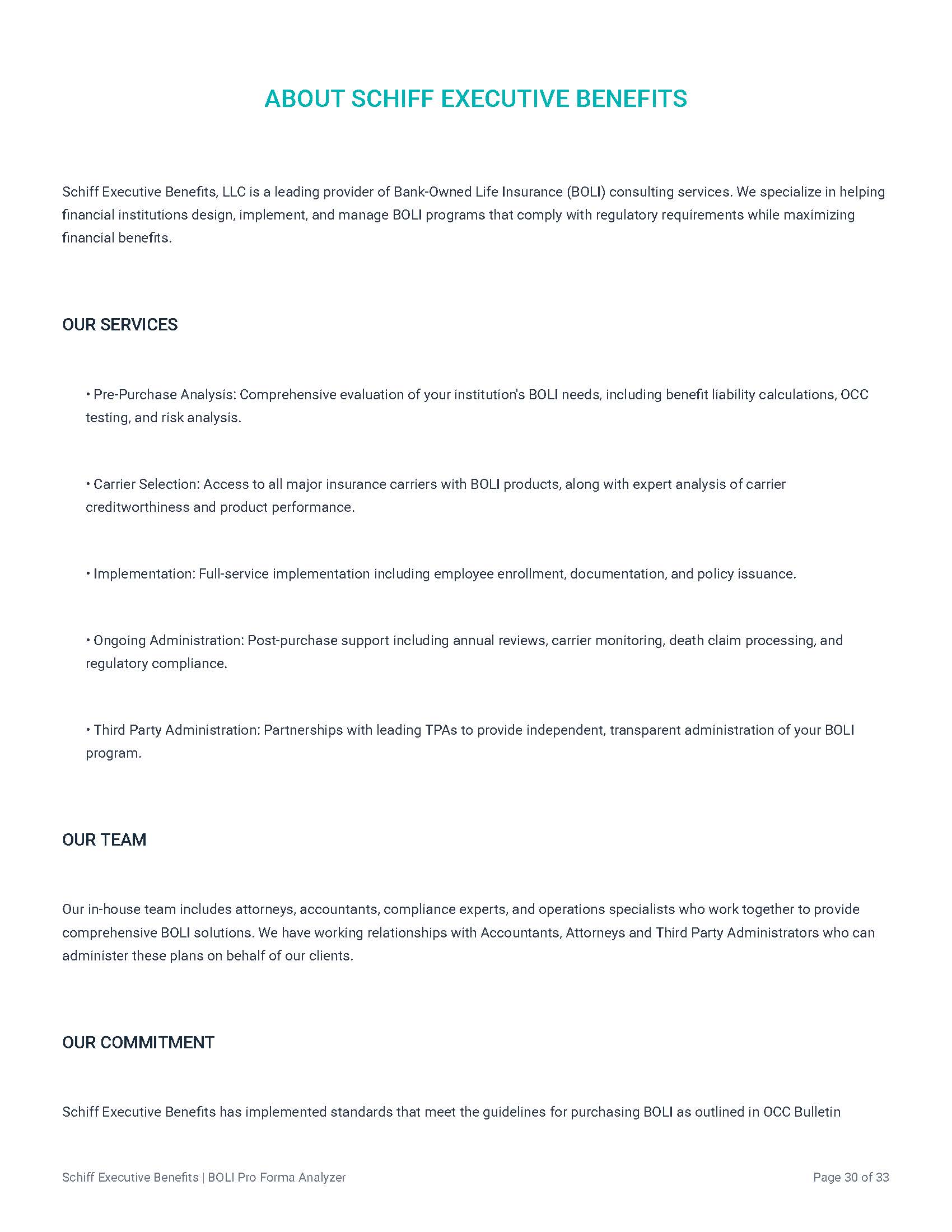
Overview of Schiff Executive Benefits’ BOLI consulting services


The Point of No Return: Why Wait?


Every day that your bank's benefit liabilities grow while your assets remain in taxable, low-yield accounts is a day of lost opportunity. Economic shifts are coming, and the cost of talent is not going down.


Are you prepared for the next five years? What if your replacement cost for your senior team increases by 20%? What if your 401(k) matches become a burden on your margins?


BOLI is not just a financial product; it is a strategic shield. It provides a calm, structured way out of the anxiety of rising costs. It allows you to focus on what you do best: banking: while we ensure your "human capital" is fully funded and protected.


Join Us for a Deeper Conversation


Navigating the complexities of executive benefits and BOLI doesn't have to be a solo journey. Whether you are looking to implement your first BOLI plan or you want a review of your existing holdings to ensure they are performing as promised, we are here to help.


Sit back, grab your coffee, and let's discuss how we can bring stability back to your executive suite. Building your bank’s legacy should be a realization of your dream value, not a source of stress.


Come join us and discover how The Perfect Plan® can help you achieve alignment and retention.


Ready to explore the possibilities? Learn more about our services here.


It is often said that a business is only as strong as the foundation upon which it is built. You have spent decades pouring your sweat, late nights, and creative energy into your company. You have survived market crashes, global shifts, and the daily grind of management. But here is an undeniable truth: building a business is a labor of love, yet leaving one should not be a labor of grief.


For many business owners, the "exit" feels like a distant shore. However, the reality of business succession is that it often happens when we least expect it. Whether it is a sudden health crisis or a partner deciding to walk away, the stability of your legacy depends entirely on a document that is likely sitting in a dusty drawer: your buy-sell agreement.


Are you certain that document will protect your family? Does it guarantee that you won't end up in business with a widow? Or worse, does it inadvertently hand over your hard-earned equity to the IRS?


At Schiff Executive Benefits, our mission is Restoring Alignment and Retention. We believe that a plan is only as good as its execution. Today, let’s walk through the common pitfalls that keep business owners up at night and how you can secure your professional legacy.


The "What If" Reality Check


We often ask our clients five core "What If" questions. Two of them are particularly relevant here:


  1. What if you end up in business with your partner’s spouse?

  2. What if you need a business buy-out tomorrow but don’t have the cash?


If you don't have a properly structured and funded agreement, these aren't just hypothetical scenarios: they are impending financial disasters. A buy-sell agreement is essentially a "business will." It dictates who can buy the departing owner's share, at what price, and where the money will come from. Without it, or with a flawed one, you are inviting litigation and chaos into your boardroom.


Business partners discussing a buy-sell agreement and succession planning in a modern office.


Mistake #1: The Ownership Trap (Redemption vs. Cross-Purchase)


One of the most frequent business owner issues we see involves the choice between an Entity-Purchase (Redemption) agreement and a Cross-Purchase agreement. While both aim to solve the same problem, their tax and legal implications are worlds apart.


The Redemption Model


In a redemption or entity-purchase agreement, the business itself buys the life insurance policy on each owner. When an owner passes away, the company receives the death benefit and uses it to buy back the shares.


  • The Pro: It is simple. Only one policy per owner is needed.

  • The Con: The surviving owners do not receive a "step-up" in tax basis. If you eventually sell the company, your tax bill could be significantly higher because your cost basis in the shares remained the same, even though you now own a larger percentage of the company.


The Cross-Purchase Model


In a cross-purchase agreement, the owners buy policies on each other.


  • The Pro: When a partner dies, you receive the insurance proceeds personally (tax-free) and use them to buy the deceased partner’s shares. This gives you a "step-up" in basis, potentially saving you millions in future capital gains taxes.

  • The Con: It can become administratively complex if there are many partners. If you have four partners, you might need 12 separate policies to cover everyone.


Which is right for you? There is no one-size-fits-all answer. Often, we utilize a cross-purchase partnership or a "Trusteed" cross-purchase to simplify the administration while retaining the tax benefits. Failing to analyze this choice is a mistake that often isn't discovered until it's too late to fix.


Mistake #2: The IRC 101(j) Compliance Trap


This is the "Life Insurance Warning" that many generalist advisors miss. Under Internal Revenue Code Section 101(j), if a business owns a life insurance policy on an employee (including owner-employees), specific notice and consent requirements must be met before the policy is issued.


If you fail to comply with 101(j), the death benefit: which you expected to be tax-free: could be treated as taxable income. Imagine needing $5 million to buy out a partner, receiving the check, and then realizing the IRS wants 37% of it.


This is what we call the "Employer-Owned Life Insurance" trap. Compliance requires:


  • Informing the insured in writing that the employer intends to insure their life.

  • Disclosing the maximum face amount for which the employee could be insured.

  • Obtaining written consent from the employee.


At Schiff Executive Benefits, we specialize in navigating these regulatory waters to ensure your COLI (Corporate Owned Life Insurance) strategies remain a source of security, not a tax liability.


Mistake #3: Using a Stale Valuation


When was the last time you valued your company? If your buy-sell agreement uses a fixed dollar amount from 2018, you are playing a dangerous game.


If the business has grown, the surviving partners may be getting a "steal," leaving the deceased partner’s family under-compensated and likely to sue. If the value has dropped, the company might be forced to overpay, potentially bankrupting the business.


We recommend a dynamic valuation formula or a requirement for an annual appraisal. Your legacy deserves an accurate price tag. Business values fluctuate; your agreement must be agile enough to keep pace.


Legal documents and business valuation papers on an executive desk for a buy-sell agreement review.


Mistake #4: The Funding Gap


A buy-sell agreement without funding is just a piece of paper with good intentions. How will you come up with the cash to buy out a partner?


  • Cash on hand? Most businesses don't keep millions in idle cash.

  • A bank loan? Banks are often hesitant to lend to a company that just lost a key partner.

  • Installment payments? This puts a massive strain on future cash flow and leaves the departing family at risk if the business fails.


This is where life insurance buy/sell agreements shine. Life insurance provides immediate, tax-free liquidity at the exact moment it is needed. It creates the "certainty" in an uncertain time. By using COLI or personal policies, you ensure that the surviving partners keep the business and the departing family gets their fair value immediately.


The Power of The Perfect Plan®


Navigating these complexities requires more than just an insurance agent; it requires a team of advisors who understand the intersection of law, tax, and corporate finance. This is the philosophy behind The Perfect Plan®.


We don't just sell policies; we help you engineer a succession strategy that stands the test of time. We look at the "point of no return": the moment when a triggering event occurs: and we work backward to ensure every piece of the puzzle is in place today.


Have you considered what happens if a partner becomes disabled rather than passing away? Most buy-sell agreements are silent on disability, yet the statistical likelihood of long-term disability is far higher than premature death. Our team at Schiff Executive Benefits looks at the holistic picture to ensure no "What If" goes unanswered.


Take the Next Step


The unstable nature of today's economic environment means that waiting "until next year" to review your succession plan is a risk you cannot afford. Economic shifts and tax law changes are happening at an accelerated pace.


Are you making these common mistakes?


  • Is your agreement funded?

  • Is it 101(j) compliant?

  • Does it offer a step-up in basis?

  • Is the valuation current?


If you aren't 100% sure of the answers, it's time for a professional review.


Financial advisors reviewing business succession and executive benefits plans in a boardroom.


Sit back, grab your coffee, and let’s have a conversation about your professional legacy. We invite you to join us for a consultative review where we can explore how to bring your buy-sell agreement into alignment with your current goals.


Don't let the foundation you've built crumble because of a technicality. Let's work together to ensure your business continues to thrive, your partners stay protected, and your family is provided for: exactly the way you intended.


Restoring Alignment and Retention. It’s not just our tagline; it’s our promise to you.


Ready to secure your future? Contact us today to learn more about how we can help you implement The Perfect Plan®.


Learn more: planning your business succession.


They say that “what gets measured gets managed.” And in executive benefits, what gets aligned gets retained. You spend years building a team, finding those rare people who drive revenue, protect relationships, and carry culture. Then you face the question that keeps owners, CFOs, and board members up at night: How do you keep them without creating a benefit that feels like an entitlement… or an expense you’ll regret?

What if you could design a benefit that:


  • Rewards a key employee in a way they actually value

  • Creates a real golden handcuff (without the awkwardness)

  • Aligns the executive’s mindset with company performance and culture

  • And gives the employer a current tax deduction


That’s where The Perfect Plan® mindset changes the conversation. We’re still talking about Split Dollar Life Insurance—but not as a “secret,” and definitely not as a cost recovery story. We’re talking about how a Restricted Executive Bonus Arrangement (REBA)—when paired with a Split Dollar Endorsement—can become a clean, practical retention engine that creates a true win-win.

If you’ve been losing sleep over executive retention, rising compensation pressure, or how to keep your best people rowing in the same direction, pull up a chair. Let’s demystify this.

What Is Split Dollar, Really?


First things first: Split Dollar isn’t a type of insurance policy. You can’t go out and "buy a Split Dollar." Instead, it is a method of sharing the costs and benefits of a life insurance policy between two parties: usually an employer and an employee.

Think of it like a partnership. The company has the capital; the executive has the need for high-limit life insurance and tax-advantaged retirement income. Split Dollar is the bridge that connects the two.

We typically see this structured in two ways:

  1. The Endorsement Method: The employer owns the policy and "endorses" a portion of the death benefit to the employee’s beneficiaries. This is often used when the primary goal is providing a death benefit.

  2. The Collateral Assignment (Loan Regime) Method: The employee owns the policy, and the employer pays the premiums. These payments are treated as a series of loans to the employee, secured by the policy’s cash value and death benefit. This is the heavy hitter for executive retention because it can build significant cash value for the executive's retirement.


Trusted advisors discussing split dollar life insurance and executive retention strategies in a professional office.

The Perfect Plan® Move: REBA + Split Dollar Endorsement (Deduction + Golden Handcuff)


Here’s the anxiety we hear all the time—from corporations, partnerships, and banks alike: “If I pay them more, it’s just more comp… and they can still leave.” A traditional bonus is appreciated, then forgotten. A retirement plan contribution is valuable, but it doesn’t always feel tied to performance or culture. And in uncertain markets, you want a strategy that creates commitment, not just compensation.

This is where The Perfect Plan® approach shines: you reverse-engineer a benefit that matches the intent of the business.

A common structure we use is a Restricted Executive Bonus Arrangement (REBA) funded with life insurance, paired with a Split Dollar Endorsement arrangement. In plain English:

  • The employer pays a “restricted bonus” to the key employee.

  • The employer takes a current tax deduction for that compensation expense (assuming it meets normal deductibility rules and is reasonable compensation).

  • The bonus dollars fund a life insurance policy designed around the executive’s goals (family protection now and supplemental income later).

  • Restrictions are added (the golden handcuff) so the executive earns access over time—typically through a vesting schedule tied to tenure, performance, or key milestones.

  • The employer-owned endorsement structure allows the employer to own/control key policy rights while endorsing benefits to the employee’s beneficiaries—helping keep the program consistent with the company’s culture and intent.


One of my favorite “real world” moments is when a founder says, “I don’t want handcuffs. I want alignment.” Then we show them how restrictions can be framed as earned ownership feel—a benefit that grows as the executive helps grow the company. That’s not punitive. That’s fair.

This is the win-win:

  • You get retention by design (not by hope).

  • They get a benefit that feels permanent and personal (not like another line item on payroll).

  • Your culture stays intact because the rules are clear, consistent, and tied to what your business actually values.


In other words: it’s not about “buying loyalty.” It’s about creating earned alignment—so your best people think twice before taking that headhunter call, because the arrangement is tied to the company’s performance, expectations, and culture.

The Technical Minefield: Why Expertise Matters


Now, here is the part the "experts" don't always explain clearly: Split Dollar is a technical minefield. If you don't have an advisor who lives and breathes this stuff, you can end up in a world of tax pain.

Take IRC Section 101(j), for example. This is a big one. It requires very specific notice and consent requirements for employer-owned life insurance. If you miss a signature or fail to file the right paperwork before the policy is issued, the death benefit: which is normally tax-free: could become taxable. Can you imagine explaining that to a grieving family or your board of directors?

Then there’s Section 409A. If your Split Dollar arrangement is deemed a "nonqualified deferred compensation" arrangement and it isn't compliant, your executive could face immediate taxation and a 20% penalty.

This is why we focus so heavily on the "Goal-Oriented Reverse Engineering" I mentioned in our previous post. We don't just pick a product; we design the compliance framework first. We ensure every "i" is dotted and every "t" is crossed so your legacy: and your company’s capital: is protected.


The Broker Advantage: Why We Don't Have a "Favorite" Carrier


One of the biggest secrets in this industry is that many firms are "captive" or heavily incentivized to push one or two specific insurance carriers. They’ll tell you that Carrier A has the best Split Dollar product because Carrier A is the only one they really sell.

At Schiff Executive Benefits, we take a different approach. We are independent brokers. We work with the giants: John Hancock, Lincoln, MetLife, Prudential, Pacific Life, and many more.

Why does this matter to you? Because every company is different. A law firm in New York has different needs than a manufacturing plant in the Midwest or a community bank in the South. One carrier might have better pricing for older executives, while another might offer superior cash-value growth for a younger team.

Our "Broker Advantage" means we shop the entire market to find the carrier that fits your arrangement, rather than forcing your arrangement into a carrier’s box. We aren't looking for the easiest sale; we’re looking for the most efficient engine to power your executive retention strategies.

Schiff Executive Benefits Carrier List

Is The Perfect Plan® Version of Split Dollar Right for You?


You’ve built something incredible. Whether it’s a corporation, a partnership, or a financial institution, your success is built on the backs of your key people. But the world is uncertain. Taxes may rise, markets will fluctuate, and the war for talent isn’t slowing down.

Ask yourself:

  • Are my top people truly aligned with our performance and culture—or are they one headhunter call away from leaving?

  • If I increase comp, will it actually change behavior and commitment—or just increase payroll?

  • Do we have a benefit that feels meaningful to the executive and disciplined to the business?


When REBA is designed with the right restrictions—and paired with a Split Dollar Endorsement—it becomes more than “a benefit.” It becomes a retention agreement with a heartbeat. It tells a key executive: we’re investing in you, and we want you here when the next chapter of this company gets written.

Building It Your Way


At the end of the day, you want to realize your dream value for your business. You want to know that the team you’ve assembled will stay together to cross the finish line.

We don't believe in one-size-fits-all "products." We believe in The Perfect Plan®. It’s about starting with your goals—retention, a current employer tax deduction, and a benefit that actually changes behavior—and reverse-engineering a solution that works.

Whether you are looking into COLI for a large corporation or a NQDC plan for a growing partnership, the strategy needs to be as unique as your thumbprint.

If you’re curious about how these "secrets" can be put to work for your firm, let’s talk. No high-pressure sales pitch, just a conversation between professionals.

Sit back, grab your coffee, and when you’re ready to see how the math works for your specific situation, come join us. We’re here to help you navigate the unstable waters of executive benefits with a steady hand and a clear map.

To your success,

Matt Schiff
President, Schiff Executive Benefits


A business partnership is a lot like a marriage, but with more paperwork and significantly higher financial stakes. You spend more time with your partners than your family. you build a legacy together, and you trust each other with your professional lives. But there is a universal truth that every business owner eventually has to face: every partnership will end.


The question isn’t if it will end, but how. Will it end with a smooth transition and a handshake, or will it end in a tax-fueled legal nightmare that leaves your family: and your partner’s family: scrambling for liquidity?


Most business owners have a Buy/Sell agreement tucked away in a dusty drawer. They signed it years ago, checked the box, and moved on. But the world has changed. Tax laws have shifted. Court cases have redefined how the IRS looks at your business value. If your agreement hasn’t been touched in three years, it’s not just outdated: it’s a ticking time bomb.


The Problem: When Protection Becomes a Tax Trap


For decades, the standard play was the "Entity Purchase" or "Redemption" agreement. The business owns a life insurance policy on each owner. If an owner passes away, the business gets the cash and uses it to buy back the shares from the deceased owner's estate. Simple, right?


Not anymore.


A recent, massive shift in the tax landscape: specifically the Connelly v. United States decision: has turned this "simple" strategy into a potential catastrophe. The Supreme Court essentially ruled that if the company receives life insurance proceeds to fund a buyout, those proceeds can be included in the company’s total valuation for estate tax purposes.


Imagine this: Your business is worth $10 million. You have a $5 million life insurance policy to buy out your partner. If you pass away, the IRS could argue the business is now worth $15 million because of that insurance cash. Your estate is taxed on a $7.5 million valuation (your half), but your family only receives the $5 million you originally agreed upon.


You’re paying taxes on money your family never sees. Does that sound like "protection" to you?


100% Protection for the Families Who Built the Business


When we talk about Buy/Sell agreements at Schiff Executive Benefits, we focus on the human element. Your spouse and your children shouldn't have to become "accidental business partners" with your co-founder. Likewise, your surviving partner shouldn't have to report to your heirs who might not know the difference between a P&L and a balance sheet.


The goal is 100% Protection.


This means the family of the deceased receives the full, fair market value of the business interest immediately, in cash, with zero tax friction. It also means the surviving owner gets 100% control of the company without taking on massive debt or draining the corporate coffers.


Financial Blueprint Analysis


The Solution: Modernizing via the Cross-Purchase Strategy


To avoid the "Connelly Trap," many savvy owners are moving toward a Cross-Purchase or a Trusteed Cross-Purchase structure.


In a traditional cross-purchase, the owners own policies on each other. Because the business doesn't own the money, it doesn't inflate the business's value in the eyes of the IRS. But the real magic happens with something called the "step-up in basis."


When you use insurance proceeds to buy your partner’s shares personally, your tax basis in the company increases. If you ever decide to sell the business later, that "step-up" could save you millions in capital gains taxes. It is the definition of tax efficiency.


However, if you have three or four partners, owning individual policies on everyone gets messy. That’s where we modernize. We often implement an LLC Insurance Ownership structure. You create a separate entity (taxed as a partnership) specifically to hold the life insurance. It provides the creditor protection of a corporation, the tax benefits of a cross-purchase, and the administrative ease of a single plan.


Golden tree inside a secure glass case representing protected business growth and executive legacy planning.


Is Your Agreement Part of The Perfect Plan®?


At Schiff Executive Benefits, we don't look at insurance in a vacuum. We look at how it fits into your broader financial legacy: what we call The Perfect Plan®.


A modern Buy/Sell agreement isn't just a legal document; it’s a wealth-transfer vehicle. It’s part of a strategy that uses corporate dollars tax-efficiently to build personal security.


Ask yourself these three questions:


  1. How is the value determined? If your agreement uses a "fixed price" from five years ago, you are either overpaying or cheating a family out of their legacy.

  2. Where does the tax go? If your plan triggers a massive estate tax bill or a capital gains nightmare, it’s a failure.

  3. Is it funded? A legal obligation to buy shares is worthless if the company doesn't have the liquidity to write the check.


If you can’t answer these with 100% certainty, you are leaving your business and your family's future to chance.


The ROI of Getting it Right


We often hear owners say, "I'll get to it next year." But the cost of waiting is higher than you think. A well-structured, modern agreement doesn't just protect you upon death; it sets the stage for a healthy exit, a smooth retirement transition, and even better terms with lenders who want to see a solid succession plan.


Think of it as the ultimate insurance for your life's work. You’ve spent decades building this company. You’ve survived market crashes, hiring woes, and global shifts. Why let a preventable tax headache dismantle it all at the finish line?


Executive Expertise in Action


Stop Worrying and Start Planning


You shouldn't have to stay up at night wondering if your partner’s spouse will end up sitting in your boardroom or if the IRS will take a 40% bite out of your family’s inheritance.


Modernizing your Buy/Sell agreement is about more than just "insurance." It’s about clarity. It’s about ensuring that the value you’ve built stays where it belongs: with the people who built it and the families who supported them.


We help business owners navigate these complexities every day. We coordinate with your legal team and your CPA to ensure the math, the law, and the logic all point in the same direction: your success.


Let’s get your plan off the "to-do" list and into the "done" column.


Grab a coffee, take a breath, and let’s look at the numbers together. You can visit our website to learn more about our approach or schedule a quick discovery call via my Calendly to see if your current agreement is helping you or hurting you.


Your legacy is too important to leave to an outdated contract. Let's make sure it's protected: 100%.


Perfect Plan Podcast Banner


Learn more: planning your business succession.


A company’s greatest asset isn’t found on the balance sheet; it’s the talent that walks out the door every evening. In the modern business landscape, the "war for talent" is no longer a catchy buzzword: it is a daily reality. As a business owner or executive, you know that losing a key player doesn’t just cost you a salary; it costs you institutional knowledge, client relationships, and momentum.


The fundamental truth is that traditional benefit packages are often insufficient for your highest earners. When 401(k) contributions are capped and tax brackets are climbing, how do you provide a meaningful incentive that actually moves the needle for a top-tier executive?


This is why everyone is talking about split dollar life insurance. It is one of the most powerful, flexible, and cost-effective executive retention strategies available today. But what is it, exactly? And more importantly, how can it fit into your broader financial strategy?


What is Split Dollar Life Insurance?


At its core, split dollar life insurance is not a specific type of insurance policy. Rather, it is a method of sharing the costs and benefits of a permanent life insurance policy between two parties: typically an employer and an employee.


Think of it as a financial partnership. The employer helps the employee secure a high-value permanent life insurance policy that provides both a death benefit and a growing cash value. In exchange, the employer is eventually reimbursed for the premiums they paid. It is a "split" because the two parties divide the policy's benefits: the death proceeds, the cash value, and the premium costs.


Symbolic pillars representing the collaborative partnership between an employer and executive in a split dollar plan.


The Two Main Strategies: Endorsement vs. Collateral Assignment


When we sit down with clients at Schiff Executive Benefits, we often start by determining which "regime" of split dollar fits their goals. These plans are generally divided into two categories:


1. The Endorsement Split Dollar Plan


In this arrangement, the employer is the owner of the policy. The employer "endorses" a portion of the death benefit to the employee’s designated beneficiaries. The employer typically pays the premiums and retains ownership of the policy’s cash value.


  • Who it’s for: Companies looking to maintain maximum control over the asset.

  • The Benefit: The employee gets significant life insurance coverage at a very low cost (only paying tax on the "economic benefit" of the insurance protection).


2. The Collateral Assignment Split Dollar Plan (The Loan Regime)


This is currently the most popular variation for high-level executive benefits. Under this structure, the employee owns the policy, and the employer "loans" the employee the funds to pay the premiums. The loan is secured by a collateral assignment of the policy back to the employer.


  • Who it’s for: Executives looking for long-term wealth accumulation and supplemental retirement income.

  • The Benefit: The employee can eventually access the policy’s cash value via tax-free loans and withdrawals. The employer is repaid their loan (often plus interest) when the employee dies or when the plan is terminated.


Financial Analysis


Why This Matters Now: The Problem with Traditional Plans


Are you tired of telling your top producers that they’ve "hit the limit" on their 401(k)? Are you concerned about the impact of future tax hikes on your executive team's retirement readiness?


Standard qualified plans are essential, but they are often highly restrictive for "Highly Compensated Employees" (HCEs). This creates a "reverse-discrimination" effect where your most valuable people are actually the ones least able to save a representative percentage of their income for the future.


This is where a split dollar life insurance plan: often used in conjunction with a NQDC plan (Non-Qualified Deferred Compensation): changes the game. It allows for:


  • Unlimited Contributions: There are no government-mandated caps on how much can be shifted into these plans.

  • Tax Efficiency: In a loan regime setup, the growth of the cash value is tax-deferred, and the eventual death benefit is generally income tax-free.

  • Selective Participation: Unlike 401(k) plans, you don’t have to offer this to everyone. You can hand-pick the key individuals who are vital to your company’s success.


The Perfect Plan® Philosophy: Reverse Engineering Success


At Schiff Executive Benefits, we don't believe in "off-the-shelf" products. Our approach is governed by The Perfect Plan® philosophy. We begin by asking: What keeps you up at night?


Is it the fear of your VP of Sales being recruited by a competitor? Is it the need to fund a future buy-sell agreement? Or is it your own desire to exit the business with a secure, tax-advantaged income stream?


By reverse engineering your specific goals, we can determine if a split dollar arrangement is the right tool for the job. We look at the "math" first: analyzing the Applicable Federal Rate (AFR), the projected policy performance, and the long-term impact on your company's P&L.


Executive Speaking


The "Holy Grail": Full Cost Recovery for the Employer


One of the most compelling reasons business owners choose split dollar is the concept of cost recovery.


In a traditional bonus or salary increase, that money is "gone" once it’s paid out. With a split dollar plan, the employer's outlay is structured as a secured interest. When the executive eventually retires or passes away, the company is made whole. They receive their premium payments back, dollar-for-dollar.


In many cases, the company can even charge a modest interest rate on the premium loans, turning an executive benefit into a neutral or even slightly positive move for the company's long-term balance sheet.


A continuous water loop in a corporate atrium symbolizing full cost recovery for employer-paid premiums.


A Poignant Example: The "Golden Handcuffs"


Consider the story of a mid-sized manufacturing firm we recently worked with. The CEO was concerned about his COO: a brilliant leader who had been approached by a private equity-backed firm with a massive signing bonus.


Instead of just offering a raise (which would be taxed heavily), the firm implemented a Collateral Assignment Split Dollar plan. The company agreed to pay $100,000 in annual premiums for seven years. If the COO stayed for ten years, he would have access to a policy with significant cash value for retirement. If he left early, the company would immediately recoup its premiums, and the COO would walk away with nothing.


The COO stayed. He saw the value of a multi-million dollar tax-free death benefit for his family and a massive supplemental retirement fund that wasn't subject to market volatility or 401(k) limits. The CEO kept his right-hand man, knowing that every penny the company "spent" on the premiums would eventually come back to the firm.


Technical Considerations: Don't Go It Alone


While the benefits are clear, the execution is technical. Between 409A compliance, IRS "economic benefit" rates, and the intricacies of the loan regime, these plans require expert oversight. This isn't just about buying a policy; it's about designing a legal and financial framework that stands up to scrutiny and delivers on its promises.


This is why we focus so heavily on the technical details and regulatory compliance. We work alongside your existing team of advisors: your CPAs and attorneys: to ensure the plan integrates seamlessly with your corporate structure.


Building Your Legacy


What do you want your professional legacy to be? Do you want to be the leader who built a revolving door of talent, or the one who built a loyal, high-performing team that feels truly valued and secure?


Split dollar life insurance is more than just a financial tool; it’s a statement of value. It tells your key people that you are invested in their long-term success as much as they are invested in yours.


If you’re ready to see how these strategies can work for your specific situation, I invite you to explore more of our resources. You can listen to deeper dives into these topics on The Perfect Plan® Podcast, where we break down the complexities of executive compensation in plain English.


Podcast Banner


The economic environment is shifting, and the "point of no return" for retaining your best people might be closer than you think. Don't wait for a resignation letter to start thinking about your benefits strategy.


Sit back, grab your coffee, and let's have a conversation about how we can help you protect what you've built. Contact us today to start designing your version of The Perfect Plan®.


Learn more: Split Dollar architecture for executive wealth.


In this episode of The Perfect Plan Podcast™ we have Steve Dark and Joe Sparacio share the basics behind financial planning, and Life Insurance.  They share stories on how much Life Insurance do you really need, as well as how and when to set up accounts that protect your family.

This is the episode you want to hear on how to plan for all of your family's "what if's", with money that you would've normally just spent.

If you are a business owner or decision making executive, how would you want to design The Perfect Plan™ to retain and reward your employees? A 401K is terrific for basic retirement savings, but there are limitations to how much you can put in, and it must be given to everyone on a proportional basis.

In this episode, we discuss the decision making process, how you can get the perfect timing of your deductions, and include the people and benefits that are needed most, in the most tax efficient manner.  No two companies are alike, and neither should your plans be.

Come and listen to this podcast as we lay it out for you.