
Hi, How Can We Help You?
  • Planning for all of life's "What Ifs".

Category Archives: Owner Benefits


They say that building a business is like raising a child: it takes years of sleepless nights, total devotion, and a fair amount of luck. But here is the undeniable truth that most entrepreneurs ignore until it is too late: it is much easier to build a business than it is to keep one together when life goes sideways.


As business owners, we spend 99% of our time focused on growth, culture, and the bottom line. We rarely want to talk about the "What Ifs." But those "What Ifs" are the very things that can dismantle a lifetime of work in a single afternoon. At Schiff Executive Benefits, we focus on Restoring Alignment and Retention, and nowhere is that alignment more critical than in your Buy/Sell arrangement.


If you don’t have a plan, or if your plan is a dusty document sitting in a drawer from ten years ago, you aren't just taking a risk: you are gambling with your legacy.


The Emotional Reality: Who Is Sitting in That Chair?


Let’s skip the legal jargon for a second and talk about the real world. Imagine it’s Monday morning. You walk into the office, grab your coffee, and head to your partner’s office. But your partner isn't there. Instead, sitting in that chair is your partner’s spouse.


They are grieving, they are overwhelmed, and they have just inherited 50% of your company.


Now, you love your partner, and you probably like their spouse. But do you want to be in business with them? Do they understand the nuances of your industry? Do they share your vision for the next five years? Most importantly, they likely need liquidity: they need the income your partner used to bring home. But the business needs that cash to stay afloat and grow.


Suddenly, your best friend’s spouse has become your most difficult board member. This is the first of our "Five What Ifs," and it is the one that keeps most owners up at night.


Or consider a different "What If": An unsolicited buyout from a competitor. Your partner decides they want out, and instead of selling back to you, they find a "strategic buyer": the very person you’ve been competing with for a decade. Now, your greatest rival has a seat at your table and access to your trade secrets.


How does that feel? It feels like a loss of control. And in business, control is everything.


Business partners discussing legacy planning and their Buy/Sell agreement in a modern office.


The Trap of the "Generic" Buy/Sell Agreement


Most business owners believe they are covered because they have a Buy/Sell agreement tucked away in a file. But let me ask you: When was the last time you looked at it? Does it reflect the actual value of your business today?


Many agreements are "form" documents provided by a lawyer years ago. They often lack a clear valuation methodology or, worse, they aren't funded. A Buy/Sell agreement without a funding mechanism is just a polite piece of paper. It tells you that you have to buy out your partner, but it doesn't tell you where the millions of dollars are going to come from to make that happen.


Without proper funding, you are forced to choose between three bad options:


  1. Draining Company Cash: Killing your working capital and stalling growth.

  2. Taking on Debt: Going to the bank at a time of crisis to borrow money for a buyout.

  3. Selling Assets: Fire-selling parts of the business to cover the cost.


The Technical Edge: Reverse-Engineering the Solution


At Schiff Executive Benefits, we don't start with products. We start with your intent. We look at your company culture and the specific goals of the owners. We use a process we call The Perfect Plan® to ensure that every piece of the puzzle fits together.


The SEB Executive Benefits Design Checklist (a.k.a. “Let’s Stop Guessing”)


Here’s a universal truth: most benefit and succession plans don’t fail because the math is wrong. They fail because the motivations are misaligned.


So before we talk about funding mechanisms and legal language, we run what we call the SEB Executive Benefits Design checklist. It’s a diagnostic. Not a sales pitch. Think of it like a pre-flight checklist—because “we’ll figure it out on the way down” is not a strategy.


We put two columns on the table:


What the employer typically needs:


  • Deductions / cost efficiency (or at least a clear path to cost recovery)

  • Retention (handcuffs… but the friendly, culture-approved kind)

  • Control (who’s in, who’s out, and what happens when life happens)


What the employee typically wants:


  • Tax-free income (especially when it matters most)

  • Long Term Care (LTC) benefits (because aging is undefeated)

  • No caps (because top performers don’t love being told “that’s the limit”)


Then we ask the questions that actually move the needle:


  • If you’re paying for this, what behavior are you buying?

  • If they’re staying for this, what promise are they counting on?

  • If the “What Ifs” show up early, does this plan still do what it said it would do?


When those two columns line up—employer needs and employee wants—you don’t just get a plan that looks good on paper. You get The Perfect Plan®. And yes, it’s as rare (and valuable) as it sounds.


1. The Valuation Piece


You cannot protect what you haven't valued. Most owners have a "gut feeling" about what their business is worth, but that doesn't hold up in court or with the IRS. To get started, you need an objective baseline. I encourage you to use our tool to start your own Business Valuation right now. Knowing your number is the first step toward security.


2. Trigger Events


A good agreement covers more than just death. It needs to address disability, retirement, divorce, and even personal bankruptcy. What happens if a partner is permanently disabled? Who decides when they are "disabled enough" to trigger a buyout? We help you define these terms so there is no ambiguity when emotions are running high.


3. Funding with COLI (Corporate Owned Life Insurance)


This is where technical expertise meets practical execution. One of the most efficient ways to fund a Buy/Sell arrangement is through Corporate Owned Life Insurance (COLI).


COLI allows the company to own policies on the lives of the owners. If a "What If" occurs, the death benefit provides immediate, tax-free liquidity to the company. The company then uses that cash to buy out the heirs. The family gets the money they need, and you get 100% control of the business back.


But it goes deeper than that. Properly structured COLI can provide cost recovery. The cash value growth within the policy can help offset the costs of the premiums over time, and in some cases, even provide a way to fund an owner's retirement if they don't pass away while active in the business. It’s about making the company's balance sheet work harder for you.


Expanding the Horizon: ESOPs and The Dilemma


Sometimes, the best exit strategy isn't a simple partner buyout. We often talk about "The Business Owner's Dilemma," a concept popularized by Ali Nasser. In our discussions on The Perfect Plan® Podcast, we dive deep into the tension between business wealth and personal freedom. Are you building a business that owns you, or a business that fuels your life?


For some companies, an Employee Stock Ownership Plan (ESOP) is a powerful alternative. I recently had a great conversation with Dan Zugell on ESOPs, which you can find in our podcast channel and on our YouTube channel. An ESOP can provide a market for your shares, incredible tax advantages, and a way to reward the people who helped you build the company: all while you maintain a level of control during the transition.


Whether it’s a standard Buy/Sell or a more complex ESOP structure, the goal remains the same: ensuring that the transition happens on your terms, not because of a crisis.


Why "Wait and See" Is Not a Strategy


I’ve sat across the table from many owners who say, "Matt, we’ll figure it out when the time comes. We’re all healthy, and we’re all friends."


That is a dangerous sentiment. Business is unstable enough as it is. Why leave the most important transaction of your life to chance? The national debt is rising, tax laws are in constant flux, and market trends can shift overnight. You need a "security" that acts as a guarantee against these external forces.


By implementing a properly designed Buy/Sell arrangement funded by COLI, you are effectively "de-risking" your legacy. You are ensuring that if the unthinkable happens, the business stays intact, the employees stay employed, and the families are taken care of.


A business owner and advisors collaborating on a de-risked corporate succession strategy.


Your Next Steps: Building Your Way


So, where do you go from here?


First, sit back, grab a coffee, and think about those "What Ifs." If your partner wasn't there tomorrow, what happens to your desk? What happens to your bank line of credit?


Second, get a real number. Go to our Business Valuation tool and start the process. It’s confidential and provides the clarity you need to move from anxiety to action.


Third, let’s talk. At Schiff Executive Benefits, we aren't just selling insurance policies; we are architects of The Perfect Plan®. We work alongside your team of advisors: your CPAs and attorneys: to make sure the technical design of your Buy/Sell matches the emotional intent of your heart.


Your professional legacy is too important to be left to a "standard" agreement. Let's make sure your plan is as unique as the business you’ve built. Come join us in the process of Restoring Alignment and Retention for your company.


Are you ready to realize your dream value and build it your way? Let’s get started.


Learn more: planning your business succession.



There is a universal truth in the world of commerce that every seasoned entrepreneur eventually realizes: It is not what you make; it is what you keep. You have spent years, perhaps decades, pouring your sweat, late nights, and capital into building a successful enterprise. You’ve navigated market volatility, managed complex teams, and scaled your vision into a reality. Yet, when you look at your personal balance sheet compared to the company’s revenue, a frustrating disconnect often appears.


Why is it that the business can afford top-tier equipment, expansive marketing budgets, and plush office spaces, but when you try to move that same capital into your personal pocket, the IRS stands at the gate demanding a 30%, 40%, or even 50% "toll"?


If you feel like you are "business rich" but "personally capped," you aren't alone. Most business owners are stuck in the traditional qualified plan trap. You maximize your 401(k), perhaps add a profit-sharing component, and then... you hit a wall. Federal limits dictate how much you can save, and as a high-earner, those limits are often a drop in the bucket compared to the lifestyle you’re building or the legacy you want to leave.


What if there was a way to use corporate dollars: money already sitting inside your business: to build personal wealth that grows tax-deferred and comes out tax-free?


The Tax Trap: Why Traditional Advice Fails High-Earners


Standard financial advice is built for the "average" employee. For the person earning $100,000 a year, a 401(k) is a fantastic tool. But for the business owner or the key executive driving millions in value, the math just doesn't work. When you factor in the "Top Heavy" testing rules and the strict contribution caps, you quickly realize that the traditional system is designed to limit your ability to accumulate wealth.


Furthermore, traditional retirement accounts are "tax-deferred," not "tax-exempt." This means you are essentially making a bet with the federal government. You’re betting that tax rates will be lower thirty years from now than they are today. Given the current trajectory of national debt and government spending, is that a bet you really want to make?


We believe there is a better way. We call it the Perfect Plan® model.


financial-blueprint-analysis.webp


Introducing the Perfect Plan® Model


At Schiff Executive Benefits, we focus on a methodology that aligns corporate objectives with personal wealth goals. The Perfect Plan® isn't a single product; it is a strategic framework designed to move money from the business to the individual in the most tax-efficient manner possible.


The goal of the Perfect Plan® is to achieve three specific outcomes:


  1. Tax-Deductible Contributions: The business gets a deduction for the cost of the benefit.

  2. Tax-Deferred Growth: The assets grow without being eroded by annual capital gains or income taxes.

  3. Tax-Free Distribution: You can access the wealth in retirement without triggering a massive tax bill.


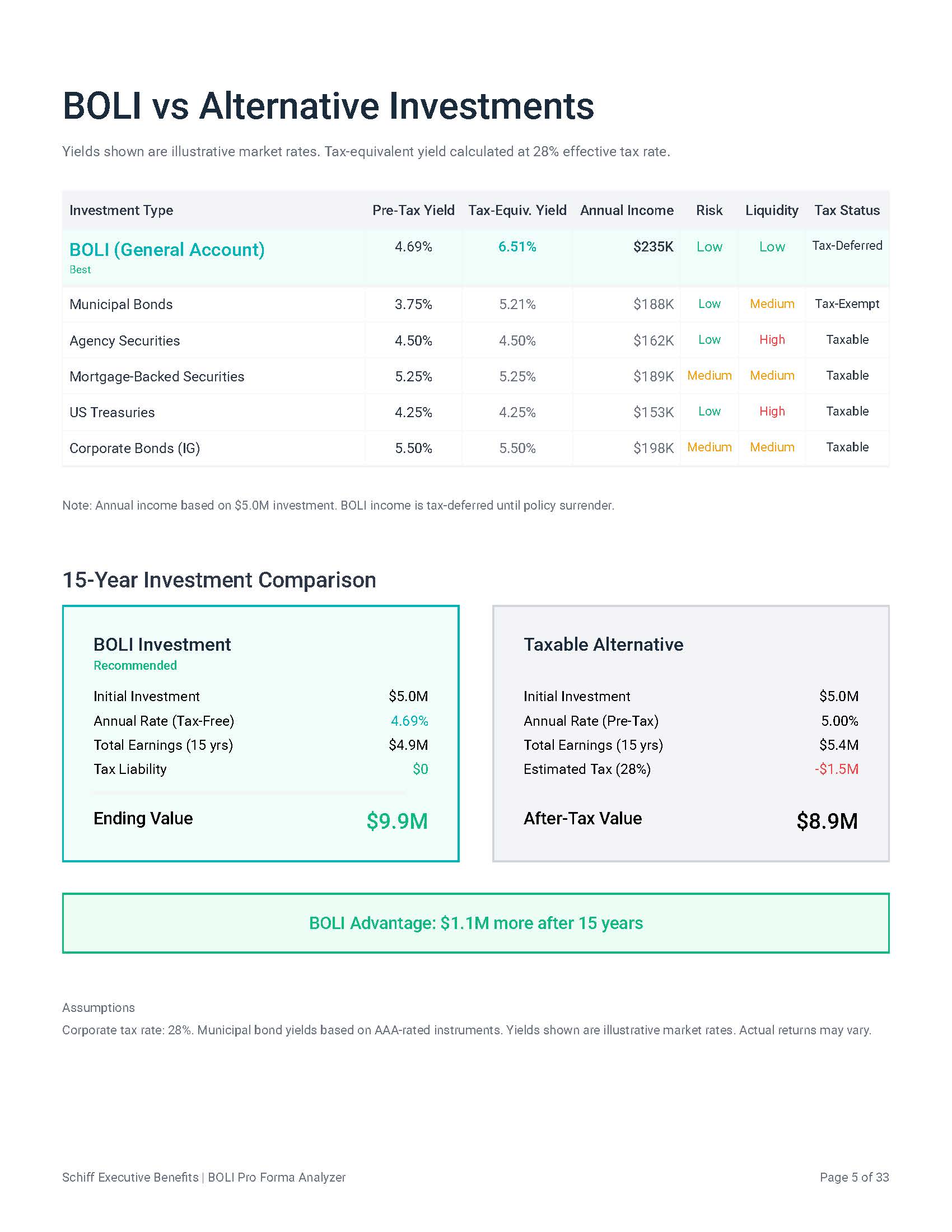
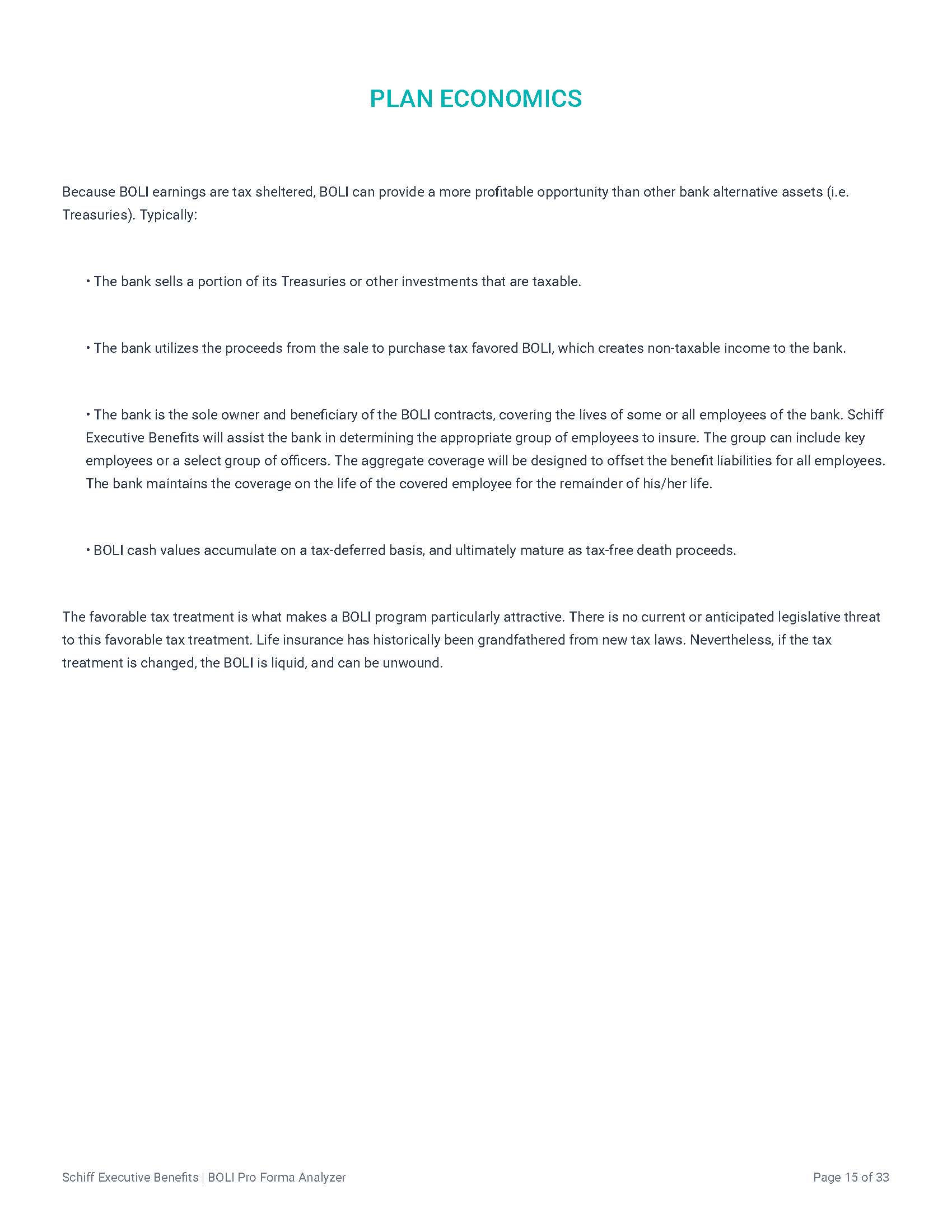
Does this sound too good to be true? It isn't. Large corporations and banks have been using these strategies for decades: often referred to as Bank-Owned Life Insurance (BOLI) or Corporate-Owned Life Insurance (COLI). The secret is simply scaling these institutional strategies down to the private business level.


Strategy 1: The Executive "Bonus" That Actually Works


Most bonuses are a tax nightmare. You pay the employee (or yourself) $100,000; the business loses $100,000 in cash, and the individual receives about $60,000 after taxes. That’s a 40% loss of friction right out of the gate.


Using an Executive Bonus Plan (Section 162), we can restructure this. The business pays the premium on a high-cash-value life insurance policy owned by the executive. The premium is deductible to the business and taxable to the executive, but we can "double bonus" the tax amount so the executive has zero out-of-pocket cost. Inside that policy, the money grows tax-deferred. When it’s time to retire, the executive can take loans against the policy: which are generally tax-free: to fund their lifestyle.


You’ve essentially used corporate dollars to create a private "bank" for yourself, bypass the 401(k) limits, and secure a tax-free income stream.


Strategy 2: Split-Dollar Arrangements


For the owner looking to move significant wealth out of the company without an immediate tax hit, "Split-Dollar" arrangements are the gold standard. In this scenario, the company and the executive "split" the costs and benefits of a permanent life insurance policy.


The company pays the premiums, which are treated as a series of loans to the executive (at very low IRS-mandated interest rates). Because it’s a loan, there’s no immediate income tax for the executive. The cash value inside the policy grows, often far exceeding the interest on the loan. At death or at a pre-determined rollout point, the company is paid back its premiums, and the executive (or their heirs) keeps the remaining millions: often entirely tax-free.


A golden tree in an executive office symbolizing tax-efficient personal wealth building and tax-free growth.


The Power of Tax-Free Growth and Distribution


Think about your current portfolio. If you have $5 million in a traditional IRA, you don't actually have $5 million. You have $3 million, and the IRS has a $2 million lien on your account. Every time the market goes up, the IRS’s share grows. Every time tax rates go up, your share shrinks.


When you build wealth using the corporate dollar strategies we advocate for, you are removing the IRS as a partner in your future. You are locking in a 0% tax rate on those distributions. This provides a level of certainty that no traditional stock-and-bond portfolio can match.


As Matthew Schiff often says on The Perfect Plan® Podcast, "The greatest risk to your retirement isn't market volatility; it's the uncertainty of future tax legislation." By using corporate dollars now to fund tax-advantaged vehicles, you are essentially "tax-morphing" your wealth: changing it from a taxable liability into a private, protected asset.


Why Retention and Wealth Building Go Hand-in-Hand


While you are building your own wealth, these same plans serve as the ultimate "Golden Handcuffs" for your key employees. In today’s competitive talent market, a simple 401(k) match isn't enough to keep a CFO or a VP of Sales from being recruited away.


By offering a Deferred Compensation or a tax-efficient executive benefit plan, you are providing them something they cannot get anywhere else: a path to tax-free wealth. If they leave, they leave the benefit behind. If they stay, they retire wealthy. It’s a win-win that uses the company’s cash flow to solve two problems at once: tax efficiency for you and retention for the business.


perfect-plan-podcast-banner.webp


The Point of No Return: Why Now?


We are currently living in a unique economic window. Tax rates are historically low, but the clock is ticking on the expiration of the Tax Cuts and Jobs Act (TCJA). Furthermore, as the national debt continues to climb, the pressure to raise revenue through higher income and estate taxes is mounting.


Waiting until you are ready to exit the business to think about tax efficiency is a mistake. The best time to start moving corporate dollars into personal, tax-efficient buckets was ten years ago. The second best time is today.


Are you currently maximizing every dollar your business generates? Or are you leaving a "tip" for the IRS every year because your benefit plan is stuck in the 1990s?


Take the Next Step Toward Your Perfect Plan®


Building wealth tax-efficiently requires more than just a good accountant; it requires a specialized architect who understands the intersection of corporate tax law, executive compensation, and insurance design.


At Schiff Executive Benefits, we don't just sell plans; we design outcomes. We help you look at your business not just as a source of current income, but as a powerful engine for personal wealth accumulation.


executive-confidence-blue-suit.webp


If you’re ready to stop overpaying the IRS and start using your corporate dollars to secure your personal legacy, let’s have a conversation. It’s time to move beyond the limitations of standard retirement planning and start building your Perfect Plan®.


Schedule a consultation with Matt Schiff today via our Calendly link here.


Sit back, grab a coffee, and let’s look at the math together. You’ve done the hard work of building the business: now let’s make sure you get to keep what you’ve earned.


Learn more: See how a Section 162 Executive Bonus Plan turns corporate dollars into personal wealth.


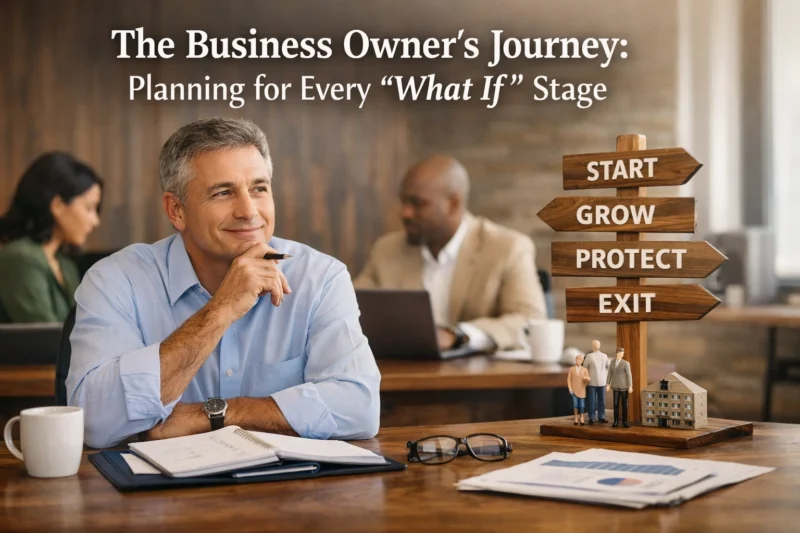
They say the only constant in life is change, but for a business owner, the only constant is the "What If."


In the early days, the "What If" is usually about survival: What if we don't get this client? What if the payroll check bounces? But as you move through the stages of the business lifecycle, those questions don't disappear: they just get more expensive. They shift from tactical anxieties to legacy-defining concerns.


At Schiff Executive Benefits, we spend a lot of time talking about "Restoring Alignment and Retention." But before we can align your benefits or retain your people, we have to look at the roadmap of your journey as an owner. Most advisors want to sell you a product to fix a specific symptom. We prefer to reverse-engineer your entire trajectory. We start at the finish line: where you want your family to be, how much income you want in retirement, and who should be running the shop — and then we build the bridge to get you there.


The Evolution of the "What If"


Every business follows a predictable path: Inception, Growth, Maturity, and eventually, Exit. The mistake most owners make is using a "Stage 1" plan to solve a "Stage 3" problem.


Think about your time allocation. When you started, you were probably 90% "doer" and 10% "leader." As you scale, that ratio has to flip. If it doesn't, you become the bottleneck. The same logic applies to your financial planning. A simple life insurance policy might have covered your debt in the startup phase, but does it solve the problem of a $20 million buy-sell triggered by an unexpected disability in the growth phase?


Probably not.


Stage 1: The Foundation and the First Big Question


In the beginning, it’s all about the "What if I die too soon?" stage. Your family is likely your primary concern. If you aren't there to drive the engine, the engine stops.


At this stage, we focus on 100% protection for the family. This isn't just about a death benefit; it's about liquidity. It's about ensuring that your spouse isn't forced to become an accidental business partner with your co-founder. We look at the first of our core five "What Ifs": What happens if your partner ends up in business with your widow?


Executive Retirement Planning Stages
(Technical visual: A flowchart mapping the flow of assets in a sudden succession event versus a structured buy-sell agreement, styled with clean, IRS-technical lines.)


Stage 2: The Scaling Phase and the Talent War


Once the business finds its footing and starts to scale, the "What Ifs" shift toward your people. You’ve hired "Rockstars." They are the reason you can finally take a vacation. But that creates a new anxiety: What if my top talent leaves?


This is where specialized executive benefits come into play. Standard 401(k) plans are great for the rank-and-file, but they are often "reverse-discriminatory" toward your highest earners due to IRS contribution limits. If your key execs can't save enough for their own retirement, they are going to look for a platform that allows them to do so.


We use strategies like Corporate Owned Life Insurance (COLI) to fund nonqualified deferred compensation plans. This allows you to offer "Golden Handcuffs": incentives that make it mathematically painful for a competitor to poach your best people. By using COLI, the business can recover the cost of these benefits, essentially creating a self-funding retention machine.


Executive Retirement Planning Stages


Reverse-Engineering Your "Perfect Plan"


Most financial planning is reactive. You have a windfall, so you look for a tax shelter. You have a heart scare, so you look for insurance. We believe in a proactive, goal-oriented approach we call The Perfect Plan®.


The philosophy of The Perfect Plan® is simple: Start with the end in mind.


When we sit down with a business owner, we ask: "In your ideal world, what does 100% income in retirement look like?" Most owners are surprised to find that their current trajectory only covers 40% or 50% of their current lifestyle once they exit. We identify that gap and then reverse-engineer a solution to fill it using the most tax-efficient vehicles allowed by the IRS.


Addressing the 5 Core "What Ifs"


To build a truly resilient business, you have to have a documented answer for these five questions:


  1. Business with a Widow: If you passed away tomorrow, would your spouse have the liquid cash to live, or would they have a pile of illiquid stock in a company they can't run?

  2. Business Buy-Out: Is your buy-sell agreement funded? A legal document without a funding mechanism (like COLI or disability buy-out insurance) is just a piece of paper that guarantees a lawsuit.

  3. Top Talent Leaving: If your #2 person left for your biggest competitor on Monday, what would it cost you in lost revenue and replacement time?

  4. Senior Exec Retirement: Are you prepared for the cost of replacing your aging leadership team? How do you transition them out with dignity while keeping the business's balance sheet healthy?

  5. Running Out of Money: This is the ultimate fear. After 30 years of building a legacy, will you have to downgrade your lifestyle because of taxes, inflation, or poor planning?


Executive Retirement Planning Stages
(Technical visual: A bar chart comparing "Traditional Retirement Savings" vs. "The Perfect Plan® Approach," showing 100% income replacement levels and the impact of tax-deferred growth.)


The Technical Edge: Why COLI Matters


For corporations and partnerships, Corporate Owned Life Insurance (COLI) is often the "Swiss Army Knife" of the balance sheet. It isn't just about a death benefit; it's an institutional asset.


COLI allows a company to:


  • Offset the liabilities of executive retirement plans.

  • Accumulate cash value on a tax-deferred basis.

  • Receive tax-free death benefits to help transition the business or buy out a partner's interest.


When you look at the technical pro-formas of these plans, the math becomes undeniable. It’s about moving money from a taxable "bucket" on your balance sheet to a tax-advantaged "bucket" that performs a specific job: protecting the business while growing an asset that can eventually fund your own exit.


Executive Retirement Planning Stages


Transitioning to the Exit


The final stage of the journey is the exit. Whether you are passing the business to your children, selling to an ESOP, or looking for a third-party buyer, your "What Ifs" are now about the "Point of No Return."


Have you maximized the value of the business? Is the culture stable enough to survive your departure? (Hint: The "Top Talent" retention strategies we mentioned in Stage 2 are what make your business attractive to a buyer in Stage 3).


We help owners realize their "dream value" by ensuring the business isn't just a job they created for themselves, but a self-sustaining entity. By addressing the "What Ifs" early, you aren't just buying insurance; you are building a fortified legacy.


You’ve Built the Business. Now, Secure the Life.


You’ve spent years, maybe decades, navigating the unstable waters of entrepreneurship. You’ve survived the market crashes, the hiring headaches, and the late-night "What Ifs." You deserve a plan that is as robust as the company you built.


Our job at Schiff Executive Benefits is to be your guide through these technical and often overwhelming financial environments. We don’t just want to talk about products; we want to talk about your mission. We want to help you realize that 100% protection for your family and 100% income in retirement isn't a pipe dream: it’s a matter of engineering.


If you’re wondering where your business stands in this lifecycle, or if one of those five "What Ifs" is currently keeping you up at 2:00 AM, let’s talk.


Sit back, grab your coffee, and let’s look at the roadmap together. Come join us at Schiff Executive Benefits to see how we can start reverse-engineering your version of The Perfect Plan®.


You can learn more about our process on The Perfect Plan® Podcast or reach out to us directly through our contact page.


Let’s turn those "What Ifs" into "I’m Covered."


A business partnership is a lot like a marriage, but with more paperwork and significantly higher financial stakes. You spend more time with your partners than your family. you build a legacy together, and you trust each other with your professional lives. But there is a universal truth that every business owner eventually has to face: every partnership will end.


The question isn’t if it will end, but how. Will it end with a smooth transition and a handshake, or will it end in a tax-fueled legal nightmare that leaves your family — and your partner’s family: scrambling for liquidity?


Most business owners have a Buy/Sell agreement tucked away in a dusty drawer. They signed it years ago, checked the box, and moved on. But the world has changed. Tax laws have shifted. Court cases have redefined how the IRS looks at your business value. If your agreement hasn’t been touched in three years, it’s not just outdated: it’s a ticking time bomb.


The Problem: When Protection Becomes a Tax Trap


For decades, the standard play was the "Entity Purchase" or "Redemption" agreement. The business owns a life insurance policy on each owner. If an owner passes away, the business gets the cash and uses it to buy back the shares from the deceased owner's estate. Simple, right?


Not anymore.


A recent, massive shift in the tax landscape: specifically the Connelly v. United States decision: has turned this "simple" strategy into a potential catastrophe. The Supreme Court essentially ruled that if the company receives life insurance proceeds to fund a buyout, those proceeds can be included in the company’s total valuation for estate tax purposes.


Imagine this: Your business is worth $10 million. You have a $5 million life insurance policy to buy out your partner. If you pass away, the IRS could argue the business is now worth $15 million because of that insurance cash. Your estate is taxed on a $7.5 million valuation (your half), but your family only receives the $5 million you originally agreed upon.


You’re paying taxes on money your family never sees. Does that sound like "protection" to you?


100% Protection for the Families Who Built the Business


When we talk about Buy/Sell agreements at Schiff Executive Benefits, we focus on the human element. Your spouse and your children shouldn't have to become "accidental business partners" with your co-founder. Likewise, your surviving partner shouldn't have to report to your heirs who might not know the difference between a P&L and a balance sheet.


The goal is 100% Protection.


This means the family of the deceased receives the full, fair market value of the business interest immediately, in cash, with zero tax friction. It also means the surviving owner gets 100% control of the company without taking on massive debt or draining the corporate coffers.


Financial Blueprint Analysis


The Solution: Modernizing via the Cross-Purchase Strategy


To avoid the "Connelly Trap," many savvy owners are moving toward a Cross-Purchase or a Trusteed Cross-Purchase structure.


In a traditional cross-purchase, the owners own policies on each other. Because the business doesn't own the money, it doesn't inflate the business's value in the eyes of the IRS. But the real magic happens with something called the "step-up in basis."


When you use insurance proceeds to buy your partner’s shares personally, your tax basis in the company increases. If you ever decide to sell the business later, that "step-up" could save you millions in capital gains taxes. It is the definition of tax efficiency.


However, if you have three or four partners, owning individual policies on everyone gets messy. That’s where we modernize. We often implement an LLC Insurance Ownership structure. You create a separate entity (taxed as a partnership) specifically to hold the life insurance. It provides the creditor protection of a corporation, the tax benefits of a cross-purchase, and the administrative ease of a single plan.


Golden tree inside a secure glass case representing protected business growth and executive legacy planning.


Is Your Agreement Part of The Perfect Plan®?


At Schiff Executive Benefits, we don't look at insurance in a vacuum. We look at how it fits into your broader financial legacy: what we call The Perfect Plan®.


A modern Buy/Sell agreement isn't just a legal document; it’s a wealth-transfer vehicle. It’s part of a strategy that uses corporate dollars tax-efficiently to build personal security.


Ask yourself these three questions:


  1. How is the value determined? If your agreement uses a "fixed price" from five years ago, you are either overpaying or cheating a family out of their legacy.

  2. Where does the tax go? If your plan triggers a massive estate tax bill or a capital gains nightmare, it’s a failure.

  3. Is it funded? A legal obligation to buy shares is worthless if the company doesn't have the liquidity to write the check.


If you can’t answer these with 100% certainty, you are leaving your business and your family's future to chance.


The ROI of Getting it Right


We often hear owners say, "I'll get to it next year." But the cost of waiting is higher than you think. A well-structured, modern agreement doesn't just protect you upon death; it sets the stage for a healthy exit, a smooth retirement transition, and even better terms with lenders who want to see a solid succession plan.


Think of it as the ultimate insurance for your life's work. You’ve spent decades building this company. You’ve survived market crashes, hiring woes, and global shifts. Why let a preventable tax headache dismantle it all at the finish line?


Executive Expertise in Action


Stop Worrying and Start Planning


You shouldn't have to stay up at night wondering if your partner’s spouse will end up sitting in your boardroom or if the IRS will take a 40% bite out of your family’s inheritance.


Modernizing your Buy/Sell agreement is about more than just "insurance." It’s about clarity. It’s about ensuring that the value you’ve built stays where it belongs: with the people who built it and the families who supported them.


We help business owners navigate these complexities every day. We coordinate with your legal team and your CPA to ensure the math, the law, and the logic all point in the same direction: your success.


Let’s get your plan off the "to-do" list and into the "done" column.


Grab a coffee, take a breath, and let’s look at the numbers together. You can visit our website to learn more about our approach or schedule a quick discovery call via my Calendly to see if your current agreement is helping you or hurting you.


Your legacy is too important to leave to an outdated contract. Let's make sure it's protected: 100%.


Perfect Plan Podcast Banner


Learn more: planning your business succession.



In this episode of the Perfect Plan™ podcast, Matt welcomes welcome Holland Haiis as our special guest! Holland is a renowned workplace strategist, speaker, and author who helps individuals and organizations boost productivity, improve communication, and unlock human potential. Known as the "Digital Detox Coach," Holland empowers people to thrive by balancing the digital demands of today's world with intentional human connection. In this episode, Holland and Matt dive deep into creating a Perfect Plan™ for leadership, communication, and living a more connected life — both online and offline. Trust me, this conversation is packed with insights you can apply right away!

Learn More About Holland: https://www.hollandhaiis.com/

If you are a business owner or decision making executive, how would you want to design The Perfect Plan™ to retain and reward your employees? A 401K is terrific for basic retirement savings, but there are limitations to how much you can put in, and it must be given to everyone on a proportional basis.

In this episode, we discuss the decision making process, how you can get the perfect timing of your deductions, and include the people and benefits that are needed most, in the most tax efficient manner.  No two companies are alike, and neither should your plans be.

Come and listen to this podcast as we lay it out for you.