


It is often said that the heaviest thing a person can carry is the weight of an empty chair: the chair that holds the final decision, the ultimate responsibility, and the vision for an entire organization’s future. When you first step into the role of a business owner or a key executive, that chair feels like a throne. But as the months turn into years, you realize it’s actually an anchor.
You’ve built something. You’ve reached the summit. But now that you’re here, the view isn’t just about the scenery; it’s about the horizon and the storms you see brewing in the distance.
At Schiff Executive Benefits, we call this the "Peace of Mind Tax." It isn’t a line item on your P&L, and you won’t find it in your tax returns, but it’s the most expensive tax you pay. It’s the mental and emotional energy drained by the nagging "What Ifs" that keep you up at 2:00 AM. It’s the cost of uncertainty.
But what if you could stop paying that tax? What if you could turn those anxieties into your most powerful assets?
The Weight of the Chair: Understanding the Hidden Cost
Success brings a specific type of isolation. As an owner, your family’s security, your employees' livelihoods, and your professional legacy all rest on your shoulders. You aren’t just managing a business; you’re managing a ecosystem of dependencies.
Most new owners spend their first few years focused on growth, revenue, and market share. This is natural. However, there is a silent transition that occurs where the fear of losing what you’ve built starts to outweigh the excitement of growing it. This is where the Peace of Mind Tax begins to accrue.
You start wondering:
- "What happens to my family if I’m not here tomorrow?"
- "Can I really afford to lose my top VP to a competitor?"
- "Am I doing enough to ensure I don’t outlive my money?"
These aren't just financial questions; they are emotional burdens. When you lead from a place of anxiety, your decisions become reactive rather than strategic. Restoring Alignment and Retention begins with securing the foundation so you can lead with a clear head.

The Five "What Ifs" That Keep You Awake
In our decades of experience, we’ve found that almost every executive anxiety boils down to five core questions. These are the thematic anchors of The Perfect Plan®. If you can answer these, the Peace of Mind Tax disappears.
- The Widow/Widower Scenario: Would your spouse end up in business with your partners? Without a properly funded buy-sell agreement, your family might inherit a job they don’t want instead of the liquidity they need.
- The Buy-Out: If a partner wants out, or if you do, is there a clear, funded path that doesn’t cripple the company’s cash flow?
- The Talent Drain: What if your "right hand" leaves for a 20% raise at a competitor? Have you created enough "golden handcuffs" to make staying the only logical choice?
- The Replacement Cost: When a senior executive retires, do you have the funds to recruit their successor without raiding your operating budget?
- The Finish Line: Are you going to run out of money in retirement, or have you built a "Fixed Dollar, Fixed Period" cash flow that you can count on?
At Schiff Executive Benefits, we don't start with products. We start with these questions. We reverse engineer solutions based on your specific culture and intent.
From Anxiety to Asset: The Strategy of Security
The shift from "anxious owner" to "secure leader" happens when you realize that the tools used to mitigate risk are the same tools used to drive growth.
For example, Corporate Owned Life Insurance (COLI) is often viewed through the lens of death benefits: a "just in case" measure. But when structured correctly within The Perfect Plan®, it becomes a powerful balance sheet asset. It can fund executive benefits, provide informal funding for Deferred Compensation (NQDC), and offer a level of cost recovery that traditional investments simply can’t match.
Similarly, a Phantom Stock Plan isn't just a way to keep employees from leaving; it’s a way to give them an "ownership feel" without actually diluting your equity. It aligns their interests with yours, turning a potential "talent drain" anxiety into a collective drive for company value.
When you implement these strategies, you aren't just "buying insurance" or "setting up a plan." You are building a fortress around your vision.

The Consultation vs. The Pitch
One of the biggest contributors to the Peace of Mind Tax is the "Sales Pitch." You’ve likely been approached by dozens of brokers wanting to sell you a product. That’s not what you need. You need a guide who understands the technical landscape of IRC 409A and IRC 101(j) but speaks the language of your goals.
Matt Schiff brings a unique perspective to these discussions—having helped draft the IRC 409A and 101(j) regulations alongside Dan Hogans of the IRS Treasury. This level of "insider" knowledge ensures that your plan isn't just compliant, but optimized at the highest level.
We work as an integrated part of your team, alongside your Accountant, Attorney, and TPA. Our goal isn't to replace your advisors; it's to provide the specialized expertise in executive benefits that ensures your total plan is cohesive.
Whether you are looking for a 401k Mirror to allow your top earners to save more, or a complex Split Dollar Program, the objective is always the same: clarity. Clarity is the only known cure for the Peace of Mind Tax.
Realizing Your Dream Value
You didn’t start this business to be a slave to uncertainty. You started it to build something that reflects your values and provides for your future. Building it "your way" means ensuring that the "What Ifs" are replaced by "When and How."
Imagine walking into your office on Monday morning knowing that if you decided to retire tomorrow, the plan is already in place. Knowing that your top three executives are so well-compensated and protected that they wouldn't dream of leaving. Knowing that your family is 100% protected, no matter what happens to you.
That’s not a dream; it’s a design.

Your Invitation to a Quieter Mind
If you’ve felt the weight of that chair lately: if the Peace of Mind Tax is taking too much of your focus: it’s time to have a different kind of conversation. We don't do high-pressure sales. We do "What If" scenarios.
We invite you to sit back, grab your coffee, and join us for a 15-minute discovery call. We’ll look at your current structure, listen to your goals, and see if there’s a way to turn your anxieties into assets.
You’ve done the hard work of building the business. Let us do the technical work of protecting it.
Schedule your 15-minute Initial Meeting with Matt Schiff here.
Come join us and start building The Perfect Plan®.

The best time to plant a tree was twenty years ago; the second best time is today.
When you first stepped into the role of a business owner, you likely felt a surge of adrenaline, pride, and perhaps a touch of vertigo. It is the culmination of years of late nights, calculated risks, and the relentless pursuit of a vision. But once the initial celebration fades, a new sensation often takes its place: the weight of the chair.
Suddenly, you aren't just responsible for your own output; you are responsible for the livelihoods of your team, the security of your family, and the continued existence of the entity you’ve worked so hard to build. You are no longer just building a business; you are building a legacy. The question is, are you building it on a foundation of granite or a foundation of sand?
At Schiff Executive Benefits, we specialize in Restoring Alignment and Retention. We understand that for a new owner, the technical jargon of the financial world: terms like IRC 409A compliance or Non-Qualified Deferred Compensation (NQDC): can feel like a secondary concern. Our expertise in these areas isn't accidental—Matt Schiff was one of the few industry leaders who actually helped draft the IRC 409A and 101(j) regulations with Dan Hogans of the IRS Treasury. You can even listen to their conversation on the history of deferred compensation on our YouTube channel. However, these are the tools we use to answer the questions that keep you up at 2:00 AM.
The Five "What Ifs" That Define Your Future
Every business owner, whether they have been in the seat for six days or six decades, eventually has to face five fundamental questions. We call these the "What Ifs." They aren't just financial hurdles; they are emotional anchors that determine the stability of your professional legacy.
- What if you had to go into business with a widow? If something happens to you tomorrow, does your spouse have the technical expertise to run the company? If not, do they have a guaranteed, fair way to exit the business with the value you created?
- What if there is a business buy-out? Do you have a pre-funded, legally binding agreement that ensures a smooth transition of ownership without bankrupting the company or leaving your family in the lurch?
- What if your top talent leaves? Your key executives are the engine of your growth. If they walked across the street to a competitor tomorrow, what would that cost you in lost institutional knowledge and client relationships?
- What if a senior executive retires? Do you have a plan to replace them that is cost-efficient, or will the "replacement cost" eat into your margins for years to come?
- What if you run out of retirement money? You’ve spent your life building an asset. How do you ensure that asset provides you with 100% income when you need it most, without being subject to the whims of the market?

Ownership Feel to Non-Owners
One of the most significant challenges for a new owner is creating a culture where your key people care about the business as much as you do. You want them to have an "ownership feel" without necessarily giving away the actual equity of your company.
This is where sophisticated tools like Phantom Stock Plans or Employee Stock Ownership Plans (ESOP) come into play. By "reverse engineering" a plan based on your specific culture and intent, we can create a benefit structure that rewards your best people for the long-term growth of the company.
Are you currently offering a benefits package that merely competes, or one that truly binds your talent to your vision? When you provide 100% protection to employee families and a clear path to 100% income in retirement, you aren't just offering a job; you’re offering a future. That is how you win the war for talent.
The Perfect Plan®: A Guided Approach
We don’t believe in "off-the-shelf" solutions. Every business is a unique ecosystem with its own history, goals, and advisors. Our role is to act as your guide, working alongside your existing Accountant, Attorney, and TPA to ensure that every piece of the puzzle fits perfectly.
We invite you to explore The Perfect Plan®, our dedicated platform where we break down these complex strategies into digestible, executive-level insights. Whether we are discussing Corporate Owned Life Insurance (COLI) or the intricacies of Split Dollar programs, our goal is always the same: clarity.

Security is Not a Luxury; It Is a Strategy
In an unstable economic environment, security is the ultimate competitive advantage. Many owners view executive benefits as an "expense" to be managed. We view them as a "recovery" to be realized. Through goal-oriented reverse engineering, we design plans that emphasize full cost recovery for the employer.
Imagine a world where you can provide world-class benefits to your key people, protect your family’s succession, and ensure your own retirement: all while the company eventually recovers the cost of the premiums. That isn't a dream; it’s a standard operating procedure for our clients.
What keeps you up at night? Is it the fear of losing your "Right Hand" person? Is it the uncertainty of what happens to the business if you aren't there to lead it? These anxieties are common, but they don't have to be permanent.
Realizing Your Dream Value
Before you can protect your legacy, you need to know exactly what it’s worth. Most owners have a "gut feeling" about the value of their business, but a gut feeling won't hold up in a buy-sell agreement or an estate plan.
To help you get started, we provide access to the RISR business valuation tool. It is a simple, data-driven way to capture the current reality of your business value so we can begin planning for its future.

Sit Back, Grab Your Coffee
You didn't become a business owner to spend your days worrying about IRC 101(j) compliance or the nuances of restricted executive bonuses. You became an owner to create, to lead, and to leave a mark on the world.
Our mission at Schiff Executive Benefits is to handle the technical "What Ifs" so you can focus on the "What’s Next." We have almost 100 years of combined experience in navigating the technical legacy of corporate environments. We’ve seen the mistakes people make when they wait too long, and we’ve seen the peace of mind that comes from a plan well-executed.
Your legacy is being built every single day, whether you are consciously planning it or not. Every decision you make: and every decision you delay: is a brick in that foundation.
Are you ready to stop reacting to the "What Ifs" and start designing your Perfect Plan®?
We invite you to come join us. Let’s sit down for a low-pressure conversation about where you are and where you want to go. No sales pitches, just a direct, consultative dialogue about your professional legacy.
Schedule your initial 15-minute meeting here.
Let's take the weight off that chair, together.
For more insights on executive retention and business protection, visit our full posts feed.

Last reviewed: September 2026 | Written by Matthew E. Schiff, CLU, ChFC, WMCP — President, Schiff Executive Benefits
If you run a closely held company, you have almost certainly had this thought: my best people act like owners, so should I make them owners? And then, about four seconds later, the second thought: what happens to my company if I do?
A phantom stock plan is the answer to both questions at once. It gives your key people the economics of ownership without putting a single share on the cap table. This guide covers what phantom stock is, how it works, what it costs, how it is taxed, where IRC 409A can wreck it, and how to decide whether it belongs in your business.
What this guide covers
- What is a phantom stock plan?
- How a phantom stock plan works, step by step
- The two types: full value vs. appreciation only
- A worked example with real numbers
- How phantom shares are valued
- Phantom stock vs. real equity, options, and SARs
- How phantom stock is taxed
- IRC 409A: the rule that breaks most plans
- The funding problem and how to solve it
- Phantom stock for small and mid-sized companies
- Advantages and disadvantages
- Is phantom stock right for your company?
- Who designs phantom stock plans?
- Frequently asked questions
What is a phantom stock plan?
A phantom stock plan is a written agreement in which a company promises to pay a key employee a future cash amount tied to the value of company stock, without actually issuing any stock. The employee receives "phantom" units that track real share value. When a triggering event occurs — vesting, a set date, retirement, or a sale of the business — the company pays out in cash. The employee never becomes a shareholder and never receives voting rights, and the owner's equity is never diluted.
Because nothing is actually transferred, phantom stock is not equity at all in the legal sense. It is a form of nonqualified deferred compensation — a contractual obligation of the company that happens to be measured by share value instead of a flat dollar amount.
You will also see it called phantom equity, shadow stock, synthetic equity, or a phantom share plan. In an LLC, the same structure is usually called a phantom unit plan, because LLCs have units rather than shares. The mechanics are identical.
Why owners choose it
Real equity brings four things an owner may not want to hand over: voting rights, information rights, a claim on distributions, and a minority shareholder who can be very difficult to remove. Phantom stock delivers the one thing the key employee actually wants — economic upside tied to the growth they helped create — and none of the four things the owner does not want to give.

How a phantom stock plan works, step by step
Every phantom stock plan, regardless of size, is built from the same seven decisions.
1. The company adopts a written plan document
The plan document defines eligibility, the unit pool, valuation method, vesting, payment triggers, forfeiture, and what happens on death, disability, termination for cause, and a change of control. This is a legal document. It is drafted by counsel, not downloaded.
2. Key employees receive phantom units
Each participant gets an award agreement granting a specific number of units, with a stated baseline value on the grant date. Units are typically expressed either as a raw number of shares or as a percentage of company value.
3. Units vest over time or on performance
Vesting is what turns a bonus into a retention tool. Cliff vesting (nothing for five years, then 100%) creates the strongest handcuffs. Graded vesting (20% a year for five years) is gentler and easier to explain. Performance vesting ties units to EBITDA, revenue, or another metric the executive can actually move.
4. The company is valued on a defined schedule
Usually annually. The valuation method must be written into the plan before anyone has a stake in the answer.
5. A triggering event occurs
Common triggers: a fixed date, separation from service, retirement, death, disability, or a change of control. The trigger must be specified at the outset — this is where 409A compliance is won or lost.
6. The company pays cash
Payment is usually a lump sum or an installment stream over three to five years. Installments soften the cash flow hit and can extend the retention effect past the payout date.
7. The company takes a deduction
The employer generally receives a compensation deduction in the year the payment is included in the employee's income, and the employee reports it as ordinary W-2 wages.
The two types of phantom stock plans
| Full Value Plan | Appreciation-Only Plan (SAR-style) | |
|---|---|---|
| What the employee receives | The entire value of each phantom unit at payout | Only the increase in value from the grant date |
| Payout if company value is flat | Full baseline value is still paid | Zero |
| Feels most like | Restricted stock | A stock option |
| Best for | Long-tenured executives; retention and retirement-style benefits | Growth-stage companies; rewarding value creation specifically |
| Company cost | Higher and more predictable | Lower, but entirely dependent on growth |
| Risk to the owner | Liability accrues even in a flat year | Executive gets nothing in a flat year, which can hurt morale |
Most closely held companies we work with land on appreciation-only, or a blend: a modest full-value tranche for stability plus an appreciation tranche for upside. The blend gives the executive a reason to stay and a reason to perform, which are not the same motivation.
A phantom stock example with real numbers
A manufacturing company is valued at $20 million. The owner wants to retain a VP of Operations who is genuinely hard to replace.
- Grant: 200 phantom units, where each unit tracks 0.01% of company value. At grant, each unit is worth $2,000 — so the award has a baseline value of $400,000.
- Type: Appreciation only.
- Vesting: Five-year cliff.
- Trigger: The later of vesting or separation from service.
Five years later the company is valued at $32 million. Each unit is now worth $3,200. The appreciation is $1,200 per unit.
Payout: 200 units × $1,200 = $240,000, paid in cash, taxed to the VP as ordinary income, and generally deductible by the company in the year paid.
Read that from the owner's side. The company grew $12 million in value. The executive who helped drive that growth captured $240,000 of it — 2% of the increase. The owner kept 100% of the stock, 100% of the votes, and 98% of the appreciation, and paid the benefit out of the growth itself rather than out of the original enterprise value.
Now read the flat scenario. If the company is still worth $20 million in year five, the appreciation-only payout is zero. That is the design working as intended — but it is also exactly why plan design matters more than the plan document. A key executive who receives nothing after five years of loyalty may leave the day the number is announced.
How phantom shares are valued
Valuation is where do-it-yourself plans fall apart. The plan document must specify the method before anyone has an incentive to argue about it. The usual options:
- Independent appraisal. Most defensible, most expensive. Common where amounts are large or the ownership group is not unanimous.
- Formula valuation. A stated multiple of EBITDA, revenue, or book value, applied consistently. Cheap and predictable, but a formula that fit the company at $8 million in revenue may be badly wrong at $40 million.
- Board determination. Fastest and least defensible. Invites disputes, and creates real 409A exposure if the method is not reasonable and consistently applied.
- Ongoing valuation platform. A monitored valuation updated continuously rather than once a year.
At Schiff Executive Benefits we use RISR for this. The reason is practical rather than technical: an owner who sees company value tracked continuously makes better decisions about plan sizing, funding, and timing than an owner who finds out once a year in a PDF.
Phantom stock vs. real equity, stock options, and SARs
| Phantom Stock | Real Equity | Stock Options | SARs | |
|---|---|---|---|---|
| Dilutes ownership | No | Yes | Yes, on exercise | No |
| Voting rights | None | Yes | After exercise | None |
| Employee out-of-pocket cost | None | Often purchase price | Exercise price | None |
| Employee tax treatment | Ordinary income at payout | Potential capital gains | Varies (ISO vs. NSO) | Ordinary income at payout |
| Employer deduction | Yes, when paid | Limited | Varies | Yes, when paid |
| Requires company cash at payout | Yes | No | No (company receives cash) | Yes |
| 409A applies | Generally yes | No | Sometimes | Generally yes |
| Reversible / adjustable | Yes, by design | Very difficult | Difficult | Yes |
The honest trade-off: real equity offers the employee better tax treatment, and phantom stock offers the owner better control and reversibility. If your key executive's primary goal is capital gains treatment on a future sale, phantom stock will not deliver that and you should say so plainly rather than sell around it.
We go deeper on this comparison in Phantom Stock vs. Stock Options vs. Real Equity: A Business Owner's Decision Guide.
How is phantom stock taxed?
For the employee
Phantom stock payouts are generally taxable as ordinary W-2 income in the year received, subject to income tax withholding. There is no capital gains treatment, because no capital asset was ever held. FICA treatment follows the special timing rule for nonqualified deferred compensation: amounts are generally taken into account for FICA in the later of the year services are performed or the year the amount vests, which can be earlier than the year of payment.
For the employer
The company generally receives a compensation deduction matching the year the employee includes the amount in income. Note that this is a deduction against ordinary income, taken when the cash actually goes out the door — which is a very different thing from the accrual the company has been carrying on its books in the years leading up to it.
For the accountants
Phantom stock is liability-classified for book purposes and is generally re-measured each reporting period. Rising company value produces a rising compensation expense that hits the P&L before any cash moves. Owners are routinely surprised by this. Tell your CFO before you adopt the plan, not after.
The pass-through question
S corporations, partnerships, and LLCs can all use phantom stock, and for many of them it is a better answer than real equity precisely because adding an owner to a pass-through entity creates K-1 complications, distribution obligations, and eligibility risks that a cash-settled plan simply avoids.
IRC 409A: the rule that breaks most phantom stock plans
A phantom stock plan is nonqualified deferred compensation, which means Internal Revenue Code Section 409A generally applies. This is not a footnote. It is the single most common failure point in plans we are asked to repair.
409A governs when deferred amounts may be paid. Payment events must be specified in writing before the compensation is earned, and must fall within a permitted category — a fixed schedule, separation from service, death, disability, an unforeseeable emergency, or a change in control. What 409A does not permit is the thing owners most want: the ability to decide later, based on how the year is going.
Where plans fail, in order of how often we see it:
- Discretionary payment timing. "We'll pay it out when it makes sense" is a 409A violation written in plain English.
- Informal acceleration. Paying an executive early as a favor blows the plan for that executive — and can taint others.
- An undefined change-of-control trigger. "Sale of the company" is not a 409A definition. The regulation has one; use it.
- Amending the plan after the fact. Changing the payment schedule mid-stream without following the subsequent-deferral rules.
- No written plan at all. A handshake plus a spreadsheet is not a plan document.
The consequence of failure lands on the employee, not the company: immediate income inclusion of all vested deferred amounts, plus an additional 20% federal tax, plus a premium interest charge. An executive who receives that letter will not be retained by the plan that produced it.
If you suspect an existing plan has a problem, there are IRS correction programs, and the sooner a defect is found the cheaper it is to fix. See 409A Corrections and our complete guide to IRC 409A compliance.

The funding problem — and how to solve it
Here is the part most articles skip. A phantom stock plan creates a real, growing, unfunded liability, and the payout arrives on a date you do not fully control. If your top three executives all retire within eighteen months of each other, the company writes three large checks in eighteen months.
Owners generally handle this one of three ways:
- Pay from cash flow. Simplest. Works until the numbers get large or several triggers cluster.
- Sinking fund. Set aside taxable investments. Straightforward, but the earnings are taxed annually, which erodes the very growth you need to keep pace with a rising liability.
- Corporate-owned life insurance (COLI). The company owns the policy, is the beneficiary, and uses the cash value to informally fund the future obligation. The asset stays on the company's balance sheet and the death benefit can recover the plan's cost.
Informal funding through COLI is the approach we design most often, and the reason is cost recovery rather than tax alchemy: the structure is intended to let the company recapture the plan's cost over time, so the retention benefit does not end up as a permanent reduction in enterprise value. It is not right for every company — it requires insurable executives, a long time horizon, and a balance sheet that can carry the asset — and any design has to be modeled against your actual numbers before it means anything.
Phantom stock plans for small and mid-sized companies
Phantom stock has a reputation as a big-company tool. In practice it is more useful to a $10–$150 million closely held business than to a public company, for a simple reason: a public company has real stock to hand out that costs it nothing in control. A closely held owner does not.
Where it fits best:
- A single owner or a small ownership group that will not dilute. This is the core case. The whole design exists for it.
- An S corporation. Adding shareholders creates eligibility risk and a second class of stock problem. Phantom stock adds neither.
- An LLC or partnership. Issuing profits interests or units means K-1s, self-employment tax questions, and a new capital account. A cash-settled phantom unit plan avoids all of it.
- A family business with non-family key employees. The most common problem we are handed: the general manager who has run the place for a decade is not a family member and never will be an owner, and everyone knows it. Phantom stock is how that gets fixed without a Thanksgiving conversation.
- An owner five to ten years from exit. Buyers pay more for a business whose leadership team is contractually motivated to stay through the transition. See tax-smart exit strategies.
Where it does not fit
Be honest about the negative cases, because they exist. Phantom stock is a poor fit if the company's cash flow cannot support a large payout in a bad year, if ownership genuinely intends to sell equity to the management team, if the executive's real goal is capital gains treatment, or if the business has no credible way to establish value. A company that cannot answer "what is this business worth?" cannot run a plan that pays out based on the answer.
What it costs to set up
Design and documentation for a straightforward single-employer plan generally runs a few thousand dollars in legal fees plus annual valuation costs, with ongoing administration that is measured in hours per year, not weeks. Compare that to the cost of a formal equity issuance, a shareholders' agreement, and a buy-sell — or to the cost of losing the executive.
Advantages and disadvantages of phantom stock
| Advantages | Disadvantages |
|---|---|
| No dilution of ownership or voting control | Payout is ordinary income — no capital gains treatment |
| No new shareholders, no information rights, no minority-holder problems | Requires company cash at payout |
| Highly flexible — awards can be sized and structured per executive | Creates a liability that grows with company value |
| Employer deduction when paid | Book compensation expense hits the P&L before cash moves |
| Works for S corps, C corps, LLCs, and partnerships | 409A compliance is mandatory and unforgiving |
| Reversible and adjustable in a way real equity is not | Requires a credible, repeatable valuation |
| Strong retention effect through vesting | Participants are general unsecured creditors of the company |
Is a phantom stock plan right for your company?
Five questions. If you answer yes to the first three, phantom stock is worth designing.
- Is there a specific person whose departure would materially damage the business? Plans built for a category of employee underperform. Plans built for a named person work.
- Are you unwilling to give up equity or voting control? If you are willing, real equity may serve the executive better and you should consider it honestly.
- Can you establish company value in a way both sides will accept? Without this, nothing else matters.
- Can the company fund the payout when it comes due? If not, solve funding as part of the design rather than after it.
- Do you have access to 409A-competent design? This is a compliance exercise dressed as a compensation exercise.

Who designs phantom stock plans?
Phantom stock sits at the intersection of three disciplines, which is why it is so often done badly. An attorney can draft the document but usually does not model the funding. A CPA can handle the tax and book treatment but does not design the retention mechanics. A financial advisor can talk about the funding vehicle but frequently does not know 409A well enough to keep the plan out of trouble.
An executive benefits specialist coordinates all three, and that is the work Schiff Executive Benefits has done since 2006. We design and administer nonqualified plans — phantom stock, SERPs, 401(k) mirror plans, split dollar, and COLI/BOLI-funded structures — for closely held businesses and banks.
Our founder, Matthew E. Schiff, CLU, ChFC, WMCP, served as a ranking member of AALU's NQDC Committee during the drafting of the IRC 409A and 101(j) regulatory frameworks in 2003 and 2005, and today supports more than 2,500 agents working in the 409A and 101(j) space. That matters here for one reason: on phantom stock, 409A is the failure point, and there are not many people who were in the room when those rules were written.
Every plan we build starts the same way: we reverse-engineer it from what you are actually trying to accomplish — retention, succession, exit value, or fairness to someone who earned it — and then work backward to the structure. That is The Perfect Plan® approach.
Free Download: Phantom Stock Plans Overview
An overview of how phantom stock plans work for closely held companies.
Frequently asked questions about phantom stock plans
Is phantom stock real stock?
No. Phantom stock is a contractual promise to pay cash based on the value of company stock. No shares are issued, no ownership transfers, and the participant receives no voting rights, no dividends as a shareholder, and no equity on the cap table.
How is phantom stock taxed?
Phantom stock payouts are generally taxed to the employee as ordinary W-2 income in the year received, with income tax withholding. There is no capital gains treatment. FICA generally applies under the special timing rule for nonqualified deferred compensation, which can be earlier than the payment year. The employer generally receives a compensation deduction in the year the employee includes the amount in income.
Does phantom stock dilute ownership?
No. That is the central design feature. Because no shares are issued, existing ownership percentages, voting control, and the cap table are unchanged.
What is the difference between phantom stock and stock appreciation rights?
They are closely related. Phantom stock most often refers to full-value units that pay the entire value of the phantom share. A stock appreciation right pays only the increase in value from the grant date. An appreciation-only phantom stock plan and a cash-settled SAR are functionally the same instrument.
Can an LLC or S corporation use phantom stock?
Yes, and it is often a better fit than real equity for both. In an LLC the units are usually called phantom units. In an S corporation, phantom stock avoids the shareholder eligibility and second-class-of-stock issues that come with issuing actual shares, and avoids putting a K-1 in a key employee's hands.
Does 409A apply to phantom stock?
Generally yes. A phantom stock plan is nonqualified deferred compensation, so payment events must be specified in writing in advance and must fall within the categories 409A permits. Failure results in immediate income inclusion of vested amounts plus an additional 20% federal tax and a premium interest charge, assessed against the employee.
How is the value of a phantom stock unit determined?
By the method written into the plan document — an independent appraisal, a stated formula such as a multiple of EBITDA, a board determination, or an ongoing valuation platform. The method must be reasonable, applied consistently, and set before anyone has a stake in the outcome.
What happens to phantom stock if the company is sold?
It depends on the change-of-control provision in the plan document. Well-drafted plans accelerate vesting and pay out at the transaction value, using the 409A definition of a change in control. Plans that say "sale of the company" without defining it create both a valuation dispute and a compliance problem at the worst possible moment.
What happens if the employee quits or is fired?
Whatever the plan says. Typically unvested units are forfeited. Treatment of vested units on a voluntary resignation, a termination without cause, and a termination for cause should each be addressed separately — and the for-cause definition should be written before you need it.
How much phantom stock should a company grant?
There is no formula, but a total phantom pool of roughly 5% to 15% of company value across all participants is a common range for closely held businesses, sized against what the executive would earn elsewhere and what the company can fund. Start with the retention target, not the percentage.
Is phantom stock a good idea for a small business?
For a closely held business with one or a few owners who will not dilute, and one or a few key employees who are genuinely hard to replace, it is one of the most effective retention tools available. It is a poor idea for a company that cannot value itself credibly or cannot fund the eventual payout.
What is the difference between phantom stock and profit sharing?
Profit sharing pays on annual earnings. Phantom stock pays on enterprise value. The distinction matters because an executive can have a great earnings year while destroying long-term value, or a flat earnings year while building it. Phantom stock rewards the thing an owner actually sells.
Talk to someone who has done this before
If you are weighing phantom stock against real equity, repairing a plan that was not designed with 409A in mind, or trying to figure out how you would fund a payout five years from now, that is a conversation worth having before the documents get drafted.
Schedule a conversation with Schiff Executive Benefits →
Keep reading
- Phantom Stock Plans: The Business Owner's Complete Setup Guide
- Phantom Stock vs. Stock Options vs. Real Equity
- The Complete Guide to Nonqualified Deferred Compensation
- IRC 409A Compliance: The Complete Guide
- Corporate Owned Life Insurance: A Strategic Guide
This material is for general informational purposes only and does not constitute tax, legal, or investment advice. Schiff Executive Benefits does not provide tax or legal advice. Consult your own tax and legal advisors regarding your specific circumstances.

 They say that the only constant in life is change, but in the world of high-stakes banking and executive leadership, the only constant is the relentless need for top-tier talent. Without the right people in the right seats, even the most storied financial institutions are just buildings with impressive vaults.
We’ve all felt the shift. The landscape of executive benefits is evolving faster than a New Orleans jazz solo. Tax codes shift, regulatory scrutiny tightens, and the "Great Reshuffle" has turned the hunt for executive retention into a strategic arms race.
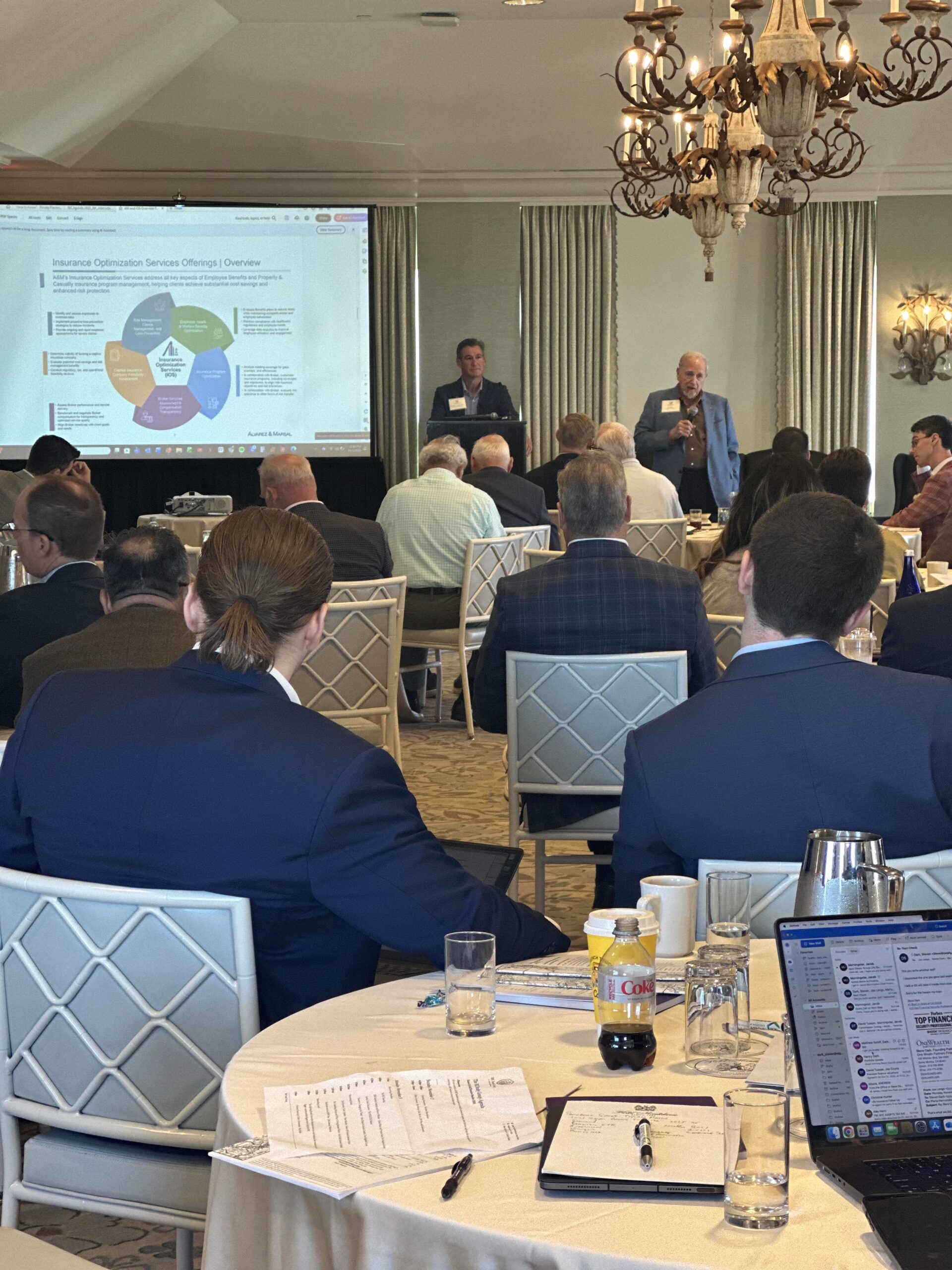
If you are an advisor to the banking industry’s elite, or a leader responsible for the long-term health of your institution, you know that standing still is the same as moving backward. That is why we are thrilled to announce that registration is officially live for the 2026 Independent Bank Corporate (IBC) Owned Life Insurance Study Group.
From November 1–3, 2026, we are returning to our spiritual home at the Hotel Monteleone in New Orleans. This isn't just another industry conference where you sit in a windowless ballroom and trade business cards over lukewarm coffee. This is an exclusive gathering designed for top-tier advisors who are serious about Restoring Alignment and Retention.
Why New Orleans? Why Now?
There is a reason we keep coming back to the French Quarter. Beyond the history and the atmosphere, New Orleans represents a blend of tradition and innovation: much like the strategies we discuss.
What keeps you up at night? For many of our attendees, it’s the "What Ifs" that haunt the boardroom.
- What if your top talent leaves for a competitor tomorrow?
- What if a senior executive retires and the replacement cost exceeds your projections?
- What if a sudden tragedy leaves the business dealing with a widow or a complex succession crisis?
These aren't just hypothetical anxieties; they are the fault lines that can crack a bank’s foundation. At the 2026 IBC Study Group, we don’t just identify these problems; we build the solutions. We focus on the mechanics of Bank-Owned Life Insurance (BOLI) and Corporate-Owned Life Insurance (COLI) not as mere products, but as the engine for The Perfect Plan®.
The Technical Heart: BOLI and Beyond
While the surroundings are legendary, the core of this study group is deeply technical. We dive into the weeds of cost-recovery strategies and the nuances of Bank-Owned Life Insurance (BOLI).
In today’s volatile market, banks are looking for ways to offset the rising costs of employee benefits without taking on undue risk. BOLI remains one of the most effective tools for institutional capital management, offering tax-deferred growth and tax-free death benefits that can be used to fund non-qualified deferred compensation (NQDC) plans or supplemental executive retirement plans (SERPs).
Our sessions will cover:
- Advanced Cost-Recovery Models: How to structure BOLI to ensure that the bank is made whole for the costs of executive benefits.
- Executive Retention Strategies: Moving beyond standard bonuses to create "Golden Handcuffs" that actually work.
- Regulatory Compliance: Navigating the latest updates to ensuring your plans remain "Gospel-compliant" with current tax and banking laws.
- Succession Planning: Solving the "Business with a Widow" scenario through structured buy-sell arrangements and key-person coverage.
We understand that you are navigating an unstable financial environment. You need a guide who has been through the cycles. Our team at Schiff Executive Benefits acts as that guide, helping you realize your institution’s dream value while protecting your most valuable assets: your people.
Food, Fun, and Friendship: The Monday Night Highlight
We have always believed that the best business happens when the formal ties are loosened. The IBC Study Group has built a reputation on the "Three Fs": Food, Fun, and Friendship. This year, we are taking that to a new level.
On Monday night, we are hosting a Mardi Gras Theme Jazz Reception and Dinner in the brand-new Courtyard at the Hotel Monteleone. Imagine the sound of a brass band echoing off the brick walls, the scent of authentic Creole cuisine in the air, and the chance to network with the brightest minds in the industry in a setting that is uniquely New Orleans.
This isn't just a dinner; it’s an experience designed to foster the kind of deep professional relationships that last decades. It’s where the real "Study Group" happens: sharing stories of what worked, what didn't, and how we are all navigating the complexities of the modern financial world.
Is This Group Right for You?
The IBC Study Group is an exclusive circle. We intentionally keep the numbers focused to ensure that every participant can engage in the high-level dialogue that makes this meeting so valuable.
If you are an advisor who deals with:
- Institutional BOLI portfolios.
- Corporate-Owned Life Insurance (COLI) for non-bank entities.
- Executive benefit plan design and 409A compliance.
- ESOPs and partnership buy-outs.
...then you belong in the room. This is your opportunity to step away from the day-to-day grind and look at the big picture. Are you building a legacy, or just managing a spreadsheet? Are you offering your clients The Perfect Plan®, or just a standard off-the-shelf solution?
Secure Your Spot
The 2025 Study Group was a complete sell-out, and we expect 2026 to follow suit. The combination of the Monteleone’s charm, the technical depth of our sessions, and the new Monday night Jazz Reception makes this a "must-attend" event on the calendar.
Don't let the "What Ifs" stay unanswered.
- What if you miss out on the specific tax-efficiency strategies that could save your client millions?
- What if your competitors are in New Orleans while you’re at your desk?
Registration is now live for the meeting, and hotel reservations are now available through the Hotel Monteleone room block. Important: meeting registration does not cover your hotel booking. They are separate, and you will need to complete both.
Meeting Registration: Register for the 2026 IBC Study Group Here
Hotel Reservation Link: Book your room at Hotel Monteleone
Block Code: IBC30J
If you prefer to call in your reservation, contact 504-523-3341 or 800-535-9595 between 9:00 a.m. and 5:00 p.m. CDT and reference the block code IBC30J.
Sit back, grab your coffee, and mark your calendar. We are heading back to the Big Easy to restore alignment, ensure retention, and celebrate the profession we love.
We can't wait to see you in the Courtyard.
Schiff Executive Benefits is dedicated to helping businesses and banks navigate the complexities of executive retention and cost recovery. Through The Perfect Plan®, we provide the security and guarantees needed in an uncertain world.
For more information on our services or to view our latest insights, visit our posts feed.

Money doesn’t come with an instruction manual, but it certainly comes with a lot of noise. If you’ve spent any time watching cable news or scrolling through financial blogs, you’ve heard the "experts" shouting the same scripts. They tell you to pay off your mortgage, max out your 401(k), and avoid insurance like the plague because "commissions are evil."
For 95% of the population, that advice is perfectly fine. It’s the financial equivalent of "eat your vegetables and go for a walk." It’s safe. It’s generic. And for a high-net-worth business owner, it’s a recipe for massive tax leakage and missed opportunities.
There is a fundamental truth in the world of high-level finance: What works for the masses will often fail the masters. If you are running a successful company, managing a complex balance sheet, and looking at a legacy that spans generations, you aren't playing the same game as the person Suze Orman is talking to. You need your money to work harder. You need what I call "Double Duty Dollars."
The Mass-Market Trap
Early in my career, I started to notice a pattern. I’d sit down with business owners who were incredibly savvy in their own industries but were following "safe" retail financial advice. They had millions sitting in taxable accounts, getting clipped by the IRS every single year. They had significant "What If" risks: what if a partner dies? What if they need long-term care? What if their top talent gets poached?: but they were trying to solve those problems with separate, inefficient buckets of money.
The mass-market advice says: "Buy term and invest the rest." That sounds great on a bumper sticker. But for a business owner, "investing the rest" in a taxable environment means you’re essentially volunteering to give the government a 30% to 40% cut of your growth every year.
I realized early on that the truly wealthy don't look at their assets as isolated piles of cash. They look for ways to make one dollar do the work of two or three. They look for the "wrapper."

What Are Double Duty Dollars?
The concept of Double Duty Dollars is actually quite simple, though the execution requires precision. Think about an asset you already own: perhaps a high-yield savings account, a bond portfolio, or a taxable brokerage account. That dollar is currently doing "Single Duty." It’s providing some growth or liquidity, but it’s also creating a tax bill, and it’s doing nothing to protect your business or your family.
Now, imagine taking that same dollar and putting a "wrapper" around it.
By using a Corporate Owned Life Insurance (COLI) structure or a similar strategic vehicle, you take that taxable asset and transform it. Suddenly, that single dollar is doing "Double Duty" (or even Triple Duty):
- Tax Efficiency: The asset now grows tax-deferred. When structured correctly, the gains can be accessed tax-free. You’ve just plugged the tax leak.
- The Death Benefit: That same dollar now provides a significant infusion of liquidity to the business or family upon your passing. This solves the "What If" of a business surviving a widow or funding a buy-out.
- Living Benefits (LTC): This is the one that keeps most people up at night. If you need long-term care, you can often access that same death benefit while you’re still alive to pay for it.
You haven't spent more money. You’ve just changed the nature of the money you already had. You’ve moved it from a "Single Duty" bucket to a "Double Duty" bucket.
Addressing the Stigma: Design Over Product
I know what some of you are thinking. "Matt, you’re talking about insurance. I’ve heard insurance is a bad investment."
I get it. The insurance industry has a bit of a reputation problem, and frankly, it’s often earned. Many people have been sold a "product" by a guy who was just looking for a commission. They were sold a "policy" that didn't fit their needs or wasn't structured for maximum efficiency.
But here is our mantra at Schiff Executive Benefits: Design Over Product.
A hammer is a product. In the hands of a toddler, it’s a disaster. In the hands of a master carpenter, it builds a mansion. The "product" (the insurance contract) is just the tool. The "design" is the architectural blueprint that ensures the tool is doing exactly what you need it to do: minimizing costs, maximizing tax-free growth, and providing the protection your specific business requires.
When we talk about Double Duty Dollars, we aren't talking about "buying a policy." We are talking about engineering a financial structure that provides Restoring Alignment and Retention. We are talking about using COLI to fund a 409A plan to keep your top talent from leaving for a competitor. We are talking about Split Dollar arrangements that provide massive value to executives without the immediate tax sting.

The 5 "What Ifs" That Keep You Up At Night
As a business owner, your mind is constantly scanning the horizon for threats. We’ve distilled these anxieties into five core questions. These are the "What Ifs" that Double Duty Dollars are designed to answer:
- The Widow Factor: What happens if your business partner passes away? Are you prepared to run the company with their spouse as your new partner?
- The Buy-Out: If you need to exit, where is the liquidity coming from? Can the business survive a massive cash drain to buy out a departing owner?
- The Talent Drain: If your "right-hand person" leaves tomorrow, what does that cost you in lost revenue and replacement expenses?
- The Efficiency Gap: Are you funding executive retirements in the most cost-effective way possible, or are you just burning cash?
- The "Running Out" Fear: Will you actually have enough to maintain your lifestyle, or will a 10-year stint in long-term care wipe out the legacy you spent 40 years building?
Mass-market advice doesn't have a cohesive answer for these. It tells you to "save more." Double Duty Dollars tell you to "save smarter."
Moving Beyond the "Safe" Advice
If you’re still following the advice meant for someone with a $50,000 salary and a 15-year mortgage, you are leaving your business vulnerable. You are likely overpaying the IRS, and you are definitely leaving your "What If" risks unaddressed.
Think about the "wrapper" concept. If you have cash sitting on your corporate balance sheet or in your personal accounts that is currently being taxed, you have a candidate for Double Duty. By moving that asset into a designed structure, you aren't "spending" the money: you’re protecting it. You’re giving it a job description that includes growth, protection, and tax-free access.
This isn't just about wealth; it’s about certainty. It’s about knowing that whether you live a long, healthy life or face a sudden health crisis, your "Perfect Plan®" is already in motion.
Why Design Matters Now
We are living in an era of shifting tax codes and economic uncertainty. The national debt isn't getting smaller, and the likelihood of taxes going down for high-earners in the long run is, let's face it, slim.
The time to put the "wrapper" on your assets isn't when the crisis hits. It’s now, while you are healthy and your business is thriving. It’s about taking control of the narrative before the government or the market does it for you.
At Schiff Executive Benefits, we don't start with a product. We start with a conversation. We look at your "What Ifs," analyze your current asset structure, and then: and only then: do we look at the tools. Whether it's a Split Dollar arrangement for your key execs, an ESOP transition strategy, or a COLI-funded retirement plan, the goal is always the same: efficiency and protection.
Your Next Step
If you’ve reached a point where you realize the "safe" advice isn't doing the job anymore, it’s time to look at your dollars differently. You’ve worked too hard to build your business to let it be dismantled by inefficient planning or unforeseen risks.
Let’s stop the tax leakage. Let’s protect your top talent. Let’s make sure your legacy is secure.
Sit back, grab your coffee, and let’s talk about how to get your money doing Double Duty.
Are you ready to build The Perfect Plan®?
Click here to schedule a consultation with Schiff Executive Benefits and let’s start restoring alignment to your business and your future.
Ready to talk?
If you’re thinking about how to protect your business, retain your top talent, and bring more certainty to your long-term plan, let’s have a conversation.
Schedule your initial NQDC meeting
It is often said that the hardest part of any journey isn’t the climb to the summit; it’s the descent back to the bottom. For decades, you’ve poured every ounce of your energy, your capital, and your identity into building your business. You’ve reached the peak. But as you look out over the horizon, a new reality is setting in: 63% of U.S. entrepreneurs are planning to exit their businesses in the next few years.
We call this the "Exit Wave." It’s a massive transfer of wealth and leadership that is currently reshaping the American landscape. But here is the undeniable truth that keeps many owners up at night: building a business is a completely different skill set than exiting one.
If you find yourself staring at the calendar and wondering what the next chapter looks like, you aren't alone. You’re facing the Business Owner’s Dilemma. It’s a complex web of financial strategy, personal identity, and legacy. So, sit back, grab your coffee, and let's talk about how to navigate the descent safely and successfully.
The Reinvestment Trap
For years, your business has been your most reliable ATM. Whenever you had extra cash flow, the logical move was to put it back into the company. New equipment, better talent, bigger marketing budgets: it all fueled the growth that got you to where you are today.
But there’s a tipping point. Many founders admit they haven't accumulated as much personal wealth as they could have because they’ve been "doubling down" on their own equity for thirty years. This leads to the first part of the dilemma: Reinvestment.
When do you stop feeding the machine and start feeding your future?
The Exit Wave is being driven by owners who realize that having 90% of their net worth tied up in a single, illiquid asset is a high-stakes gamble. As we move closer to the "point of no return," the goal shifts from maximizing enterprise value to maximizing net proceeds and personal security.

The Three Dilemmas of the Modern Founder
In a recent conversation on The Perfect Plan® Podcast, we broke down the three specific dilemmas every business owner must face before they sign the closing documents.
1. The Reinvestment Dilemma
As mentioned, this is the struggle of cash flow. Do you keep growing, or do you start diversifying? If you sell tomorrow, what does that cash do for you? Many owners fear that once they sell, they lose their greatest "engine" for wealth. We help clients look at strategies like Corporate Owned Life Insurance (COLI) or deferred compensation plans to create a transition that doesn't feel like a cold-turkey stop to their financial momentum.
2. The Purpose Dilemma
What is the wealth actually for? This sounds like a simple question, but for a founder whose identity is "The Boss," "The Innovator," or "The Provider," the answer is often elusive. Is the wealth for your children? Is it for a second act in philanthropy? Or is it simply to buy back your time? Without a clear purpose, the "Exit Wave" can feel more like a wipeout.
3. The Exit Dilemma
This is the "Identity Crisis." When you walk into a room and people no longer ask you about the company, who are you? The Exit Dilemma is about lifestyle. It’s about the "Return on Life Experience" (ROLE) rather than just the "Return on Investment" (ROI).

ROI vs. ROLE: A Shift in Perspective
In the world of finance, we are trained to obsess over ROI. We look at the multiples, the EBITDA, and the tax efficiency. And while those are vital, they aren't the whole story.
At Schiff Executive Benefits, we talk a lot about ROLE: Return on Life Experience.
Think about it this way: If you sell your business for $20 million but lose your connection to your community, your health, or your sense of purpose, was it a good trade? The Exit Wave is forcing owners to ask: "What does my 'Perfect Plan®' look like for the next 30 years?"
It’s about restoring alignment between your bank account and your heartbeat.
The Family Business Maze
If you are running a family business, the complexity of the Exit Wave multiplies. You aren't just dealing with a buyer and a seller; you’re dealing with Thanksgiving dinner.
The dilemma here is three-fold:
- Ownership Dynamics: Who owns the shares?
- Family Dynamics: Who gets the "say" in how things are run?
- Non-Family Dynamics: How do you retain the key executives who aren't in the family but are essential to the company's value?
This is where things like buy/sell arrangements and retention strategies become critical. If your top talent sees the "Exit Wave" coming and fears for their job security, they might jump ship before you can even get the business to market.
We often ask our clients one of our core "What If" questions: What if your top talent leaves right when you are trying to sell? Your valuation would crater. Protecting that talent through Split Dollar or 409A plans is how you ensure the mountain descent remains stable.

The Mountain Climbing Analogy: Planning the Descent
I often tell my clients that they are world-class mountain climbers. You’ve braved the storms, you’ve navigated the crevasses, and you are standing on the peak. But most climbing accidents happen on the way down.
Why? Because the descent requires a different kind of focus. You’re tired. The weather is changing. And you might be rushing because you can see the finish line.
Planning for your business exit is your descent. You need a team of advisors: a "Sherpa" of sorts: to make sure you don't slip. This means coordinating your legal team, your tax professionals, and your executive benefit specialists.
Are you prepared for the "5 What Ifs"?
- What happens to the business with a widow at the helm?
- Is your buy-out agreement funded and up to date?
- How do you stop your top talent from leaving for a competitor?
- Can you replace a senior executive without it costing you a fortune?
- Are you at risk of running out of money in retirement because you didn't plan the tax-efficient distribution?
These aren't just technical questions; they are the anchors that keep you attached to the mountain.

Restoring Alignment and Retention
As the President of Schiff Executive Benefits, my mission is simple: Restoring Alignment and Retention.
When you are caught in the 63% Exit Wave, alignment is the first thing to go. You’re pulled between the needs of the business and the needs of your family. You’re pulled between your legacy and your liquidity.
By using sophisticated tools like COLI and tailored executive benefit packages, we help you lock in the value of your company while simultaneously preparing your personal balance sheet for the "ROLE" you’ve earned.
Whether you’re looking at an ESOP, selling to a strategic buyer, or passing the torch to the next generation, you need a strategy that considers the human element as much as the financial one.
Ready to Talk?
The Exit Wave is coming. You can either be swept away by it, or you can ride it to the shore of your next great adventure.
Don't wait until the "point of no return" to start thinking about these dilemmas. Let’s start the conversation now. We can help you look at your current setup, stress-test your retention plans, and ensure your The Perfect Plan® is actually perfect for you.
Ready to talk? Book an initial meeting here.
To learn more about how we help business owners navigate these complexities, feel free to explore our video library of services or browse our latest insights.
Success is a journey, but the exit is a choice. Make sure yours is a choice you can live with: and enjoy: for the rest of your life.

A parent’s greatest ambition is to provide a better life for their children than the one they had. It is a universal, undeniable truth that spans generations and tax brackets. We work late, we climb the corporate ladder, and we navigate high-stakes environments, often with the singular goal of ensuring our children have every opportunity: starting with a world-class education.
But for the modern executive, that ambition often runs head-first into a "math problem" that most people don’t even realize exists.
In Part 1 of our "Sandwich Generation" series, we looked at the emotional and financial toll of caring for aging parents while raising children. Today, in Part 2, we are getting tactical. We are looking upward at the looming cost of higher education and how the current legislative environment actually penalizes the highest earners in the room.
If you are an executive making $450,000 or more, you aren't just facing higher tuition bills; you are facing a structural disadvantage in how you are allowed to save for them.
The 401(k) Math Problem: A 10% Disadvantage
Most people view the 401(k) as the gold standard of retirement and savings. For the average American worker, it is. If an employee earns $150,000 a year and contributes the 2026 limit of $24,500 (plus any catch-up contributions), they are shielding roughly 16% of their income from taxes and growing it for the future.
Now, let’s look at the C-suite.
If you are an executive earning $460,000, that same $24,500 contribution represents only about 5% of your income. While your peers are saving 15% to 20% of their earnings in a tax-advantaged environment, you are capped at 5%. The remaining 95% of your income is subject to the highest marginal tax rates.
This creates a massive "Savings Gap." When the time comes to write a check to Tulane, Harvard, or Michigan, most executives are forced to do so with "expensive" dollars: money that has already been taxed at 37% or higher.
Furthermore, if you try to tap into your 401(k) to cover a tuition spike, you aren't just hit with the tax; you’re hit with a 10% early withdrawal penalty if you are under age 59½. For the Sandwich Generation executive, whose children hit college age while they are in their peak earning years (usually their 40s or 50s), the 401(k) is a locked box that is too small to begin with.

The 401(k) Mirror Plan: A Pre-Tax Tuition Solution
At Schiff Executive Benefits, we focus on Restoring Alignment and Retention. One of the most powerful ways to do that is through a Nonqualified Deferred Compensation (NQDC) plan, often referred to as a "Mirror Plan."
A Mirror Plan allows executives to defer a much larger percentage of their compensation: sometimes up to 80% or 90%: into a tax-deferred account. Unlike a 401(k), there are no IRS-mandated contribution caps on NQDC plans. If you need to save $100,000 a year for your children’s education, a Mirror Plan allows you to do that with pre-tax dollars.
But the real "magic" for college funding lies in the Specific Date Withdrawal feature.
Navigating 409A: The Specific Date Strategy
Under Internal Revenue Code Section 409A, NQDC plans allow participants to schedule distributions for specific times. Unlike a 401(k), where you generally have to wait until retirement or 59½ to avoid penalties, an NQDC plan can be structured to pay out while you are still working.
Imagine your daughter is 10 years old. You know that in eight years, you will need to start paying tuition. Under a Mirror Plan, you can elect to defer a portion of your salary or bonus today and schedule that distribution to hit your bank account in exactly eight years.
The benefits are twofold:
- Pre-Tax Funding: You are funding the "College Fund" with gross dollars, not net dollars. This significantly increases your "buying power" for tuition.
- No 10% Penalty: Because these plans are designed for flexibility, you avoid the early withdrawal penalties associated with traditional retirement accounts.
It is a tactical, solution-oriented way to ensure that your "Sandwich" years don't result in you running out of retirement money: one of the core "What Ifs" we help business owners and executives solve.

Why Companies Offer the "College Funding" Benefit
You might ask, "Why would my company set this up for me?"
The answer is simple: Executive Retention.
In today’s market, losing a top-tier executive costs a company significantly more than just their salary. It costs institutional knowledge, client relationships, and momentum. By offering a Mirror Plan, a company provides a "Golden Handshake" that solves the executive's most pressing personal anxiety: paying for their children’s future without sacrificing their own retirement.
When a company helps an executive solve the "401(k) Math Problem," they aren't just providing a benefit; they are building a bridge of loyalty. We call this The 401(k) Cap Problem: How a Mirror Plan Rewards Your Best People.
Integrating the Mirror Plan into The Perfect Plan®
At Schiff Executive Benefits, we don't look at these tools in a vacuum. A Mirror Plan is one piece of a larger puzzle we call The Perfect Plan®.
Whether we are discussing Corporate Owned Life Insurance (COLI) to informally fund these obligations or structured buy/sell arrangements, the goal is always the same: clarity.
We often see executives who are "over-funded" in their 401(k) but "under-saved" for their specific life goals. They have the assets, but they don't have the liquidity or the tax efficiency they need when the tuition bill arrives.
By utilizing a Mirror Plan, you can keep your 401(k) on track for your 70s while using your deferred compensation to handle your 50s.

The Professional’s Legacy
We often talk about the "5 What Ifs" that keep business owners awake at night. When it comes to the Sandwich Generation, the fear of Senior exec retirement/replacement cost efficiency and running out of retirement money are top of mind.
But there is a deeper, more personal "What If": What if I can't provide the same level of education for my kids that my parents provided for me?
Economic shifts and rising tuition costs have made the "standard" path: saving in a 529 and maxing out a 401(k): insufficient for high earners. You need a strategy that reflects your income level. You need a strategy that recognizes that as an executive, the rules of the game are different for you.
Tactical Summary for the Executive
If you are looking at your 401(k) and realizing it won't cover the gap, consider these steps:
- Audit your "Savings Gap": Calculate what percentage of your total income is actually protected by tax-advantaged accounts. If it's less than 10%, you have a cap problem.
- Review the Plan Documents: Does your company offer an NQDC or Mirror Plan? If so, does it allow for "In-Service" or "Specific Date" distributions?
- Coordinate with your Team: Ensure your tax advisor and financial consultant are looking at your deferrals as part of a holistic education funding strategy, not just a retirement strategy.
Join the Conversation
Solving the college funding gap is about more than just numbers; it’s about peace of mind. It’s about knowing that while you are leading your company toward its goals, your family’s future is being secured with the same level of executive precision.
If you are a business owner looking to reward your top talent, or an executive trying to navigate the "Sandwich" years, we invite you to sit back, grab your coffee, and explore how we can help.
Check out our latest insights on The Perfect Plan® Podcast or reach out to our team to discuss how a Mirror Plan can work for your organization.
Stay tuned for Part 3 of our series, where we will dive into the "Downstage" of the Sandwich: Caring for Aging Parents without Derailing Your Corporate Legacy.

Restoring Alignment and Retention.

title: "The 5 'What Ifs' That Keep Business Owners Awake at Night"
meta_title: "The 5 What Ifs for Business Owners | Schiff Executive Benefits"
description: "The 5 What Ifs every business owner should address: succession, buy/sell planning, executive retention strategies, COLI funding, and retirement income certainty."
meta_description: "The 5 What Ifs every business owner should address: succession, buy/sell planning, executive retention strategies, COLI funding, and retirement income certainty."
keywords:
- executive retention strategies
- business succession planning
- buy sell agreement funding
- COLI
- deferred compensation
- retirement income planning
"Success is a lousy teacher; it seduces smart people into thinking they can't lose." This observation, often attributed to Bill Gates, captures the precarious nature of business ownership. You have spent years, perhaps decades, building an engine of growth. You have weathered economic cycles, navigated hiring crises, and outmaneuvered competitors. Yet, in the quiet hours of the night, when the emails stop and the house is still, a different kind of tension takes hold. It isn't the tension of what happened today, but the anxiety of what could happen tomorrow.
At Schiff Executive Benefits, we believe that the foundation of any great enterprise isn't just its current balance sheet: it’s the strength of its contingencies. We call these the "What Ifs." Our mission is simple: Helping Business Owners, Executives, and their families plan for all of life’s "What Ifs."
By addressing these five core scenarios, we focus on Restoring Alignment and Retention, ensuring that your legacy is protected and your future is guaranteed.
Quick next step: Start your own Business Valuation here: https://schiffbenefits.com/articles-and-forms/business-valuation/
1. What if you ended up in business with your partner’s widow or widower?
It is an uncomfortable thought, but a necessary one. Most business partnerships are built on a foundation of mutual skill and shared vision. You and your partner "click." But what happens if that partner passes away unexpectedly? Without a robust, funded buy/sell agreement, their shares of the company typically pass to their heirs.
Suddenly, your new 50% business partner might be a grieving spouse who has never stepped foot in your warehouse or attended a board meeting. They may want to be involved in operations they don't understand, or more likely, they may demand dividend distributions to replace the deceased partner's income: distributions the company might not be able to afford while trying to replace a key leader.
Effective business succession isn’t just a legal document in a drawer; it is a financial strategy. Are you using Split Dollar Life Insurance to fund the buyout? Does your agreement have a clear valuation formula that prevents a legal battle during an already emotional time?

2. What if someone came to you today and said they wanted to buy your business?
Every owner has a "number": that figure that would make all the years of sacrifice worth it. But an unexpected buyout offer is a double-edged sword. If an offer arrived tomorrow, would your business be "exit-ready"?
Potential buyers don't just look at your EBITDA; they look at the stability of your leadership team. If the value of your company is entirely tied to you, the buyer will likely discount the price or insist on a long, grueling earn-out period. To realize your dream value, you need to prove that the business can thrive without you.
This is where exit strategies and incentives like Phantom Stock come into play. By giving your key executives a "stake in the outcome" without giving away actual voting equity, you align their interests with yours. When a buyer sees a motivated management team with "Golden Handcuffs" in place, your valuation skyrockets. You move from selling a job to selling a high-performing machine.
Want to pressure-test what your business is worth before an unsolicited offer lands on your desk? Start here: https://schiffbenefits.com/articles-and-forms/business-valuation/
3. What if your top salesperson or manager left for any reason?
Imagine your top revenue generator walks into your office on a Monday morning and hands you a resignation letter. They aren’t just leaving; they are heading to a competitor for a 20% raise and a "better" benefits package.
The cost of losing a key executive is often calculated at 200% to 300% of their annual salary when you factor in lost momentum, recruitment costs, and the "brain drain" of institutional knowledge. In today’s talent-starved market, standard 401(k) plans and basic health insurance are no longer enough to win the war for talent.
To keep your "MVPs," you need executive retention strategies that actually resonate. We specialize in Non-Qualified Deferred Compensation (NQDC) and Executive Bonus Plans that create a powerful incentive for leaders to stay. We ask the hard question: What is the cost of doing nothing? If you aren't providing a Perfect Plan® for their future, your competitor will.

4. What if you could incent senior execs to retire while also retaining their replacement cost-efficiently?
There comes a point in every organization’s lifecycle where a transition is necessary. You have a loyal, senior executive who has been with you for twenty years. They are ready to slow down, but the cost of funding their retirement "promise" while simultaneously paying a high salary to recruit their successor can put a massive strain on company cash flow.
This is a common friction point in corporate and bank leadership. The solution lies in Corporate Owned Life Insurance (COLI). This is not just an insurance policy; it is a sophisticated financial asset that can provide tax-deferred growth to help offset the liabilities of executive benefits.
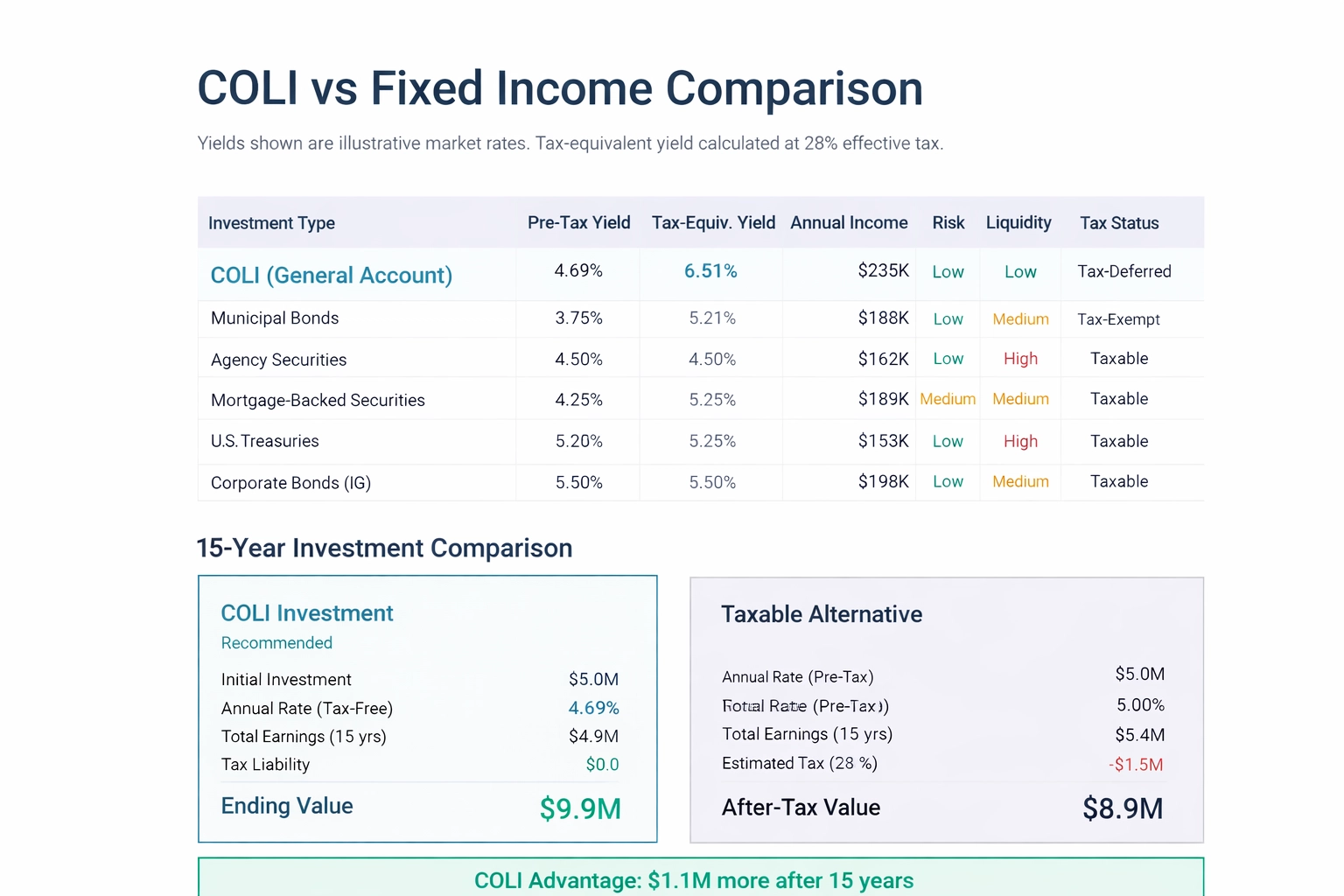
As shown in the chart above, strategies like COLI can significantly outperform traditional fixed-income investments, providing the liquidity and yield necessary to fund retirement obligations without depleting the company’s operating capital. It allows the senior executive to retire with dignity while giving the company the financial "breathing room" to hire the next generation of leadership. You can learn more about how we structure these for corporations on our COLI information page.
5. Lastly, when I retire, what if I run out of money?
This is the ultimate "What If." You have spent your life managing risk for your company, your employees, and your customers. But who is managing the risk for you?
Many high-net-worth business owners are surprised to find that their standard of living in retirement requires a cash flow that their traditional investments might not guarantee, especially in a volatile market or a high-tax environment. The fear isn't just about "having enough"; it's about the "sequence of returns" and the impact of taxes on your distributions.
This is why we developed The Perfect Plan®.
The Perfect Plan® is designed to provide a fixed rate and a fixed flow of income, removing the guesswork from your post-career life. It is about moving from "accumulation" to "distribution" with absolute certainty. We focus on tax-efficient strategies that ensure your wealth lasts as long as you do, protecting your family’s lifestyle and your professional legacy.
Moving from Anxiety to Authority
These five questions are not meant to cause alarm; they are meant to spark action. In the world of executive benefits, silence is the greatest risk. The longer you wait to address these "What Ifs," the fewer options you have when the crisis finally hits.
Are you ready to stop reacting to the market and start leading your legacy?
At Schiff Executive Benefits, we don't just sell products; we architect security. We work alongside your existing team of advisors: your CPAs and attorneys: to ensure that every piece of your financial puzzle fits together. Whether you are a corporation looking to optimize your COLI strategy or a private business owner looking to secure your family's future, we are here to guide you through the "unstable" and into the "guaranteed."
Succession, retention, and retirement are not separate silos; they are the three pillars of a healthy business. When they are aligned, you sleep better. When they are funded, you lead better. If you are evaluating broader executive retention strategies, the right structure can help you attract, retain, and reward key people without forcing a one-size-fits-all approach.
Sit back, grab your coffee, and let’s start a conversation.
You’ve built something incredible. Now, let’s make sure it’s built to last. Come join us at Schiff Executive Benefits and discover how we can help you plan for all of life's "What Ifs."
To dive deeper into these strategies, listen to our latest episodes on The Perfect Plan® Podcast, where we break down the technicalities of 409A compliance, exit planning, and the macro-economic trends affecting business owners today.
Additional resources (go deeper, stay in one place):
- Start your Business Valuation (first step): Get a baseline before you negotiate, gift, sell, or recruit your next key leader: https://schiffbenefits.com/articles-and-forms/business-valuation/
- The Business Owner’s Dilemma (Ali Nasser): Listen/watch the episode on our channel here (podcast hub with the embedded player): https://schiffbenefits.com/posts
- Dan Zugell on ESOPs: Explore the SEB hub page (embedded podcast + links out to the YouTube conversation): https://schiffbenefits.com/posts

Ready to address your "What Ifs"? Contact us today for a confidential consultation.
Ready to talk?
If you’re thinking about deferred compensation, executive retention, or how to structure a plan that fits your goals, let’s talk it through.