
Hi, How Can We Help You?
  • Planning for all of life's "What Ifs".

Category Archives: Bank Owned Life Insurance


They say that comparison is the thief of joy, but in the banking world, comparison is the bedrock of survival.
Whether you are managing a small community bank with ten employees or steering a multi-billion dollar institution, you are constantly looking at the peer group. You look at their ROA, their efficiency ratios, and their net interest margins. You do this not out of envy, but out of a necessity to understand where the market is moving and ensure you aren’t being left behind in the race for stability and talent.


One of the most significant, yet often under-discussed, benchmarks in this comparison is Bank-Owned Life Insurance (BOLI).


If you’ve spent any time in the C-suite, you know that BOLI is no longer a "niche" strategy. It has become a standard tool for high-performing banks to offset the rising costs of employee benefits. But the question remains: Is your bank above or below the BOLI average? And more importantly, if you are an outlier, do you know why?


The State of the Market: By the Numbers


To understand where you stand, we have to look at the cold, hard data. As we move through 2026, the reliance on Bank-Owned Life Insurance has reached a critical mass.


Currently, 67% of all banks in the United States hold BOLI on their balance sheets. It is the majority position. If you don't have it, you are officially in the minority.


But holding it is only half the story. The depth of the investment is where the strategy really reveals itself. Among those who do hold BOLI, 65% have more than 3.5% of their Tier 1 assets committed to these programs. When we look at the heavy hitters: institutions with over $50 billion in assets: the average BOLI holding jumps to 12.8% of regulatory capital.


Why the disparity? Large institutions didn't get large by accident. They realized long ago that "benefit bleed": the slow, steady drain of capital used to fund executive retirements and rising healthcare costs: is a silent killer of shareholder value. They use BOLI as a specialized asset to recover those costs.


Banking Executive Analyzing Data


Why Averages Matter (and Why They Don't)


When a CEO asks me, "Matt, are we holding too much BOLI?" I rarely start with a number. I start with a question about their The Perfect Plan®.


Averages are a great starting point for a conversation, but they are a terrible way to run a business. If your bank is currently holding 2% of Tier 1 assets in BOLI while your peers are at 12%, you aren't "safer": you are likely just less efficient. You are paying for benefits with after-tax dollars while your competitors are using tax-advantaged assets to do the heavy lifting.


However, being "above" the average carries its own set of responsibilities. If you are pushing toward that 25% regulatory capital concentration limit, your documentation, your risk assessment, and your board oversight must be bulletproof.


The Technical Guardrails: OCC 2004-56 and IRC 7702


In this environment, you can’t afford to "wing it." The regulatory landscape for BOLI is defined largely by OCC Bulletin 2004-56. This isn't just a suggestion; it's the rulebook. It requires banks to perform comprehensive pre-purchase analysis and ongoing monitoring.


One of the most critical technical aspects we navigate with our clients is IRC Section 7702. This section of the Internal Revenue Code defines what actually constitutes a "life insurance contract" for federal tax purposes. If your policy doesn’t meet these stringent requirements, you lose the very tax advantages: tax-free inside buildup and tax-free death benefits: that make BOLI attractive in the first place.


At Schiff Executive Benefits, we focus on ensuring that every program we design is compliant not just today, but for the long haul. We reverse engineer the solution based on your specific liabilities, ensuring that the asset matches the intent.


Managing the 6 Key Risks


When the regulators come knocking, they aren't just looking at your earnings. They are looking at your risk management framework. OCC 2004-56 outlines six key risks that every bank must address regarding their BOLI holdings:


  1. Liquidity Risk: BOLI is an illiquid asset. You can't just flip it for cash tomorrow without potential tax penalties and surrender charges. How does this fit into your overall liquidity profile?

  2. Transaction/Operational Risk: This involves the complexity of the program. Is it being administered correctly? Are the death benefits being tracked?

  3. Reputation Risk: What happens if the carrier fails? Or if the public perceives the plan as "excessive"?

  4. Credit Risk: You are essentially making a long-term loan to an insurance carrier. Is that carrier stable? We work as a broker with a wide variety of top-tier carriers to ensure diversification and credit quality.

  5. Interest Rate Risk: BOLI values can fluctuate based on the interest rate environment. Does your board understand the impact of a rising or falling rate environment on your BOLI yield?

  6. Compliance/Legal Risk: From insurable interest laws to the 25% concentration limits, the legal hurdles are high.


Risk and Compliance Balance


Offsetting Benefit Bleed: Matching Assets to Liabilities


The most common "What If" we hear from bank presidents is: "What if our top talent leaves for the competitor down the street?"


In the current war for talent, standard 401(k) plans often fall short for high-earning executives due to IRS contribution limits. This is where we implement specialized tools like the 401k Mirror Plan.


But here is the catch: creating a promise (a liability) to pay an executive a SERP (Supplemental Executive Retirement Plan) or a Mirror Plan benefit in 15 years is easy. Funding it is the hard part. If you don't have an asset earmarked to grow alongside that liability, you are creating a massive hole in your future balance sheet.


By utilizing BOLI, we can match the asset to the future liability. When the executive retires, the cash value of the BOLI can provide the cash flow to pay the benefit. If the executive passes away prematurely, the death benefit protects the bank and the executive's family. It’s about restoring alignment and retention.


The Schiff Approach: Reverse Engineering Your Success


We don't believe in "off-the-shelf" products. Our team has almost 100 years of combined experience in technical benefit design. We don’t start with a BOLI policy; we start with your goals.


We ask the tough questions:


  • What is the cost of your current benefit "bleed"?

  • How much of your capital is working for you versus sitting in low-yield traditional assets?

  • Are your top three executives truly tied to the long-term success of the bank?


Once we have those answers, we "reverse engineer" a solution that fits your culture. We call this The Perfect Plan®. It’s a process that ensures your benefits are a bridge to your goals, not a weight on your earnings.


Strategic Growth and Data


Where Do You Go From Here?


If you find that your bank is below the average, don't panic. It’s an opportunity. It means you have "eligible purchase capacity": dry powder that can be deployed to increase your ROA and secure your key people.


If you are above the average, it's time for a check-up. Are you managing those six key risks? Is your documentation up to the standards of the latest OCC exams?


Regardless of where you sit on the curve, the goal is the same: realizing your dream value and building it your way. Don't let your executive benefits be an afterthought.


If you want to see exactly how your bank stacks up against a specific peer group: not just national averages, but the banks in your own backyard: let’s talk. Sit back, grab your coffee, and come join us for a deeper dive into the technical side of retention.


Your legacy is too important to leave to chance. Let's make sure you have The Perfect Plan® in place and help your bank maximize your BOLI Portfolio. Our Proprietary BOLI Model can give you a peer analysis and projected earnings analysis in seconds. Give us a call at 610-292-9330 or email us at info@schiffbenefits.com for your bank's copy.  We're here to help, and have the expertise to work with ANY carrier.


Financial Legacy and Precision


Learn more: our complete guide to Bank Owned Life Insurance (BOLI).



"The best time to plant a tree was twenty years ago. The second best time is now."


It’s an old aphorism, but in the world of executive benefits and bank regulation, it’s a universal truth that separates the thriving organizations from the ones just waiting for an audit to go sideways.


Welcome to the Friday Wrap. Pull up a chair, grab your coffee (black, if you’re doing it right), and let’s look at what we’ve tackled this week. We’ve been moving fast, focusing on two heavy hitters that define whether a company is truly aligned or just coasting on hope. We’re talking about the technical minefield of BOLI compliance and the strategic elegance of the Non-Qualified Deferred Compensation (NQDC) plan: otherwise known as the "401(k) Mirror."


At Schiff Executive Benefits, our mission is simple: Restoring Alignment and Retention. We spend our days reverse-engineering solutions to ensure that when you look at your top talent, you aren't asking yourself, "What if they leave?" Instead, you’re confident that they have every reason to stay. That is the core of The Perfect Plan®.


Section 1: The BOLI Compliance Minefield


First up, we dove deep into the world of Bank-Owned Life Insurance. Now, BOLI is a fantastic tool: it’s a way for banks to offset the rising costs of employee benefits using a tax-advantaged asset. But here is the problem: many boards treat BOLI like a "set it and forget it" crockpot.


Bad idea.


complianceImage


If you aren't staying on top of your BOLI compliance, you aren't just risking a slap on the wrist; you’re risking the "safety and soundness" rating of your entire institution. We discussed the 7 common mistakes boards make, and if any of these sound familiar, it’s time for a check-up:


  1. The 25% Tier 1 Capital Guideline: You can’t just buy BOLI until your heart's content. Regulatory guidance (specifically OCC 2004-56) suggests that a bank’s total BOLI holdings should generally not exceed 25% of its Tier 1 Capital. Are you pushing that limit?

  2. The 1% Concentration Rule: While not always a hard regulatory floor, many conservative boards set a limit that no single insurance carrier should represent more than 1% of the bank's total assets. Diversification isn't just for your personal portfolio; it’s for your balance sheet protection.

  3. The IRC 101(j) Gotcha: This is the big one. If you don’t get written, informed consent from the employee before the policy is issued, the death benefit: which is supposed to be tax-free: becomes taxable. That is a massive, preventable unforced error.

  4. Lack of Annual Board Review: The regulators want to see that the board is actually looking at the performance and risk of the BOLI asset every single year.

  5. Credit Analysis Neglect: When was the last time you did a deep dive into the creditworthiness of the carriers holding your BOLI?

  6. Ignoring Mortality Performance: Are you tracking how the actual mortality experience matches up against the projections you were sold?

  7. Failing the Peer Analysis: Regulators love to see how you stack up against your peers. If you aren't doing a peer analysis of your BOLI holdings, you’re flying blind.


BOLI is a powerful component of The Perfect Plan®, but only if it’s managed with the precision it deserves.


Section 2: Breaking the "Success Ceiling" with the 401(k) Mirror


Next, we shifted gears to look at how corporate entities (and banks, too) handle their most expensive and valuable asset: their people.


Have you ever noticed that the more successful your executives become, the more the government penalizes them? It’s called the "Success Ceiling."


successCeiling


In a traditional 401(k), there is a hard limit on what an employee can defer. For high-earning executives, that limit often represents a tiny fraction of their total income: sometimes as low as 2% or 3%. While the rest of your staff can defer 10% or 15% toward their future, your top leaders are hitting a wall.


That’s where the NQDC 401(k) Mirror Plan comes in.


By creating a "Mirror" plan, you allow your key talent to defer significantly more of their compensation: often up to 80% of salary and 100% of bonuses: on a tax-deferred basis. It "mirrors" the 401(k) experience they already know: they choose their investments, they see their statements, and they watch their money grow.


Section 3: The Power of Golden Handcuffs


Why does this matter to you as a business owner or a board member? Because it solves one of the most critical of the "5 What Ifs": What if your top talent leaves?


goldenHandcuffs


When you implement a Mirror Plan, you aren't just giving them a place to save; you’re creating "Golden Handcuffs." By structuring employer contributions with specific vesting schedules or "tail" payouts, you create a powerful incentive for your executives to stay for the long haul.


Imagine an executive who has $500,000 or $1,000,000 in a deferred comp account that they only get if they stay for another five years. That makes the recruiter’s phone call a lot less tempting.


This is the essence of The Perfect Plan®. It’s about building a structure where the company’s goals and the executive’s personal financial goals are perfectly aligned. When they win, you win. When they stay, the company grows.


Section 4: Strategy Over Product


At Schiff Executive Benefits, we aren't just selling insurance or setting up plans. We’re reverse-engineering your goals. Whether it's ensuring your BOLI is compliant so you don't get a "Matter Requiring Attention" from the OCC, or designing a Mirror Plan that keeps your CEO from jumping ship to a competitor, we start with the intent.


strategyImage


Does your current benefit structure match your company culture? Does it actually protect you from the "What Ifs"?


If you're not sure, it might be time to take a look at how we build The Perfect Plan®. We work alongside your existing team: your accountants, your attorneys, and your TPA: to ensure that every piece of the puzzle fits perfectly.


Wrapping Up the Week


It’s been a productive week, but there is always more work to be done in the pursuit of alignment.


If any of this resonated with you: if you’re worried about your BOLI concentration limits or if you realize your top talent is hitting a ceiling they can’t break through: let’s talk.


You can check out our full range of services on our Posts page or, better yet, come join the conversation over on The Perfect Plan® Podcast YouTube channel. We’re constantly dropping new insights to help you navigate these technical waters.


Have a great weekend. Rest up, stay focused, and remember: alignment isn't an accident. It’s a choice.


Warmly,


Matt Schiff
President, Schiff Executive Benefits


Schiff Executive Benefits helps businesses attract, retain, and reward key talent through goal-oriented reverse engineering and deep technical expertise. Visit us at schiffbenefits.com to learn more.


Note: This post is scheduled to publish on Friday, May 15, 2026, at 7:00 AM ET.


Learn more: our complete guide to Bank Owned Life Insurance (BOLI) and how a 401(k) Mirror Plan works.


They say that the only constant in life is change, but in the world of high-stakes banking and executive leadership, the only constant is the relentless need for top-tier talent. Without the right people in the right seats, even the most storied financial institutions are just buildings with impressive vaults.


We’ve all felt the shift. The landscape of executive benefits is evolving faster than a New Orleans jazz solo. Tax codes shift, regulatory scrutiny tightens, and the "Great Reshuffle" has turned the hunt for executive retention into a strategic arms race.

If you are an advisor to the banking industry’s elite, or a leader responsible for the long-term health of your institution, you know that standing still is the same as moving backward. That is why we are thrilled to announce that registration is officially live for the 2026 Independent Bank Corporate (IBC) Owned Life Insurance Study Group.

From November 1–3, 2026, we are returning to our spiritual home at the Hotel Monteleone in New Orleans. This isn't just another industry conference where you sit in a windowless ballroom and trade business cards over lukewarm coffee. This is an exclusive gathering designed for top-tier advisors who are serious about Restoring Alignment and Retention.

Why New Orleans? Why Now?


There is a reason we keep coming back to the French Quarter. Beyond the history and the atmosphere, New Orleans represents a blend of tradition and innovation: much like the strategies we discuss.

What keeps you up at night? For many of our attendees, it’s the "What Ifs" that haunt the boardroom.

  • What if your top talent leaves for a competitor tomorrow?

  • What if a senior executive retires and the replacement cost exceeds your projections?

  • What if a sudden tragedy leaves the business dealing with a widow or a complex succession crisis?


These aren't just hypothetical anxieties; they are the fault lines that can crack a bank’s foundation. At the 2026 IBC Study Group, we don’t just identify these problems; we build the solutions. We focus on the mechanics of Bank-Owned Life Insurance (BOLI) and Corporate-Owned Life Insurance (COLI) not as mere products, but as the engine for The Perfect Plan®.

The Technical Heart: BOLI and Beyond


While the surroundings are legendary, the core of this study group is deeply technical. We dive into the weeds of cost-recovery strategies and the nuances of Bank-Owned Life Insurance (BOLI).

In today’s volatile market, banks are looking for ways to offset the rising costs of employee benefits without taking on undue risk. BOLI remains one of the most effective tools for institutional capital management, offering tax-deferred growth and tax-free death benefits that can be used to fund non-qualified deferred compensation (NQDC) plans or supplemental executive retirement plans (SERPs).

Our sessions will cover:

  • Advanced Cost-Recovery Models: How to structure BOLI to ensure that the bank is made whole for the costs of executive benefits.

  • Executive Retention Strategies: Moving beyond standard bonuses to create "Golden Handcuffs" that actually work.

  • Regulatory Compliance: Navigating the latest updates to ensuring your plans remain "Gospel-compliant" with current tax and banking laws.

  • Succession Planning: Solving the "Business with a Widow" scenario through structured buy-sell arrangements and key-person coverage.


We understand that you are navigating an unstable financial environment. You need a guide who has been through the cycles. Our team at Schiff Executive Benefits acts as that guide, helping you realize your institution’s dream value while protecting your most valuable assets: your people.

Food, Fun, and Friendship: The Monday Night Highlight


We have always believed that the best business happens when the formal ties are loosened. The IBC Study Group has built a reputation on the "Three Fs": Food, Fun, and Friendship. This year, we are taking that to a new level.

On Monday night, we are hosting a Mardi Gras Theme Jazz Reception and Dinner in the brand-new Courtyard at the Hotel Monteleone. Imagine the sound of a brass band echoing off the brick walls, the scent of authentic Creole cuisine in the air, and the chance to network with the brightest minds in the industry in a setting that is uniquely New Orleans.

This isn't just a dinner; it’s an experience designed to foster the kind of deep professional relationships that last decades. It’s where the real "Study Group" happens: sharing stories of what worked, what didn't, and how we are all navigating the complexities of the modern financial world.

Is This Group Right for You?


The IBC Study Group is an exclusive circle. We intentionally keep the numbers focused to ensure that every participant can engage in the high-level dialogue that makes this meeting so valuable.

If you are an advisor who deals with:

  • Institutional BOLI portfolios.

  • Corporate-Owned Life Insurance (COLI) for non-bank entities.

  • Executive benefit plan design and 409A compliance.

  • ESOPs and partnership buy-outs.


...then you belong in the room. This is your opportunity to step away from the day-to-day grind and look at the big picture. Are you building a legacy, or just managing a spreadsheet? Are you offering your clients The Perfect Plan®, or just a standard off-the-shelf solution?

Secure Your Spot


The 2025 Study Group was a complete sell-out, and we expect 2026 to follow suit. The combination of the Monteleone’s charm, the technical depth of our sessions, and the new Monday night Jazz Reception makes this a "must-attend" event on the calendar.

Don't let the "What Ifs" stay unanswered.

  • What if you miss out on the specific tax-efficiency strategies that could save your client millions?

  • What if your competitors are in New Orleans while you’re at your desk?


Registration is now live for the meeting, and hotel reservations are now available through the Hotel Monteleone room block. Important: meeting registration does not cover your hotel booking. They are separate, and you will need to complete both.

Meeting Registration: Register for the 2026 IBC Study Group Here

Hotel Reservation Link: Book your room at Hotel Monteleone

Block Code: IBC30J

If you prefer to call in your reservation, contact 504-523-3341 or 800-535-9595 between 9:00 a.m. and 5:00 p.m. CDT and reference the block code IBC30J.

Sit back, grab your coffee, and mark your calendar. We are heading back to the Big Easy to restore alignment, ensure retention, and celebrate the profession we love.

We can't wait to see you in the Courtyard.


Schiff Executive Benefits is dedicated to helping businesses and banks navigate the complexities of executive retention and cost recovery. Through The Perfect Plan®, we provide the security and guarantees needed in an uncertain world.

For more information on our services or to view our latest insights, visit our posts feed.


A bank is only as strong as its community, and its community is only as strong as the leaders who serve it. In the financial world, stability is the cornerstone of trust. Yet, many bank executives find themselves facing an unstable paradox: how do you maintain a competitive edge and protect your balance sheet while simultaneously funding the escalating costs of employee benefits?


If you are leading a financial institution today, you are likely wrestling with the "What Ifs" that keep even the most seasoned presidents awake at night. What if your top talent is lured away by a larger competitor? What if the cost of your pension and health plans continues to outpace your portfolio’s yield? What if your senior executive retirement costs become a drag on your regulatory capital?


To find the answer, we look toward a strategy utilized by over 65% of banks in the United States. It is a tool designed for Restoring Alignment and Retention: Bank-Owned Life Insurance (BOLI).


What is BOLI, and Why Does It Matter?


At its most fundamental level, Bank-Owned Life Insurance is a life insurance policy purchased by a bank on the lives of its key employees: usually officers and directors. The bank is the owner and the beneficiary of the policy.


While the term "insurance" is in the name, for a financial institution, BOLI is primarily a sophisticated investment and a Tier 1 asset. The bank pays a premium (often a single lump sum), and the cash value of the policy grows over time.


Why is this so popular? Because it solves the problem of "lazy capital." Instead of holding assets in low-yield taxable instruments, banks move capital into a tax-advantaged BOLI structure where the growth can offset specific liabilities. It is a method of taking a "dead" expense: like the cost of executive benefits: and turning it into a high-performing asset.


Comparison chart showing Bank-Owned Life Insurance (BOLI) versus alternative fixed income investments


The Economic Reality: After-Tax Yield and Efficiency


In a world where interest rates are volatile and traditional fixed-income yields are often squeezed by taxes, BOLI stands out as a beacon of efficiency.


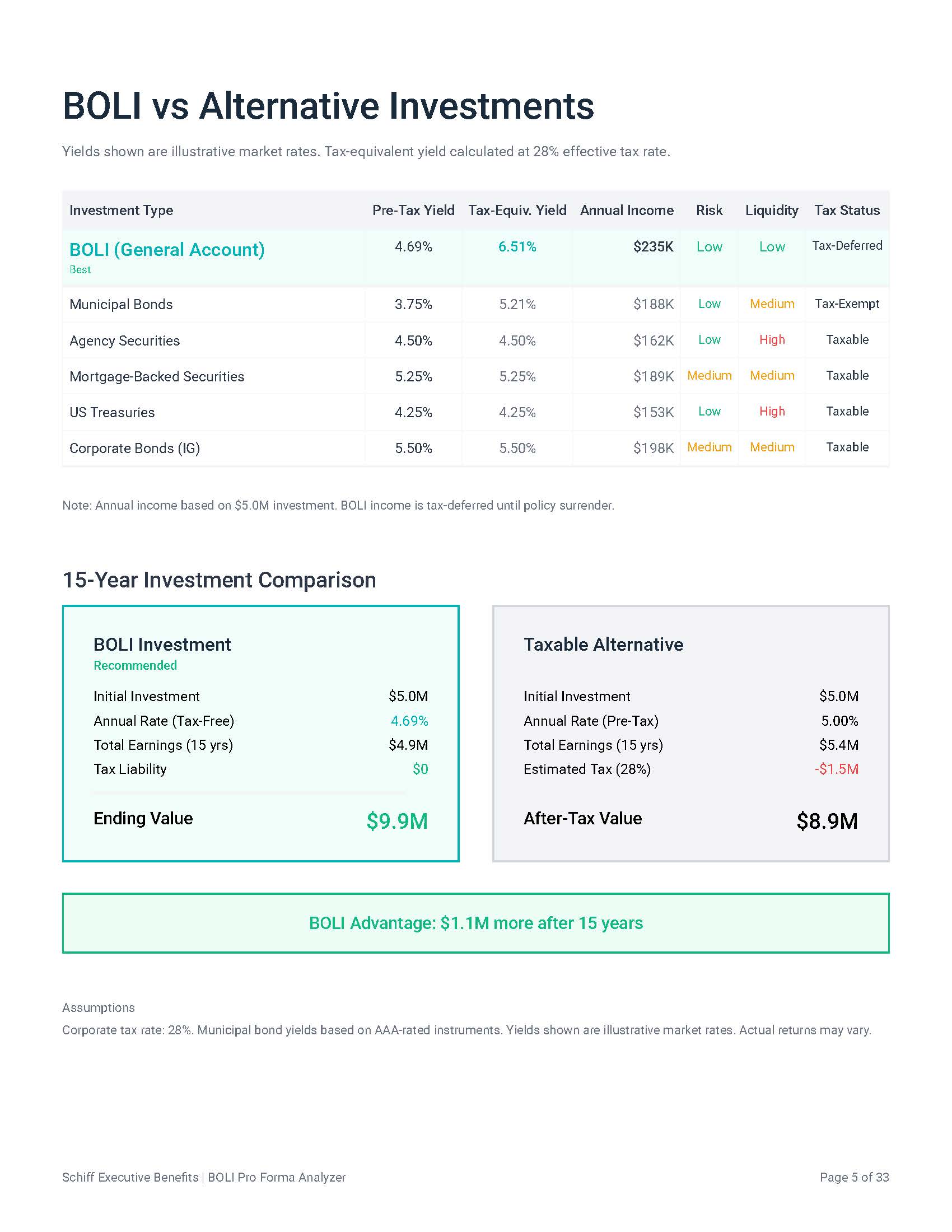
When you compare BOLI to alternative fixed-income investments: such as municipal bonds, agency securities, or Treasuries: the difference is often staggering. Because the cash value growth within a BOLI policy is tax-deferred (and tax-free if held until the death of the insured), the "tax-equivalent" yield is significantly higher than what a bank can typically earn elsewhere.


As shown in our proprietary BOLI Pro Forma Analyzer, a $5 million investment in BOLI can provide a tax-equivalent rate that significantly outperforms corporate bonds or MBS portfolios. This isn't just about "beating the market"; it’s about generating the necessary cash flow to fund Non-Qualified Deferred Compensation (NQDC) and other executive carve-outs that are essential for retention.


Offsetting the Rising Cost of Talent


What is the true cost of losing your CFO or a high-performing VP of Lending? It isn't just the recruiter's fee. It is the loss of institutional knowledge, the disruption of client relationships, and the significant expense of "buying" a replacement in a competitive market.


Most banks use BOLI to recover the costs of:


  • Post-retirement medical benefits

  • Supplemental Executive Retirement Plans (SERPs)

  • Group term life insurance premiums

  • 401(k) matching and pension obligations


By utilizing BOLI, you are essentially creating an informal "sinking fund" to pay for these future obligations. It allows you to offer "ownership-like" benefits without actually diluting your bank’s equity. This is how you retain your key people while keeping the bank’s financial health intact.


Bank executives in a boardroom discussing bank-owned life insurance and executive retention strategies.


Regulatory Compliance: The Tier 1 Advantage


One of the most frequent questions I get from Bank Presidents is: "How will the regulators view this?"


The answer is found in the Interagency Statement on the Purchase and Risk Management of Life Insurance. BOLI is recognized as a permissible investment for banks, provided it is managed within specific guidelines. Most notably, the Office of the Comptroller of the Currency (OCC) and other regulators generally allow BOLI holdings up to 25% of a bank’s Tier 1 capital.


Because BOLI is a high-quality asset backed by highly-rated insurance carriers, it provides a stable foundation for your balance sheet. Unlike securities portfolios, BOLI cash values are typically not subject to the "mark-to-market" volatility that can plague a bank during periods of rising interest rates. This makes it a preferred tool for managing earnings consistency.


The Human Element: Survivor Income as an Incentive


While the bank is the primary beneficiary, BOLI can also be structured to provide a powerful direct benefit to the insured executives.


Through "split-dollar" arrangements, a portion of the death benefit can be directed to the executive’s family. This provides "pre-retirement survivor income": a massive incentive for a key leader who wants to ensure their family is protected while they focus on growing your institution.


Think about the peace of mind you are offering your top officers. You aren't just giving them a salary; you are giving them a legacy. When you align the bank’s financial goals with the personal security of its leaders, you create an environment where talent stays for the long haul.


Why the "Carrier Agnostic" Approach Matters


The BOLI market is nuanced. There are different types of products: General Account, Hybrid Account, and Separate Account: each with its own risk profile and yield potential.


At Schiff Executive Benefits, we believe that your bank deserves a solution tailored to your specific capital structure and risk appetite, not a "product of the month." We operate as independent brokers, which means we work with all the major, highly-rated carriers to find the right fit for you.


Our process, which we call The Perfect Plan®, involves:


  1. A Deep-Dive Needs Analysis: We look at your current benefit liabilities and capital ratios.

  2. Carrier Evaluation: We vet the financial strength and historical performance of potential insurance partners.

  3. Pro Forma Modeling: We show you exactly how BOLI will impact your EPS and ROA over 10, 20, and 30 years.

  4. Implementation and Administration: We handle the heavy lifting, from board education to ongoing compliance monitoring.


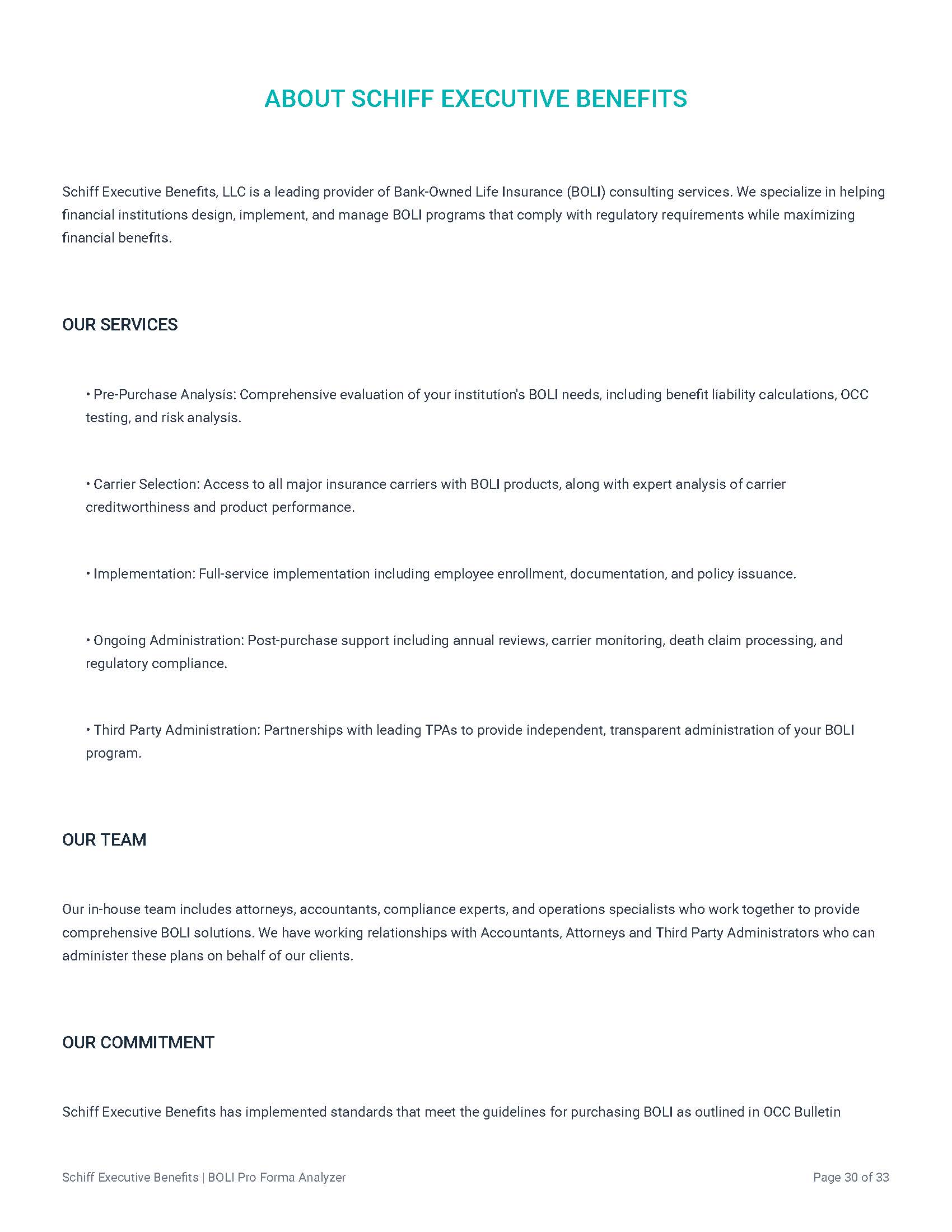
Overview of Schiff Executive Benefits’ BOLI consulting services


The Point of No Return: Why Wait?


Every day that your bank's benefit liabilities grow while your assets remain in taxable, low-yield accounts is a day of lost opportunity. Economic shifts are coming, and the cost of talent is not going down.


Are you prepared for the next five years? What if your replacement cost for your senior team increases by 20%? What if your 401(k) matches become a burden on your margins?


BOLI is not just a financial product; it is a strategic shield. It provides a calm, structured way out of the anxiety of rising costs. It allows you to focus on what you do best: banking: while we ensure your "human capital" is fully funded and protected.


Join Us for a Deeper Conversation


Navigating the complexities of executive benefits and BOLI doesn't have to be a solo journey. Whether you are looking to implement your first BOLI plan or you want a review of your existing holdings to ensure they are performing as promised, we are here to help.


Sit back, grab your coffee, and let's discuss how we can bring stability back to your executive suite. Building your bank’s legacy should be a realization of your dream value, not a source of stress.


Come join us and discover how The Perfect Plan® can help you achieve alignment and retention.


Ready to explore the possibilities? Learn more about our services here.


Time is the only asset that cannot be replaced. In the world of high-level finance, whether you are running a regional bank or a multi-state corporation, you know that a missed opportunity today translates into a massive liability tomorrow. You’ve worked hard to build your organization, to hire the right people, and to protect your bottom line. But often, the very tools designed to safeguard your future, Corporate Owned Life Insurance (COLI) and Bank Owned Life Insurance (BOLI), become stagnant because of a "set it and forget it" mentality.


Are you absolutely certain your current portfolio is actually working for you, or is it just sitting there? Does your executive benefits strategy still align with the goals you set five years ago?


At Schiff Executive Benefits, we believe in a "reverse engineering" approach. We don't start with a product; we start with your desired outcome. Whether you’re looking to offset benefit costs, secure "golden handcuffs" for key talent, or fund a buy/sell arrangement, your portfolio needs to be precise.


Here are the 7 most common mistakes we see in COLI and BOLI portfolios and, more importantly, how you can fix them.


1. Treating Your Portfolio as a "Static" Asset


The market moves. Regulations shift. Tax codes evolve. Yet, many corporations and banks treat their life insurance portfolios like a dusty file in a cabinet. A common misperception is that BOLI or COLI is illiquid or unchangeable. In reality, these are dynamic financial instruments.


If you haven't reviewed your portfolio in the last 24 months, you are likely missing out on repricing opportunities or better-performing crediting rates. Market conditions change, and a portfolio requires periodic review to identify upgrade opportunities. Just as you wouldn't ignore your equity portfolio or your loan book, you cannot ignore your COLI/BOLI holdings.


2. Neglecting 101(j) and 409A Compliance


Compliance isn't just a box to check; it’s the foundation of your tax-advantaged status. Under IRC Section 101(j), if you don’t follow specific notice and consent requirements before the policy is issued, the death benefit, which should be tax-free, could suddenly become taxable income.


Similarly, for corporations using nonqualified deferred compensation (NQDC) plans, the shadow of Section 409A is always present. A single mistake in how your plan is structured or how the COLI informally funds it can lead to immediate taxation and 20% penalties for your key executives.


The Fix: Conduct a comprehensive audit of your documentation. Do you have the signed consents? Is your plan document 409A compliant? If you're unsure, it’s time to bring in our team to look under the hood.


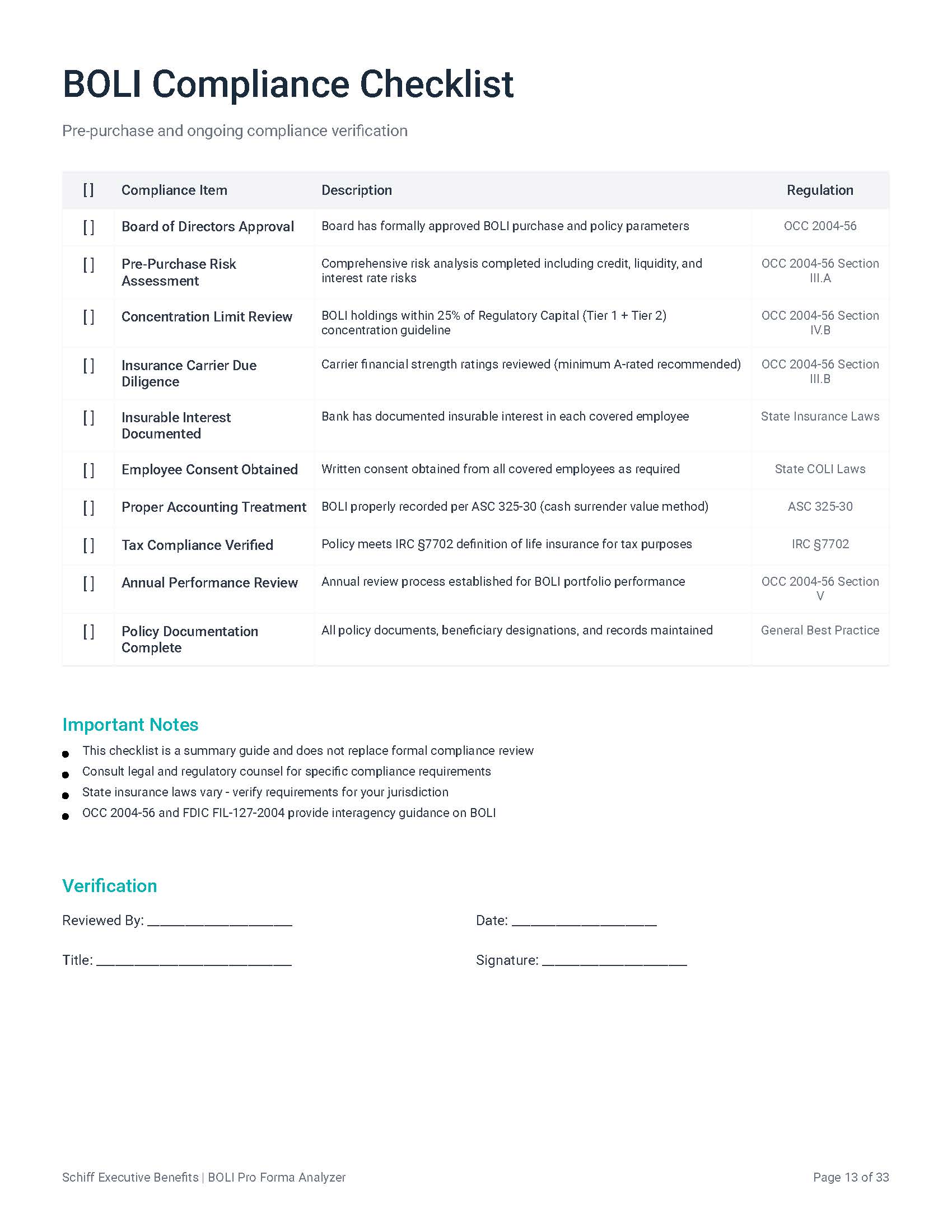
BOLI Compliance Checklist showing detailed regulatory requirements


3. Ignoring Credit Quality and Concentration Risk


We’ve all seen what happens when an organization puts too many eggs in one basket. In a BOLI environment, credit quality is paramount. Many providers pass along data from insurance carriers without truly validating it. Are you monitoring the financial health of the carrier? Are you diversified across multiple carriers to mitigate risk?


A healthy portfolio requires in-depth insurance carrier analysis. At Schiff Executive Benefits, we help you look beyond the marketing materials to the actual solvency and commitment of the carrier to the BOLI/COLI market.


Professional advisors analyzing carrier solvency and credit quality for a BOLI and COLI portfolio.
Suggested prompt: A professional, high-end close-up of a hand reviewing a financial spread sheet with a glass of water on a polished wooden desk, warm natural lighting.


4. Failing to Link the Portfolio to Executive Retention


Why do you have these policies in the first place? For many of our clients, the goal is "Full Cost Recovery" of executive benefit plans. However, if your executive retention strategies are disconnected from your portfolio performance, you aren’t maximizing your "Ownership Feel."


Are you using Split Dollar arrangements? Are you leveraging the portfolio to create a "Golden Handcuff" effect that makes it impossible for your competitors to poach your top talent? If your portfolio is just a line item on the balance sheet and not a tool for talent management, you’re missing half the value.


5. Underestimating the Power of ESOP Integration


For partnerships and private corporations, Employee Stock Ownership Plans (ESOPs) are a powerful way to align employee interests with company growth. However, ESOPs create unique liquidity needs, especially when it comes to repurchase obligations.


Mistake number five is failing to use COLI to "sprinkle in" liquidity for these obligations. By reverse-engineering your future cash flow needs, we can structure a COLI portfolio that grows tax-deferred, providing the cash exactly when the company needs to buy back shares from retiring employees.


A compilation of diverse company logos representing Schiff Executive Benefits clients


6. Overlooking Buy/Sell and Succession Funding


What keeps you up at night? For many business owners, it’s the question of what happens to the firm if a partner passes away or becomes disabled. Many Buy/Sell arrangements are funded with outdated policies that don't account for the current valuation of the business.


If your business has grown (and we hope it has!), your 10-year-old policy is likely insufficient. You are essentially leaving your legacy to chance. We use a technical lens to ensure your Buy/Sell funding matches your current "dream value," ensuring a smooth transition for the remaining partners and the family of the deceased.


7. Lacking a "Team of Advisors" Approach


The most dangerous phrase in business is "I’ve got it covered." Managing a COLI/BOLI portfolio requires a blend of legal, tax, accounting, and insurance expertise. If your insurance agent doesn't understand the nuances of FASB accounting or the specific regulatory hurdles faced by banks, they aren't helping you, they're creating risk.


At Schiff Executive Benefits, we don't work in a vacuum. We collaborate with your existing CPAs and legal counsel to ensure that your Perfect Plan® is airtight from every angle.


Comparison chart showing BOLI versus alternative fixed income investments


The Path Forward: Reverse Engineering Your Success


The national debt is rising, market volatility is the new constant, and the "war for talent" is only getting more intense. In this environment, you cannot afford a mediocre portfolio. You need a strategy that is as sophisticated as the organization you’ve built.


Are you realizing the maximum after-tax yield on your assets? Is your plan structured to recover every dollar of cost, including the opportunity cost of the money?


If these questions give you pause, it’s okay. Most of our clients felt the same way before we began the "reverse engineering" process with them. They were looking for security and a guarantee that their hard work would translate into a lasting legacy.


We invite you to stop guessing and start knowing. Your professional legacy is too important to leave to "standard" industry practices. You deserve a plan that is built your way, with your goals as the blueprint.


Sit back, grab your coffee, and let’s have a conversation. Whether you want to dive deep into the technicalities of a 409A plan or just want a second set of eyes on your BOLI holdings, we are here to guide you through the uncertainty.


Come join us at Schiff Executive Benefits. Let’s make sure your portfolio is doing exactly what it was meant to do: protect your business and reward your people.


To hear more about our philosophy and see these strategies in action, check out The Perfect Plan® Podcast where we break down complex financial structures into actionable executive advice.


Schiff Executive Benefits provides specialized consulting. For specific legal or tax advice, please consult with your professional advisors. You can find our full disclosure here.


Learn more: our complete guide to Bank Owned Life Insurance (BOLI) and Corporate Owned Life Insurance (COLI).