


Decisions define institutions. In the world of banking, where every basis point is scrutinized and every regulatory guideline is a fence, the strongest institutions are those that do not drift. They decide. They operate with a level of strategic intentionality that turns balance sheet line items into competitive advantages.
If your bank is currently navigating the dual challenge of attracting, retaining, and rewarding key talent while simultaneously managing balance sheet performance in a shifting interest rate environment, Bank-Owned Life Insurance (BOLI) deserves more than just a passing glance. It shouldn't be viewed as a novelty or a “nice-to-have” asset. Instead, BOLI is a prudent, highly regulated asset class that the most well-run banks in the country use to support executive benefit liabilities.
The real question for your board is about optimization. As Matt Schiff often discusses on The Perfect Plan®, the goal is to align corporate assets with long-term promises and benchmark performance against clear financial and governance objectives.
So, here is the benchmark question: Does your bank have an optimized strategy, supported by current BOLI performance benchmarks, or has the conversation simply not been revisited lately?
The Benchmark Reality: 67% and Rising
Across the United States, BOLI adoption remains one of the most consistent trends in the financial sector. Based on the latest FDIC Call Report data, roughly 67% of all banks nationally hold BOLI. When you narrow the lens to specific high-performance markets like South Dakota, the numbers are even more telling. In South Dakota, adoption sits at 72.4%.
When more than two-thirds of the market: and nearly three-quarters of banks in leading financial hubs: utilize a specific tool, the conversation changes. It is no longer a question of "What is this?" or "Should we do this?" The question becomes: "Is our current strategy optimized with the same level of strategic intentionality, carrier discipline, and prudent performance benchmarking as our top-performing peers?"
Strategic drift happens when a board assumes that a decision made five years ago remains the optimal choice today. In a world where the cost of talent is rising and the regulatory landscape is constantly evolving, "status quo" is often the most expensive strategy a bank can have.

The Optimization Framework: Regulation and Discipline
Optimization begins with a deep respect for the guardrails. The Office of the Comptroller of the Currency (OCC) has long recognized BOLI as a legitimate balance sheet and benefit financing tool. However, they don't view it as a blank check.
One of the most critical benchmarks for any bank board is the 25% of Tier 1 / Regulatory Capital guideline. This isn't a target to hit; it's a discipline to maintain. Optimization means finding the "sweet spot" where the asset provides maximum benefit cost recovery without creating undue concentration risk.
A truly optimized BOLI strategy within our BOLI consulting framework includes:
- Formal Board-Level Review: Regular evaluation of the portfolio's performance against initial projections.
- Carrier Diversification: Ensuring the bank isn't overly exposed to a single credit, regardless of how high their rating might be.
- Pre-Purchase Technical Analysis: Using a "reverse engineering" approach to ensure the product matches the specific liability it's intended to offset.
- Credit Quality Monitoring: Maintaining a rigorous, ongoing due diligence process that satisfies regulatory expectations.
- Clear Documentation: Connecting the dots between the BOLI asset and the specific executive benefit strategy, such as deferred compensation or NQDC plans.
In this context, compliance isn't a hurdle: it’s the foundation. Compliance is the framework for a strategy that is optimized for performance within regulatory guardrails.
Solving for the "What Ifs"
At Schiff Executive Benefits, we focus on the five core "What If" questions that keep bank presidents and board chairs up at night. BOLI, when optimized, provides a technical answer to several of them:
- What if your top talent leaves? If you haven't built an "ownership feel" for your non-owner executives, they are susceptible to poaching.
- What if the cost of replacing senior execs skyrockets? BOLI provides the cost recovery necessary to fund the transition and the replacement search.
- What if your benefit costs outpace your asset yields? This is the "optimization gap" where BOLI often shines.
When a bank views its benefits as a pure expense line, it is reacting to the market. When a bank uses an optimized BOLI strategy to informally finance those promises, it is leading the market. It allows the institution to offer 100% protection to employee families while maintaining a focus on the bank's long-term profitability.
BOLI vs. Traditional Fixed Income: A Technical Comparison
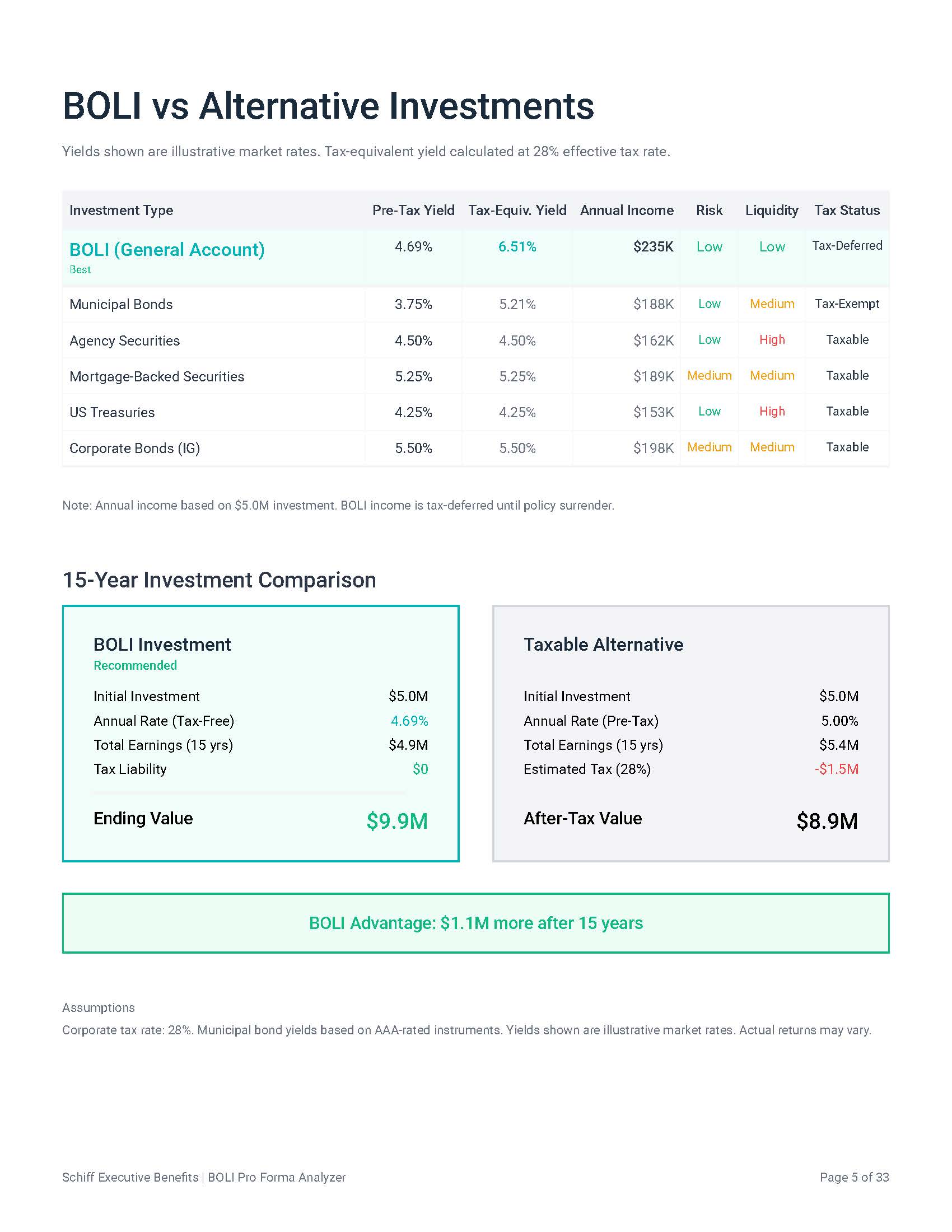
Bank boards often compare BOLI to familiar alternatives: Agency bonds, Mortgage-Backed Securities (MBS), and Corporate bonds. This comparison is fair, but to be truly optimized, it must be complete.
On the surface, fixed income is comfortable. It fits easily into the investment committee’s existing vocabulary. But once you factor in after-tax performance, book-value stability, carrier credit quality, and the specific role of the asset in financing executive benefit liabilities, the math often shifts. The right benchmark is not headline yield alone. It is net economic performance relative to the liability being financed.
Why Optimized BOLI Often Outperforms
- Tax-Advantaged Growth: Earnings inside a properly structured BOLI portfolio grow income tax-deferred. When death proceeds are eventually received, they are generally income tax-free under IRC Section 101(j).
- Book-Value Stability: BOLI is generally recorded at its Cash Surrender Value (CSV). Unlike many fixed-income positions, it doesn't create the same mark-to-market "noise" or volatility on the balance sheet during periods of rising interest rates.
- The Yield Advantage: When analyzed on a tax-equivalent basis, BOLI frequently offers a net yield potential that compares very favorably to high-grade taxable alternatives.
If your bank is carrying significant executive benefit obligations without a corresponding recovery asset, you are essentially "self-insuring" a liability with taxable dollars. That is the opposite of optimization.
The Governance Questions: Conviction vs. Inertia
An optimized board does not ask if BOLI is "trendy." It asks technical, governance-focused questions that cut through the noise:
- Are we below the national adoption benchmark of 67% for a strategic reason, or just because we haven't looked at the data in three years?
- Have we benchmarked our BOLI vs. MBS and Corporate bonds on an after-tax basis recently?
- If our peers are using BOLI to attract the same talent we are chasing, what is the opportunity cost of our current inaction?
- Does our current carrier list represent the best available credit quality in today's market?
These aren't sales questions. They are the hallmark of a high-functioning board that is committed to Restoring Alignment and Retention.
Benchmarking is About Intentionality
No two banks should have identical BOLI positions. Your culture, your capital levels, and your specific benefit designs must lead the way. However, benchmarking data is an essential tool because it reveals whether your institution is operating from conviction or from inertia.
Lack of intentional review is, in itself, a decision: often an expensive one.

If your bank is materially below the national average: or lagging behind what comparable institutions are doing in your specific market: the right next step isn't to rush into a purchase. The right next step is to run a comprehensive benchmarking review.
This analysis should review your regulatory capital capacity, portfolio design, credited rate expectations, benefit cost recovery goals, and the current credit quality of potential carriers. It should be an integrated approach where we work alongside your existing team of advisors: your accountants, attorneys, and TPAs: to ensure the plan matches your company culture and intent.
The Perfect Plan® for Your Bank
At Schiff Executive Benefits, we don't believe in canned pitches. We believe in reverse engineering. We start with your goals: what you want to achieve for your executives and your shareholders: and we build the structure to match.
We call this The Perfect Plan®. It’s about more than just insurance; it’s about creating a structure where the bank wins, the executive wins, and the regulatory requirements are met with room to spare.
If your bank has not benchmarked its BOLI position recently, you are likely operating with an unoptimized strategy. With national adoption at 67% and rising, the question is no longer whether BOLI belongs on a bank balance sheet. The question is whether your bank is applying the strategic intentionality and technical discipline required to make it a high-performance asset.
Sit back, grab your coffee, and let’s take a look at the numbers together. We invite you to join us in a conversation about what an optimized strategy could look like for your institution.
Restoring Alignment and Retention.