

In business, as in life, you get what you pay for. But for the modern business owner, the price of top-tier talent isn't always measured in salary and bonuses. It’s measured in skin in the game.
Every founder eventually hits a crossroads. You have a "key person", someone who works like an owner, thinks like an owner, and quite frankly, the business might struggle to survive without. You want to reward them. You want to lock them in. But the idea of handing over actual shares of your company? That feels like giving away a piece of your soul, or at least a piece of your voting power and future profit.
This is the Founder’s Paradox: How do you provide the "ownership feel" that keeps talent loyal for the long haul without actually diluting your equity?
The answer often lies in a sophisticated, yet surprisingly flexible tool called Phantom Stock.
The Dilution Trap: Why Real Equity Isn't Always the Answer
When you give an employee real equity (actual stock), you aren't just giving them money. You are giving them a seat at the table. You’re giving them voting rights, the right to inspect your books, and a slice of every dividend you ever pay.
Most importantly, you are diluting your own ownership. If you give 5% to your COO and 5% to your Head of Sales, you now own 90%. That might seem fine today, but what happens when you need to bring in more investors? Or what happens if that Head of Sales leaves on bad terms? Now you have a "ghost" on your cap table, someone who doesn't work for you anymore but still owns a piece of your hard work.
Real equity is a "marriage" that is very difficult to divorce.

Enter Phantom Stock: The "Mirror" Strategy
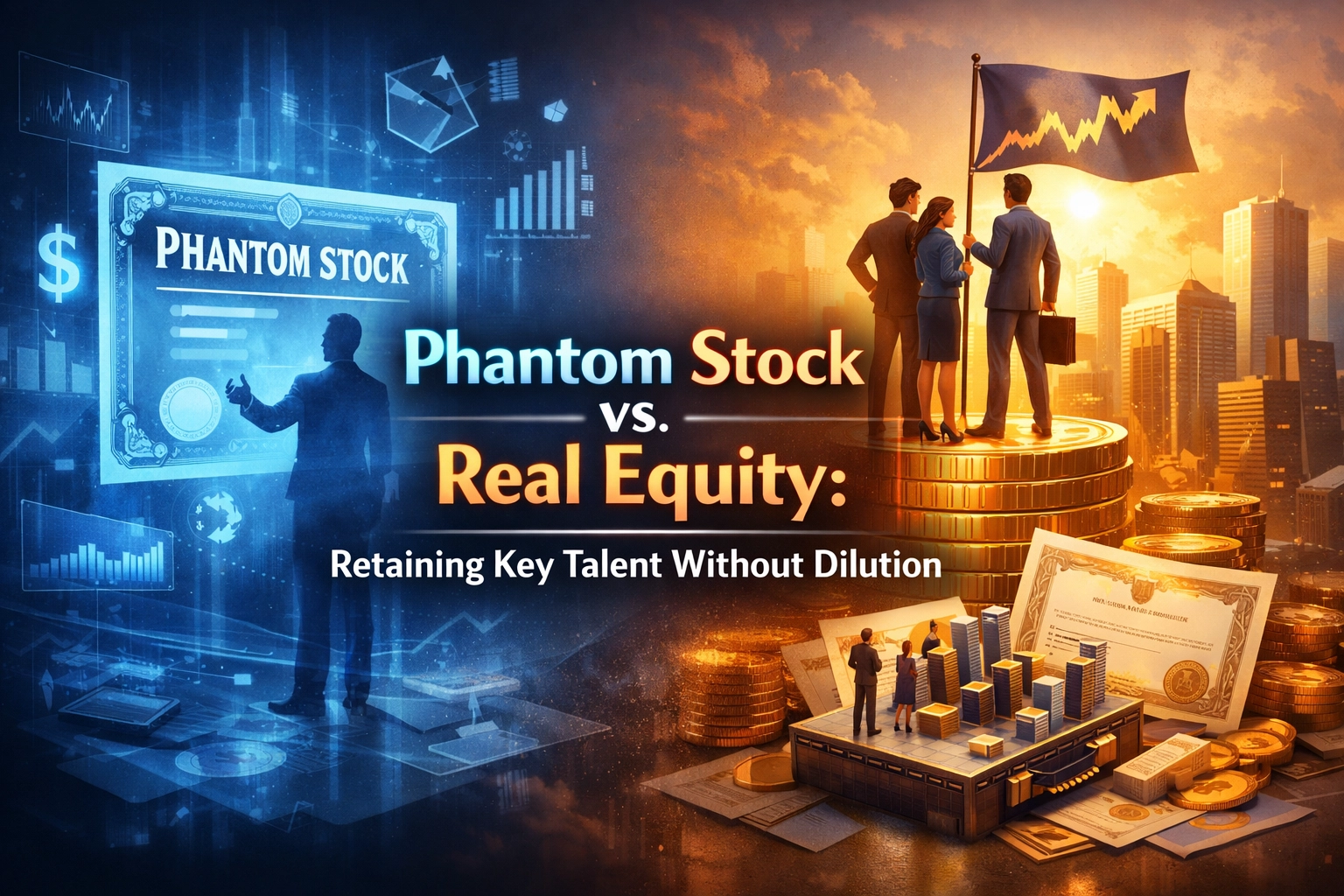
Phantom stock is exactly what it sounds like. It’s a contractual agreement that "mimics" the behavior of real stock without actually being stock. It’s a promise to pay a cash bonus at a future date, and the size of that bonus is tied directly to the value of the company’s shares.
At Schiff Executive Benefits, we often describe it as a "shadow" plan. If the real stock goes up, the phantom stock goes up. If the company pays a dividend, the phantom stock can pay a "dividend equivalent."
But here is the magic: The employee never actually owns a single share.
Two Ways to Structure the "Ghost"
- Full-Value Plans: The employee receives the full value of the "share" when the plan vests or a trigger event occurs. If the share is worth $100, they get $100.
- Appreciation-Only Plans: The employee only gets the increase in value from the date the plan started. If the share was worth $100 at the start and is worth $150 at the end, they get $50. This is very similar to a Stock Option.
For the owner, the benefits are clear: No dilution. No voting rights. No messy cap tables. You keep the steering wheel; they get to enjoy the ride.
Creating the "Ownership Feel" Without the Headache
What keeps a key executive up at night? Usually, it's the same thing that keeps you up: the desire to see their hard work turn into a significant financial legacy.
Psychologically, Phantom Stock bridges the gap between being an "employee" and being a "partner." When an executive knows that their payout in five years is directly tied to the EBITDA or the valuation of the company today, their behavior changes. They stop looking at the clock and start looking at the balance sheet.
We specialize in executive benefits that align these interests perfectly. By using Phantom Stock, you are essentially saying, "I want you to benefit from the value you help create, but I need to maintain the integrity of the company's structure." It’s a win-win that feels like a partnership but functions like a high-performance incentive plan.
The Technical Hurdle: Keeping 409A at Bay
Now, let’s get into the weeds for a second, because if you don’t get the technical details right, the IRS will be the only one winning.
Section 409A of the Internal Revenue Code governs "non-qualified deferred compensation." Since Phantom Stock is essentially a promise to pay money in the future, it falls squarely under 409A. If your plan isn't designed correctly, your employees could face immediate taxation on money they haven't even received yet, plus a 20% penalty.
This is where deep technical expertise becomes a requirement, not a luxury. At Schiff Executive Benefits, we don't just "buy a plan off the shelf." We reverse engineer the solution. We start with your exit strategy or your 10-year goal and work backward to ensure the Phantom Stock plan is 409A compliant, while still giving you the flexibility you need.

Full Cost Recovery: The Schiff USP
One of the biggest anxieties owners have about Phantom Stock is the cash outlay. If the company value triples and you owe your top three executives a massive payout in five years, where is that cash coming from? You don't want to be "success-poor", where your company is doing so well that you can't afford to pay the incentives you promised.
This is where our proprietary approach to Full Cost Recovery comes in.
We don't just help you design the plan; we help you fund it. By using specific corporate-owned assets, often involving specialized life insurance or diversified portfolios, we can create a structure where the employer can eventually recover the entire cost of the plan, including the "cost of money."
Imagine being able to offer a multi-million dollar incentive to your key talent, and then having a mechanism in place that eventually puts that money back into the company’s coffers. It sounds like magic, but it’s actually just math and strategic engineering.
Why "Reverse Engineering" is the Only Way to Fly
Most consultants start with a product. They want to sell you a specific insurance policy or a specific legal template. We do the opposite.
When you sit down with Matt Schiff and the team, we ask about your legacy.
- What keeps you up at night regarding your key people?
- What is the "point of no return" for your business if your COO walked out tomorrow?
- Do you plan to sell to a private equity firm in five years, or pass this to your kids?
By reverse engineering from that goal, we can determine whether Phantom Stock, SARs (Stock Appreciation Rights), or even Bank-Owned Life Insurance is the right vehicle.
A Quick Comparison: Phantom Stock vs. Real Equity
| Feature | Real Equity | Phantom Stock |
|---|---|---|
| Ownership | Actual shares issued | Contractual promise (No shares) |
| Dilution | Yes | No |
| Voting Rights | Yes | No |
| Taxation | Capital Gains (usually) | Ordinary Income |
| IRS Complexity | High (Equity grants) | High (Section 409A) |
| Cost to Company | High (Loss of equity) | Cash payout (Can be recovered) |
| "Ownership Feel" | High | High |
The Bottom Line
You’ve spent years, maybe decades, building your business. Protecting your equity is synonymous with protecting your legacy. But you can't grow a kingdom without generals.
Phantom Stock allows you to recruit and retain those generals by giving them a piece of the action without giving them the keys to the castle. It is a sophisticated, professional way to ensure that the people who make your business great stay with you until the finish line.
Are you worried about losing a key player to a competitor? Or are you concerned that your current incentive plans are just "empty calories" that don't drive real performance?
Let's look at the numbers together. At Schiff Executive Benefits, we pride ourselves on being the "architects" of these plans. We bring the deep technical expertise to the table so you can focus on what you do best: running your company.
Come join us for a conversation. Sit back, grab your coffee, and let’s talk about how we can protect your equity while supercharging your talent retention.
Contact us today to start reverse-engineering your perfect retention plan.